

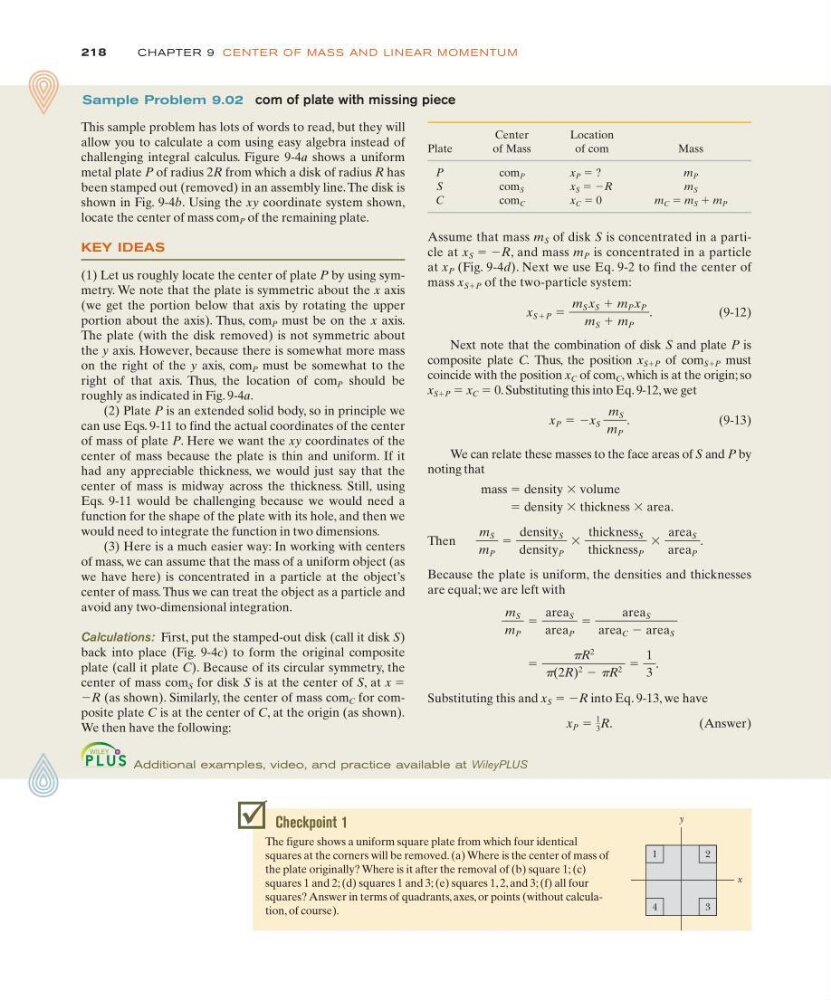
218
CHAPTE R 9 CE NTE R OF MASS AN D LI N EAR M OM E NTU M
Center
Location
Plate
of Mass
of com
Mass
P
com P
x P ϭ ?
m P
S
com S
x S ϭ ϪR
m S
C
com C
x C ϭ 0
m C ϭ m S ϩ m P
Assume that mass m S of disk S is concentrated in a particle at x S ϭ ϪR, and mass m P is concentrated in a particle
at x P (Fig. 9-4d). Next we use Eq. 9-2 to find the center of
mass x SϩP of the two-particle system:
(9-12)
Next note that the combination of disk S and plate P is
composite plate C. Thus, the position x SϩP of com SϩP must
coincide with the position x C of com C , which is at the origin; so
x SϩP ϭ x C ϭ 0. Substituting this into Eq. 9-12, we get
(9-13)
We can relate these masses to the face areas of S and P by
noting that
mass ϭ density ϫ volume
ϭ density ϫ thickness ϫ area.
Then
Because the plate is uniform, the densities and thicknesses
are equal; we are left with
Substituting this and x S ϭ ϪR into Eq. 9-13, we have
(Answer)
x P ϭ
1
3 R.
ϭ
pR
2
p(2R)
2 Ϫ pR
2
ϭ
1
3
.
m S
m P
ϭ
area S
area P
ϭ
area S
area C Ϫ area S
m S
m P
ϭ
density S
density P
ϫ
thickness S
thickness P
ϫ
area S
area P
.
x P ϭ Ϫx S
m S
m P
.
x SϩP ϭ
m S x S ϩ m P x P
m S ϩ m P
.
Sample Problem 9.02 com of plate with missing piece
This sample problem has lots of words to read, but they will
allow you to calculate a com using easy algebra instead of
challenging integral calculus. Figure 9-4a shows a uniform
metal plate P of radius 2R from which a disk of radius R has
been stamped out (removed) in an assembly line. The disk is
shown in Fig. 9-4b. Using the xy coordinate system shown,
locate the center of mass com P of the remaining plate.
KEY IDEAS
(1) Let us roughly locate the center of plate P by using symmetry. We note that the plate is symmetric about the x axis
(we get the portion below that axis by rotating the upper
portion about the axis). Thus, com P must be on the x axis.
The plate (with the disk removed) is not symmetric about
the y axis. However, because there is somewhat more mass
on the right of the y axis, com P must be somewhat to the
right of that axis. Thus, the location of com P should be
roughly as indicated in Fig. 9-4a.
(2) Plate P is an extended solid body, so in principle we
can use Eqs. 9-11 to find the actual coordinates of the center
of mass of plate P. Here we want the xy coordinates of the
center of mass because the plate is thin and uniform. If it
had any appreciable thickness, we would just say that the
center of mass is midway across the thickness. Still, using
Eqs. 9-11 would be challenging because we would need a
function for the shape of the plate with its hole, and then we
would need to integrate the function in two dimensions.
(3) Here is a much easier way: In working with centers
of mass, we can assume that the mass of a uniform object (as
we have here) is concentrated in a particle at the object’s
center of mass. Thus we can treat the object as a particle and
avoid any two-dimensional integration.
Calculations: First, put the stamped-out disk (call it disk S)
back into place (Fig. 9-4c) to form the original composite
plate (call it plate C). Because of its circular symmetry, the
center of mass com S for disk S is at the center of S, at x ϭ
ϪR (as shown). Similarly, the center of mass com C for composite plate C is at the center of C, at the origin (as shown).
We then have the following:
Additional examples, video, and practice available at WileyPLUS
Checkpoint 1
The figure shows a uniform square plate from which four identical
squares at the corners will be removed. (a) Where is the center of mass of
the plate originally? Where is it after the removal of (b) square 1; (c)
squares 1 and 2; (d) squares 1 and 3; (e) squares 1, 2, and 3; (f) all four
squares? Answer in terms of quadrants, axes, or points (without calculation, of course).
y
x
1
2
4
3
CHAPTE R 9 CE NTE R OF MASS AN D LI N EAR M OM E NTU M
Center
Location
Plate
of Mass
of com
Mass
P
com P
x P ϭ ?
m P
S
com S
x S ϭ ϪR
m S
C
com C
x C ϭ 0
m C ϭ m S ϩ m P
Assume that mass m S of disk S is concentrated in a particle at x S ϭ ϪR, and mass m P is concentrated in a particle
at x P (Fig. 9-4d). Next we use Eq. 9-2 to find the center of
mass x SϩP of the two-particle system:
(9-12)
Next note that the combination of disk S and plate P is
composite plate C. Thus, the position x SϩP of com SϩP must
coincide with the position x C of com C , which is at the origin; so
x SϩP ϭ x C ϭ 0. Substituting this into Eq. 9-12, we get
(9-13)
We can relate these masses to the face areas of S and P by
noting that
mass ϭ density ϫ volume
ϭ density ϫ thickness ϫ area.
Then
Because the plate is uniform, the densities and thicknesses
are equal; we are left with
Substituting this and x S ϭ ϪR into Eq. 9-13, we have
(Answer)
x P ϭ
1
3 R.
ϭ
pR
2
p(2R)
2 Ϫ pR
2
ϭ
1
3
.
m S
m P
ϭ
area S
area P
ϭ
area S
area C Ϫ area S
m S
m P
ϭ
density S
density P
ϫ
thickness S
thickness P
ϫ
area S
area P
.
x P ϭ Ϫx S
m S
m P
.
x SϩP ϭ
m S x S ϩ m P x P
m S ϩ m P
.
Sample Problem 9.02 com of plate with missing piece
This sample problem has lots of words to read, but they will
allow you to calculate a com using easy algebra instead of
challenging integral calculus. Figure 9-4a shows a uniform
metal plate P of radius 2R from which a disk of radius R has
been stamped out (removed) in an assembly line. The disk is
shown in Fig. 9-4b. Using the xy coordinate system shown,
locate the center of mass com P of the remaining plate.
KEY IDEAS
(1) Let us roughly locate the center of plate P by using symmetry. We note that the plate is symmetric about the x axis
(we get the portion below that axis by rotating the upper
portion about the axis). Thus, com P must be on the x axis.
The plate (with the disk removed) is not symmetric about
the y axis. However, because there is somewhat more mass
on the right of the y axis, com P must be somewhat to the
right of that axis. Thus, the location of com P should be
roughly as indicated in Fig. 9-4a.
(2) Plate P is an extended solid body, so in principle we
can use Eqs. 9-11 to find the actual coordinates of the center
of mass of plate P. Here we want the xy coordinates of the
center of mass because the plate is thin and uniform. If it
had any appreciable thickness, we would just say that the
center of mass is midway across the thickness. Still, using
Eqs. 9-11 would be challenging because we would need a
function for the shape of the plate with its hole, and then we
would need to integrate the function in two dimensions.
(3) Here is a much easier way: In working with centers
of mass, we can assume that the mass of a uniform object (as
we have here) is concentrated in a particle at the object’s
center of mass. Thus we can treat the object as a particle and
avoid any two-dimensional integration.
Calculations: First, put the stamped-out disk (call it disk S)
back into place (Fig. 9-4c) to form the original composite
plate (call it plate C). Because of its circular symmetry, the
center of mass com S for disk S is at the center of S, at x ϭ
ϪR (as shown). Similarly, the center of mass com C for composite plate C is at the center of C, at the origin (as shown).
We then have the following:
Additional examples, video, and practice available at WileyPLUS
Checkpoint 1
The figure shows a uniform square plate from which four identical
squares at the corners will be removed. (a) Where is the center of mass of
the plate originally? Where is it after the removal of (b) square 1; (c)
squares 1 and 2; (d) squares 1 and 3; (e) squares 1, 2, and 3; (f) all four
squares? Answer in terms of quadrants, axes, or points (without calculation, of course).
y
x
1
2
4
3