

80
CHAPTE R 4 MOTION IN TWO AND THREE DIM ENSIONS
4-7 RELATIVE MOTION IN TWO DIMENSIONS
frames that move relative to each other at constant velocity
and in two dimensions.
Learning Objective
After reading this module, you should be able to . . .
4.19 Apply the relationship between a particle’s position, velocity, and acceleration as measured from two reference
where
is the velocity of B with respect to A. Both
observers measure the same acceleration for the particle:
a
:
PA ϭ a
:
PB .
v
:
BA
v
:
PA ϭ v
:
PB ϩ v
:
BA
,
Key Idea
● When two frames of reference A and B are moving relative
to each other at constant velocity, the velocity of a particle
P as measured by an observer in frame A usually differs from
that measured from frame B. The two measured velocities are
related by
Relative Motion in Two Dimensions
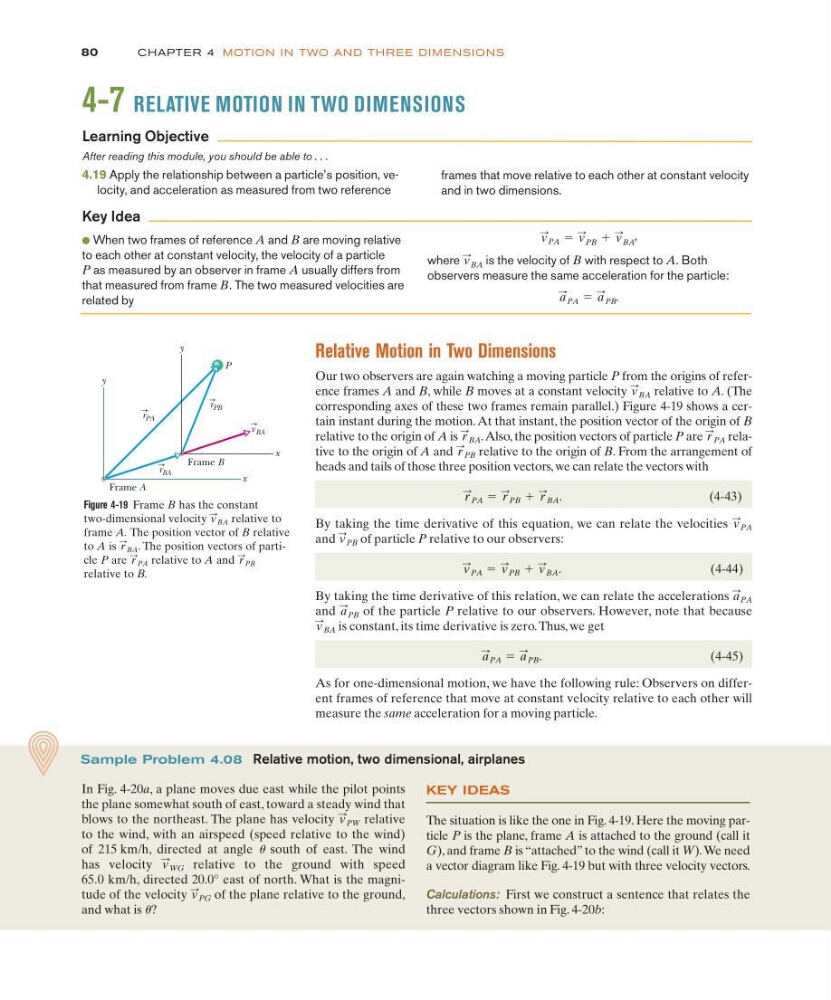
Our two observers are again watching a moving particle P from the origins of reference frames A and B, while B moves at a constant velocity
relative to A. (The
corresponding axes of these two frames remain parallel.) Figure 4-19 shows a certain instant during the motion. At that instant, the position vector of the origin of B
relative to the origin of A is
.Also, the position vectors of particle P are
relative to the origin of A and
relative to the origin of B. From the arrangement of
heads and tails of those three position vectors, we can relate the vectors with
(4-43)
By taking the time derivative of this equation, we can relate the velocities
and
of particle P relative to our observers:
(4-44)
By taking the time derivative of this relation, we can relate the accelerations
and
of the particle P relative to our observers. However, note that because
is constant, its time derivative is zero. Thus, we get
(4-45)
As for one-dimensional motion, we have the following rule: Observers on different frames of reference that move at constant velocity relative to each other will
measure the same acceleration for a moving particle.
a
:
PA ϭ a
:
PB .
v
:
BA
a
:
PB
a
:
PA
v
:
PA ϭ v
:
PB ϩ v
:
BA .
v
:
PB
v
:
PA
r
:
PA ϭ r
:
PB ϩ r
:
BA .
r
:
PB
r
:
PA
r
:
BA
v
:
BA
Figure 4-19 Frame B has the constant
two-dimensional velocity
relative to
frame A. The position vector of B relative
to A is
. The position vectors of particle P are
relative to A and
relative to B.
r
:
PB
r
:
PA
r
:
BA
v
:
BA
x
x
y
y
r PB
r PA
r BA
Frame B
Frame A
v BA
P
Sample Problem 4.08 Relative motion, two dimensional, airplanes
In Fig. 4-20a, a plane moves due east while the pilot points
the plane somewhat south of east, toward a steady wind that
blows to the northeast. The plane has velocity
relative
to the wind, with an airspeed (speed relative to the wind)
of 215 km/h, directed at angle u south of east. The wind
has velocity
relative to the ground with speed
65.0 km/h, directed 20.0° east of north. What is the magnitude of the velocity
of the plane relative to the ground,
and what is ?
v
:
PG
v
:
WG
v
:
PW
KEY IDEAS
The situation is like the one in Fig. 4-19. Here the moving particle P is the plane, frame A is attached to the ground (call it
G), and frame B is “attached” to the wind (call it W). We need
a vector diagram like Fig. 4-19 but with three velocity vectors.
Calculations: First we construct a sentence that relates the
three vectors shown in Fig. 4-20b:
CHAPTE R 4 MOTION IN TWO AND THREE DIM ENSIONS
4-7 RELATIVE MOTION IN TWO DIMENSIONS
frames that move relative to each other at constant velocity
and in two dimensions.
Learning Objective
After reading this module, you should be able to . . .
4.19 Apply the relationship between a particle’s position, velocity, and acceleration as measured from two reference
where
is the velocity of B with respect to A. Both
observers measure the same acceleration for the particle:
a
:
PA ϭ a
:
PB .
v
:
BA
v
:
PA ϭ v
:
PB ϩ v
:
BA
,
Key Idea
● When two frames of reference A and B are moving relative
to each other at constant velocity, the velocity of a particle
P as measured by an observer in frame A usually differs from
that measured from frame B. The two measured velocities are
related by
Relative Motion in Two Dimensions
Our two observers are again watching a moving particle P from the origins of reference frames A and B, while B moves at a constant velocity
relative to A. (The
corresponding axes of these two frames remain parallel.) Figure 4-19 shows a certain instant during the motion. At that instant, the position vector of the origin of B
relative to the origin of A is
.Also, the position vectors of particle P are
relative to the origin of A and
relative to the origin of B. From the arrangement of
heads and tails of those three position vectors, we can relate the vectors with
(4-43)
By taking the time derivative of this equation, we can relate the velocities
and
of particle P relative to our observers:
(4-44)
By taking the time derivative of this relation, we can relate the accelerations
and
of the particle P relative to our observers. However, note that because
is constant, its time derivative is zero. Thus, we get
(4-45)
As for one-dimensional motion, we have the following rule: Observers on different frames of reference that move at constant velocity relative to each other will
measure the same acceleration for a moving particle.
a
:
PA ϭ a
:
PB .
v
:
BA
a
:
PB
a
:
PA
v
:
PA ϭ v
:
PB ϩ v
:
BA .
v
:
PB
v
:
PA
r
:
PA ϭ r
:
PB ϩ r
:
BA .
r
:
PB
r
:
PA
r
:
BA
v
:
BA
Figure 4-19 Frame B has the constant
two-dimensional velocity
relative to
frame A. The position vector of B relative
to A is
. The position vectors of particle P are
relative to A and
relative to B.
r
:
PB
r
:
PA
r
:
BA
v
:
BA
x
x
y
y
r PB
r PA
r BA
Frame B
Frame A
v BA
P
Sample Problem 4.08 Relative motion, two dimensional, airplanes
In Fig. 4-20a, a plane moves due east while the pilot points
the plane somewhat south of east, toward a steady wind that
blows to the northeast. The plane has velocity
relative
to the wind, with an airspeed (speed relative to the wind)
of 215 km/h, directed at angle u south of east. The wind
has velocity
relative to the ground with speed
65.0 km/h, directed 20.0° east of north. What is the magnitude of the velocity
of the plane relative to the ground,
and what is ?
v
:
PG
v
:
WG
v
:
PW
KEY IDEAS
The situation is like the one in Fig. 4-19. Here the moving particle P is the plane, frame A is attached to the ground (call it
G), and frame B is “attached” to the wind (call it W). We need
a vector diagram like Fig. 4-19 but with three velocity vectors.
Calculations: First we construct a sentence that relates the
three vectors shown in Fig. 4-20b: