

79
4-6 RELATIVE M OTION I N ON E DI M E NSION
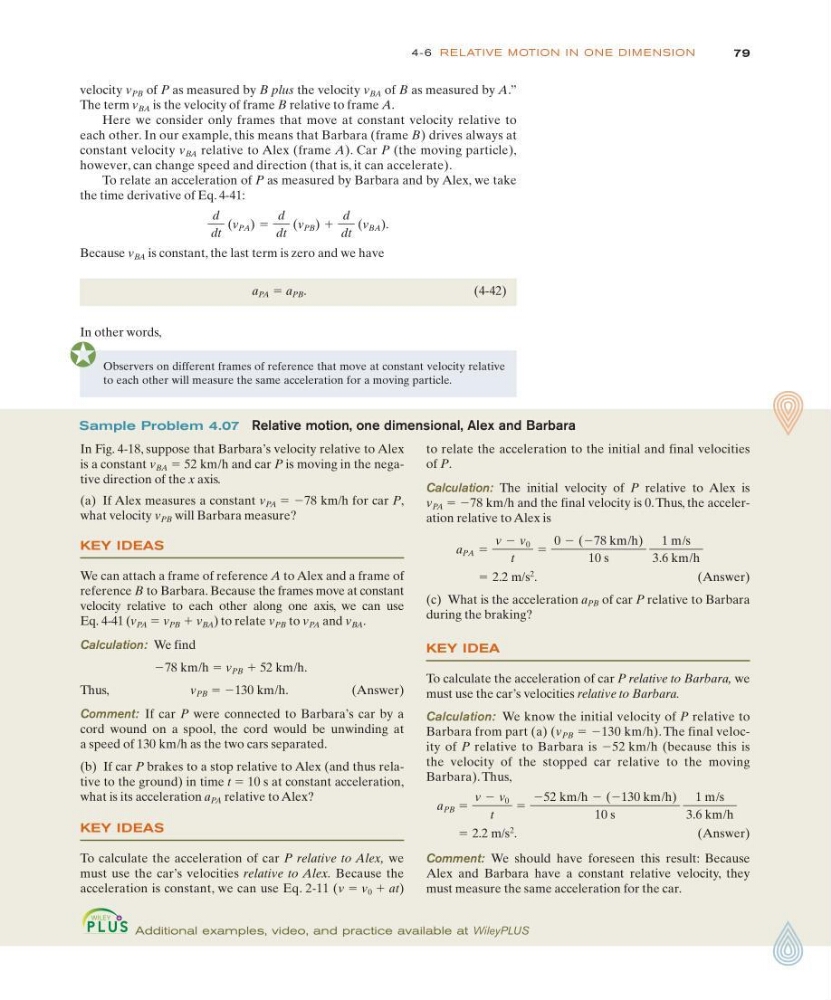
velocity v PB of P as measured by B plus the velocity v BA of B as measured by A.”
The term v BA is the velocity of frame B relative to frame A.
Here we consider only frames that move at constant velocity relative to
each other. In our example, this means that Barbara (frame B) drives always at
constant velocity v BA relative to Alex (frame A). Car P (the moving particle),
however, can change speed and direction (that is, it can accelerate).
To relate an acceleration of P as measured by Barbara and by Alex, we take
the time derivative of Eq. 4-41:
Because v BA is constant, the last term is zero and we have
a PA ϭ a PB .
(4-42)
In other words,
d
dt
(v PA ) ϭ
d
dt
(v PB ) ϩ
d
dt
(v BA ).
Observers on different frames of reference that move at constant velocity relative
to each other will measure the same acceleration for a moving particle.
Sample Problem 4.07 Relative motion, one dimensional, Alex and Barbara
to relate the acceleration to the initial and final velocities
of P.
Calculation: The initial velocity of P relative to Alex is
v PA ϭ Ϫ78 km/h and the final velocity is 0. Thus, the acceleration relative to Alex is
(Answer)
(c) What is the acceleration a PB of car P relative to Barbara
during the braking?
KEY IDEA
To calculate the acceleration of car P relative to Barbara, we
must use the car’s velocities relative to Barbara.
Calculation: We know the initial velocity of P relative to
Barbara from part (a) (v PB ϭ Ϫ130 km/h). The final velocity of P relative to Barbara is Ϫ52 km/h (because this is
the velocity of the stopped car relative to the moving
Barbara). Thus,
(Answer)
Comment: We should have foreseen this result: Because
Alex and Barbara have a constant relative velocity, they
must measure the same acceleration for the car.
ϭ 2.2 m/s
2
.
a PB ϭ
v Ϫ v 0
t
ϭ
Ϫ52 km/h Ϫ (Ϫ130 km/h)
10 s
1 m/s
3.6 km/h
ϭ 2.2 m/s
2
.
a PA ϭ
v Ϫ v 0
t
ϭ
0 Ϫ (Ϫ78 km/h)
10 s
1 m/s
3.6 km/h
In Fig. 4-18, suppose that Barbara’s velocity relative to Alex
is a constant v BA ϭ 52 km/h and car P is moving in the negative direction of the x axis.
(a) If Alex measures a constant v PA ϭ Ϫ78 km/h for car P,
what velocity v PB will Barbara measure?
KEY IDEAS
We can attach a frame of reference A to Alex and a frame of
reference B to Barbara. Because the frames move at constant
velocity relative to each other along one axis, we can use
Eq. 4-41 (v PA ϭ v PB ϩ v BA ) to relate v PB to v PA and v BA .
Calculation: We find
Ϫ78 km/h ϭ v PB ϩ 52 km/h.
Thus,
v PB ϭ Ϫ130 km/h.
(Answer)
Comment: If car P were connected to Barbara’s car by a
cord wound on a spool, the cord would be unwinding at
a speed of 130 km/h as the two cars separated.
(b) If car P brakes to a stop relative to Alex (and thus relative to the ground) in time t ϭ 10 s at constant acceleration,
what is its acceleration a PA relative to Alex?
KEY IDEAS
To calculate the acceleration of car P relative to Alex, we
must use the car’s velocities relative to Alex. Because the
acceleration is constant, we can use Eq. 2-11 (v ϭ v 0 ϩ at)
Additional examples, video, and practice available at WileyPLUS
4-6 RELATIVE M OTION I N ON E DI M E NSION
velocity v PB of P as measured by B plus the velocity v BA of B as measured by A.”
The term v BA is the velocity of frame B relative to frame A.
Here we consider only frames that move at constant velocity relative to
each other. In our example, this means that Barbara (frame B) drives always at
constant velocity v BA relative to Alex (frame A). Car P (the moving particle),
however, can change speed and direction (that is, it can accelerate).
To relate an acceleration of P as measured by Barbara and by Alex, we take
the time derivative of Eq. 4-41:
Because v BA is constant, the last term is zero and we have
a PA ϭ a PB .
(4-42)
In other words,
d
dt
(v PA ) ϭ
d
dt
(v PB ) ϩ
d
dt
(v BA ).
Observers on different frames of reference that move at constant velocity relative
to each other will measure the same acceleration for a moving particle.
Sample Problem 4.07 Relative motion, one dimensional, Alex and Barbara
to relate the acceleration to the initial and final velocities
of P.
Calculation: The initial velocity of P relative to Alex is
v PA ϭ Ϫ78 km/h and the final velocity is 0. Thus, the acceleration relative to Alex is
(Answer)
(c) What is the acceleration a PB of car P relative to Barbara
during the braking?
KEY IDEA
To calculate the acceleration of car P relative to Barbara, we
must use the car’s velocities relative to Barbara.
Calculation: We know the initial velocity of P relative to
Barbara from part (a) (v PB ϭ Ϫ130 km/h). The final velocity of P relative to Barbara is Ϫ52 km/h (because this is
the velocity of the stopped car relative to the moving
Barbara). Thus,
(Answer)
Comment: We should have foreseen this result: Because
Alex and Barbara have a constant relative velocity, they
must measure the same acceleration for the car.
ϭ 2.2 m/s
2
.
a PB ϭ
v Ϫ v 0
t
ϭ
Ϫ52 km/h Ϫ (Ϫ130 km/h)
10 s
1 m/s
3.6 km/h
ϭ 2.2 m/s
2
.
a PA ϭ
v Ϫ v 0
t
ϭ
0 Ϫ (Ϫ78 km/h)
10 s
1 m/s
3.6 km/h
In Fig. 4-18, suppose that Barbara’s velocity relative to Alex
is a constant v BA ϭ 52 km/h and car P is moving in the negative direction of the x axis.
(a) If Alex measures a constant v PA ϭ Ϫ78 km/h for car P,
what velocity v PB will Barbara measure?
KEY IDEAS
We can attach a frame of reference A to Alex and a frame of
reference B to Barbara. Because the frames move at constant
velocity relative to each other along one axis, we can use
Eq. 4-41 (v PA ϭ v PB ϩ v BA ) to relate v PB to v PA and v BA .
Calculation: We find
Ϫ78 km/h ϭ v PB ϩ 52 km/h.
Thus,
v PB ϭ Ϫ130 km/h.
(Answer)
Comment: If car P were connected to Barbara’s car by a
cord wound on a spool, the cord would be unwinding at
a speed of 130 km/h as the two cars separated.
(b) If car P brakes to a stop relative to Alex (and thus relative to the ground) in time t ϭ 10 s at constant acceleration,
what is its acceleration a PA relative to Alex?
KEY IDEAS
To calculate the acceleration of car P relative to Alex, we
must use the car’s velocities relative to Alex. Because the
acceleration is constant, we can use Eq. 2-11 (v ϭ v 0 ϩ at)
Additional examples, video, and practice available at WileyPLUS