

Copyright © National Academy of Sciences. All rights reserved.
Solar and Space Physics: A Science for a Technological Society
ADDRESSING SOCIETAL NEEDS
69
and at their most destructive they damage electronics components, including the temporary (single-event)
upset of spacecraft commanding. Furthermore, upper atmospheric heating associated with the dynamics
of the space environment can dramatically change drag effects on low-Earth-orbiting satellites, notably
the International Space Station (ISS).
Ionospheric Variability, Communication, and Navigation
The specification and forecasting of ionospheric scintillation (i.e., radio propagation fluctuations due
to plasma density irregularities) is a high priority for both civilian and military space operations. These
scintillations are prevalent at low geographic latitudes as well as in the auroral regions, disrupting radio
communications in critical geographical locations. They occur more frequently and extend to higher altitudes during times of high solar activity. Changes in ionospheric total electron content during geomagnetic
storms compromise the performance of GPS technology vital for aviation and many other commercial and
defense applications (see Figure 3.3). The participating electrons from the aurora also charge space systems,
such as the ISS, generating the danger of arcing associated with discharges.
Radiation and Human Space Exploration
Humans venturing into space are vulnerable to damage caused by episodic radiation in the form of
energetic particles from the Sun and from cosmic rays that constantly impinge on the solar system from
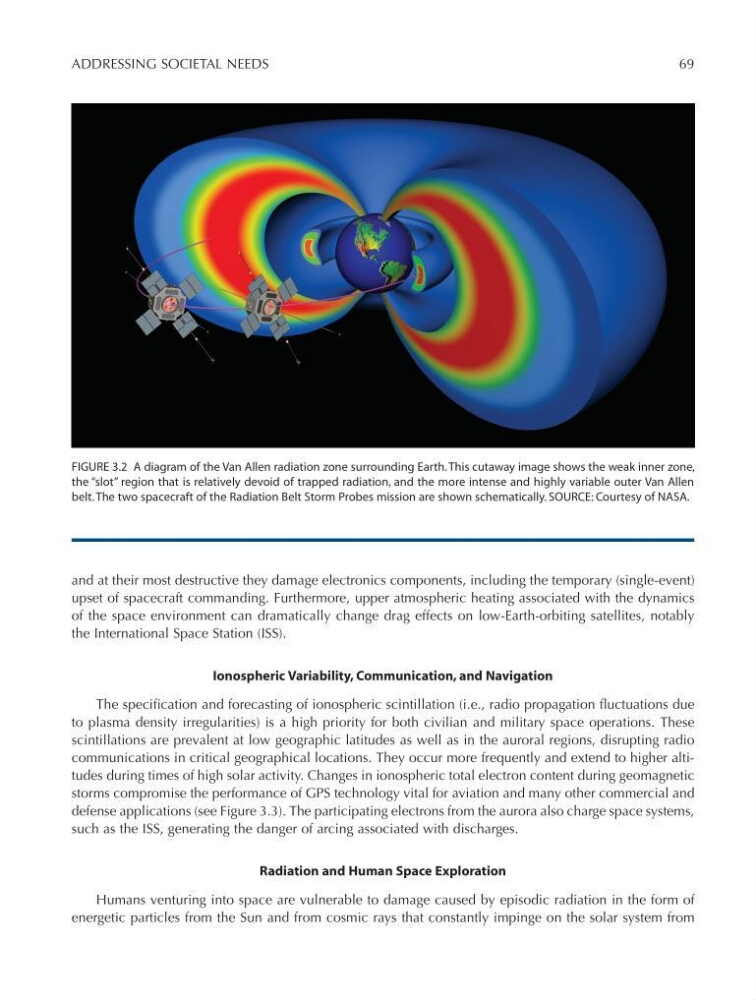
FIGURE 3.2 A diagram of the Van Allen radiation zone surrounding Earth. This cutaway image shows the weak inner zone,
the “slot” region that is relatively devoid of trapped radiation, and the more intense and highly variable outer Van Allen
belt. The two spacecraft of the Radiation Belt Storm Probes mission are shown schematically. SOURCE: Courtesy of NASA.
Figure 3-2
Solar and Space Physics: A Science for a Technological Society
ADDRESSING SOCIETAL NEEDS
69
and at their most destructive they damage electronics components, including the temporary (single-event)
upset of spacecraft commanding. Furthermore, upper atmospheric heating associated with the dynamics
of the space environment can dramatically change drag effects on low-Earth-orbiting satellites, notably
the International Space Station (ISS).
Ionospheric Variability, Communication, and Navigation
The specification and forecasting of ionospheric scintillation (i.e., radio propagation fluctuations due
to plasma density irregularities) is a high priority for both civilian and military space operations. These
scintillations are prevalent at low geographic latitudes as well as in the auroral regions, disrupting radio
communications in critical geographical locations. They occur more frequently and extend to higher altitudes during times of high solar activity. Changes in ionospheric total electron content during geomagnetic
storms compromise the performance of GPS technology vital for aviation and many other commercial and
defense applications (see Figure 3.3). The participating electrons from the aurora also charge space systems,
such as the ISS, generating the danger of arcing associated with discharges.
Radiation and Human Space Exploration
Humans venturing into space are vulnerable to damage caused by episodic radiation in the form of
energetic particles from the Sun and from cosmic rays that constantly impinge on the solar system from
FIGURE 3.2 A diagram of the Van Allen radiation zone surrounding Earth. This cutaway image shows the weak inner zone,
the “slot” region that is relatively devoid of trapped radiation, and the more intense and highly variable outer Van Allen
belt. The two spacecraft of the Radiation Belt Storm Probes mission are shown schematically. SOURCE: Courtesy of NASA.
Figure 3-2