

Copyright © National Academy of Sciences. All rights reserved.
Solar and Space Physics: A Science for a Technological Society
70
SOLAR AND SPACE PHYSICS: A SCIENCE FOR A TECHNOLOGICAL SOCIETY
the galaxy. These dangers are well recognized 3 if not yet predictable: astronauts on the ISS must retreat to
protected areas in the event of high-energy solar radiation. Space radiation from all sources will pose important hazards for space systems and astronauts on long-duration flights away from Earth’s magnetic field.
Geomagnetic Effects on the Electric Power Grid
The electric power grid, the backbone of modern society, is particularly vulnerable to space environmental effects. As the geomagnetic field changes as a consequence of impacts from solar eruptions, large
currents are generated and guided into the ionized layers of Earth’s upper atmosphere, where they contribute substantially to the outward expansion of the outer atmosphere, causing satellite drag effects. Even
more importantly, temporal changes in the currents induce voltages in the ground. The ground conductor
of the power grid is connected to this source of voltage, and consequently currents other than those associ3 National Research Council, Managing Space Radiation Risk in the New Era of Space Exploration, The National Academies Press,
Washington, D.C., 2008.
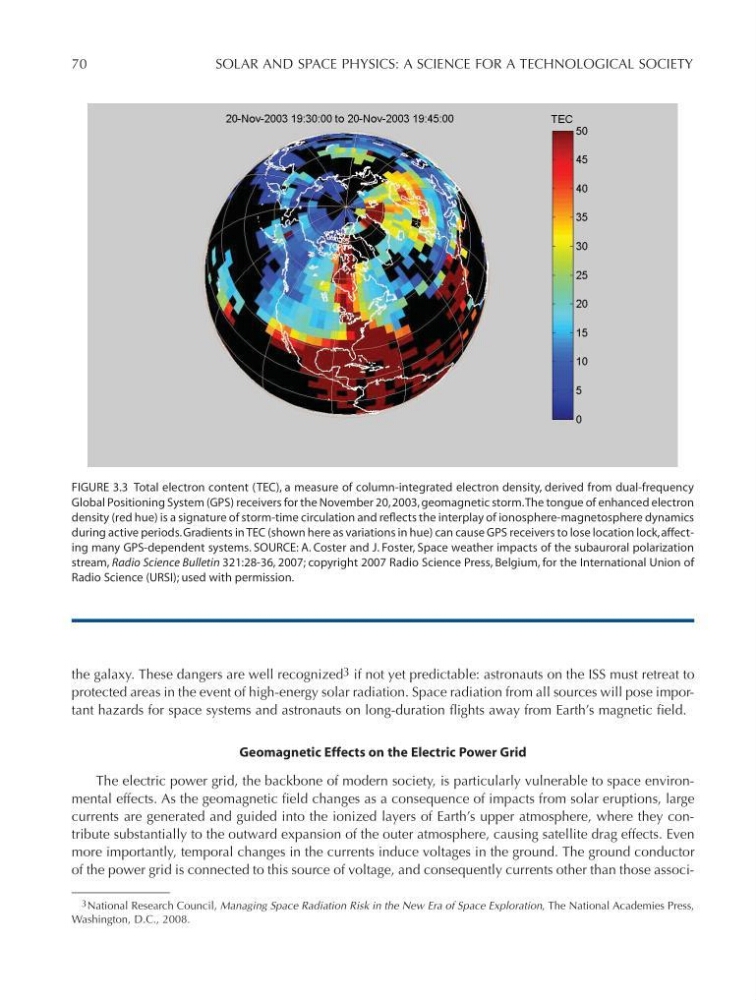
FIGURE 3.3 Total electron content (TEC), a measure of column-integrated electron density, derived from dual-frequency
Global Positioning System (GPS) receivers for the November 20, 2003, geomagnetic storm. The tongue of enhanced electron
density (red hue) is a signature of storm-time circulation and reflects the interplay of ionosphere-magnetosphere dynamics
during active periods. Gradients in TEC (shown here as variations in hue) can cause GPS receivers to lose location lock, affecting many GPS-dependent systems. SOURCE: A. Coster and J. Foster, Space weather impacts of the subauroral polarization
stream, Radio Science Bulletin 321:28-36, 2007; copyright 2007 Radio Science Press, Belgium, for the International Union of
Radio Science (URSI); used with permission. Figure 3-3 and 8-9
Solar and Space Physics: A Science for a Technological Society
70
SOLAR AND SPACE PHYSICS: A SCIENCE FOR A TECHNOLOGICAL SOCIETY
the galaxy. These dangers are well recognized 3 if not yet predictable: astronauts on the ISS must retreat to
protected areas in the event of high-energy solar radiation. Space radiation from all sources will pose important hazards for space systems and astronauts on long-duration flights away from Earth’s magnetic field.
Geomagnetic Effects on the Electric Power Grid
The electric power grid, the backbone of modern society, is particularly vulnerable to space environmental effects. As the geomagnetic field changes as a consequence of impacts from solar eruptions, large
currents are generated and guided into the ionized layers of Earth’s upper atmosphere, where they contribute substantially to the outward expansion of the outer atmosphere, causing satellite drag effects. Even
more importantly, temporal changes in the currents induce voltages in the ground. The ground conductor
of the power grid is connected to this source of voltage, and consequently currents other than those associ3 National Research Council, Managing Space Radiation Risk in the New Era of Space Exploration, The National Academies Press,
Washington, D.C., 2008.
FIGURE 3.3 Total electron content (TEC), a measure of column-integrated electron density, derived from dual-frequency
Global Positioning System (GPS) receivers for the November 20, 2003, geomagnetic storm. The tongue of enhanced electron
density (red hue) is a signature of storm-time circulation and reflects the interplay of ionosphere-magnetosphere dynamics
during active periods. Gradients in TEC (shown here as variations in hue) can cause GPS receivers to lose location lock, affecting many GPS-dependent systems. SOURCE: A. Coster and J. Foster, Space weather impacts of the subauroral polarization
stream, Radio Science Bulletin 321:28-36, 2007; copyright 2007 Radio Science Press, Belgium, for the International Union of
Radio Science (URSI); used with permission. Figure 3-3 and 8-9