

Copyright © National Academy of Sciences. All rights reserved.
Solar and Space Physics: A Science for a Technological Society
68
SOLAR AND SPACE PHYSICS: A SCIENCE FOR A TECHNOLOGICAL SOCIETY
Satellite Infrastructure
Satellites orbiting Earth support essential societal infrastructure and now form the basis for a total
global economy in excess of $250 billion per year. 2 To inform our daily activities and decisions, we rely
on weather predictions based on measurements from satellites. Satellites serve as communication relays
and platforms for direct broadcasts of data and television signals. The nation’s military protects U.S. strategic interests around the world through continuous surveillance from satellites and depends on satellites
for global communication, continuous situational awareness, and geolocation related to national security.
Although a relatively new technology, the use of signals from Global Positioning System (GPS) satellites is
pervasive, facilitating everyday activities that range from navigation to financial transactions.
The magnetosphere is the domain of nearly all Earth-orbiting satellites, affecting those in low, medium,
and geostationary orbits, as well as those in high-apogee orbits. It is a region filled with charged particles,
including the intense radiation belts that vary continuously in response to changes in the solar wind and to
the solar disturbances that strongly affect the space environment. (See Figure 3.2.) Charged particles affect
space technology in a variety of ways: at their most benign they cause surface charging and discharging,
2 See Report on the Space Economy Symposium, March 13, 2009, available at http://spaceeconomy.gmu.edu/ses2009/
symposiumreport2009.pdf.
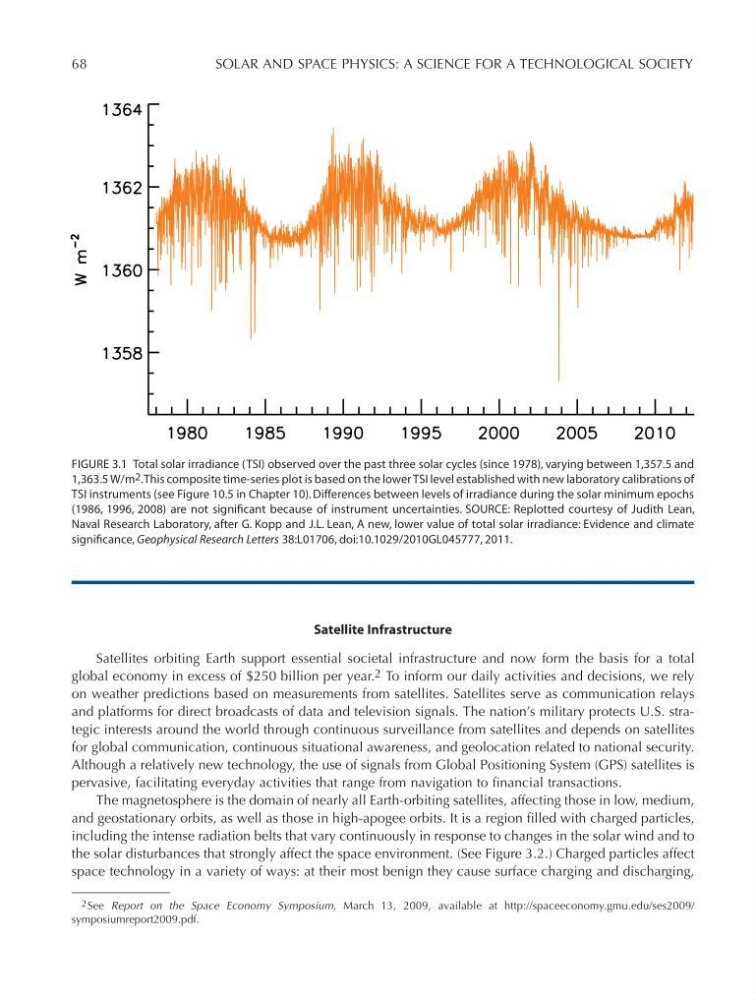
FIGURE 3.1 Total solar irradiance (TSI) observed over the past three solar cycles (since 1978), varying between 1,357.5 and
1,363.5 W/m 2 . This composite time-series plot is based on the lower TSI level established with new laboratory calibrations of
TSI instruments (see Figure 10.5 in Chapter 10). Differences between levels of irradiance during the solar minimum epochs
(1986, 1996, 2008) are not significant because of instrument uncertainties. SOURCE: Replotted courtesy of Judith Lean,
Naval Research Laboratory, after G. Kopp and J.L. Lean, A new, lower value of total solar irradiance: Evidence and climate
significance, Geophysical Research Letters 38:L01706, doi:10.1029/2010GL045777, 2011.
Figure 3-1
Solar and Space Physics: A Science for a Technological Society
68
SOLAR AND SPACE PHYSICS: A SCIENCE FOR A TECHNOLOGICAL SOCIETY
Satellite Infrastructure
Satellites orbiting Earth support essential societal infrastructure and now form the basis for a total
global economy in excess of $250 billion per year. 2 To inform our daily activities and decisions, we rely
on weather predictions based on measurements from satellites. Satellites serve as communication relays
and platforms for direct broadcasts of data and television signals. The nation’s military protects U.S. strategic interests around the world through continuous surveillance from satellites and depends on satellites
for global communication, continuous situational awareness, and geolocation related to national security.
Although a relatively new technology, the use of signals from Global Positioning System (GPS) satellites is
pervasive, facilitating everyday activities that range from navigation to financial transactions.
The magnetosphere is the domain of nearly all Earth-orbiting satellites, affecting those in low, medium,
and geostationary orbits, as well as those in high-apogee orbits. It is a region filled with charged particles,
including the intense radiation belts that vary continuously in response to changes in the solar wind and to
the solar disturbances that strongly affect the space environment. (See Figure 3.2.) Charged particles affect
space technology in a variety of ways: at their most benign they cause surface charging and discharging,
2 See Report on the Space Economy Symposium, March 13, 2009, available at http://spaceeconomy.gmu.edu/ses2009/
symposiumreport2009.pdf.
FIGURE 3.1 Total solar irradiance (TSI) observed over the past three solar cycles (since 1978), varying between 1,357.5 and
1,363.5 W/m 2 . This composite time-series plot is based on the lower TSI level established with new laboratory calibrations of
TSI instruments (see Figure 10.5 in Chapter 10). Differences between levels of irradiance during the solar minimum epochs
(1986, 1996, 2008) are not significant because of instrument uncertainties. SOURCE: Replotted courtesy of Judith Lean,
Naval Research Laboratory, after G. Kopp and J.L. Lean, A new, lower value of total solar irradiance: Evidence and climate
significance, Geophysical Research Letters 38:L01706, doi:10.1029/2010GL045777, 2011.
Figure 3-1