

Copyright © National Academy of Sciences. All rights reserved.
Solar and Space Physics: A Science for a Technological Society
SOLAR AND SPACE PHYSICS: RECENT DISCOVERIES, FUTURE FRONTIERS
65
RISING TO THE CHALLENGES OF THE COMING DECADE
Achievement of the survey committee’s four key science goals (see Chapter 1) for the coming decade
requires addressing the 12 science challenges, discussed above and also listed in Table 2.1, for the three
subdisciplines of solar and space physics. In turn, addressing science challenges requires optimal use of
existing assets, as well as initiation of new programs that will drive future discovery. Chapters 4, 5, and 6
outline the survey committee’s recommendations for the upcoming decade and discuss how they may be
implemented by NSF and NASA. The survey committee’s recommendations were informed by a recognition that the interconnected nature of the science of solar and space physics requires a research effort that
spans the entire front of science challenges. New missions, as described in Chapter 4, can be carefully
chosen to address the most pressing of these science challenges. It will be evident, however, that in the
foreseeable future nearly half of the science challenges are not targeted by any new heliophysics mission.
The survey committee views the Explorer line as a critical asset for broadening the field of inquiry to
include questions not addressed by upcoming or recommended missions. In addition, the rich array of
existing assets of NASA, NSF, NOAA, and DOD, as well as the use of non-science space platforms, also
facilitates scientific discovery in solar and space physics provided that these assets are adequately supported
and that research and analysis efforts are sustained. The central importance of L1 in situ observations of the
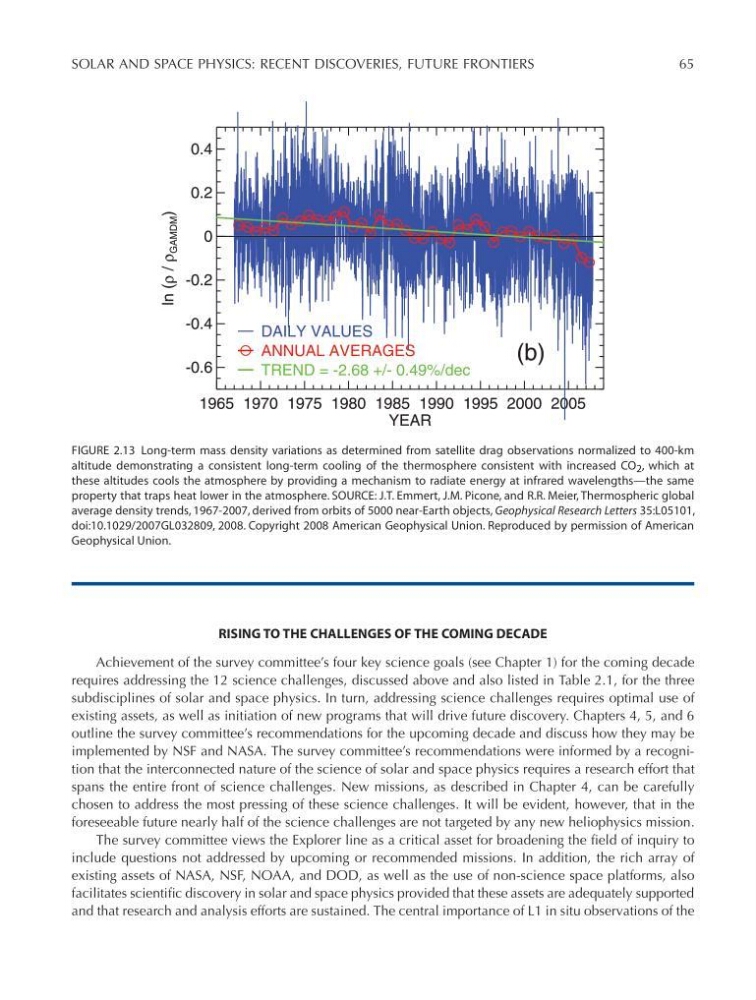
FIGURE 2.13 Long-term mass density variations as determined from satellite drag observations normalized to 400-km
altitude demonstrating a consistent long-term cooling of the thermosphere consistent with increased CO 2 , which at
these altitudes cools the atmosphere by providing a mechanism to radiate energy at infrared wavelengths—the same
property that traps heat lower in the atmosphere. SOURCE: J.T. Emmert, J.M. Picone, and R.R. Meier, Thermospheric global
average density trends, 1967-2007, derived from orbits of 5000 near-Earth objects, Geophysical Research Letters 35:L05101,
doi:10.1029/2007GL032809, 2008. Copyright 2008 American Geophysical Union. Reproduced by permission of American
Geophysical Union.
Figure 2-13 and 8-18
vector editable, may be enlarged
Solar and Space Physics: A Science for a Technological Society
SOLAR AND SPACE PHYSICS: RECENT DISCOVERIES, FUTURE FRONTIERS
65
RISING TO THE CHALLENGES OF THE COMING DECADE
Achievement of the survey committee’s four key science goals (see Chapter 1) for the coming decade
requires addressing the 12 science challenges, discussed above and also listed in Table 2.1, for the three
subdisciplines of solar and space physics. In turn, addressing science challenges requires optimal use of
existing assets, as well as initiation of new programs that will drive future discovery. Chapters 4, 5, and 6
outline the survey committee’s recommendations for the upcoming decade and discuss how they may be
implemented by NSF and NASA. The survey committee’s recommendations were informed by a recognition that the interconnected nature of the science of solar and space physics requires a research effort that
spans the entire front of science challenges. New missions, as described in Chapter 4, can be carefully
chosen to address the most pressing of these science challenges. It will be evident, however, that in the
foreseeable future nearly half of the science challenges are not targeted by any new heliophysics mission.
The survey committee views the Explorer line as a critical asset for broadening the field of inquiry to
include questions not addressed by upcoming or recommended missions. In addition, the rich array of
existing assets of NASA, NSF, NOAA, and DOD, as well as the use of non-science space platforms, also
facilitates scientific discovery in solar and space physics provided that these assets are adequately supported
and that research and analysis efforts are sustained. The central importance of L1 in situ observations of the
FIGURE 2.13 Long-term mass density variations as determined from satellite drag observations normalized to 400-km
altitude demonstrating a consistent long-term cooling of the thermosphere consistent with increased CO 2 , which at
these altitudes cools the atmosphere by providing a mechanism to radiate energy at infrared wavelengths—the same
property that traps heat lower in the atmosphere. SOURCE: J.T. Emmert, J.M. Picone, and R.R. Meier, Thermospheric global
average density trends, 1967-2007, derived from orbits of 5000 near-Earth objects, Geophysical Research Letters 35:L05101,
doi:10.1029/2007GL032809, 2008. Copyright 2008 American Geophysical Union. Reproduced by permission of American
Geophysical Union.
Figure 2-13 and 8-18
vector editable, may be enlarged