

Copyright © National Academy of Sciences. All rights reserved.
Solar and Space Physics: A Science for a Technological Society
64
SOLAR AND SPACE PHYSICS: A SCIENCE FOR A TECHNOLOGICAL SOCIETY
The release of greenhouse gases (e.g., CO 2 and CH 4 ) into the atmosphere is changing Earth’s surface
climate by warming the lower atmosphere; these gases are also changing geospace climatology by cooling
the upper atmosphere. In the lower atmosphere, the opacity of greenhouse gases to infrared radiation traps
energy by capturing the radiant infrared energy from Earth’s surface and transferring it to thermal energy
via collisions with other molecules. In the thermosphere, however, where intermolecular collisions are
less frequent, greenhouse gases promote cooling by acquiring energy via collisions and then radiating this
energy to space in the infrared. This well-understood role of CO 2 as an effective radiator of energy in the
upper atmosphere has produced a systematic decrease in thermospheric mass density by several percent
per decade near the 400-km altitude. This systematic decrease follows from the record of satellite orbit
decay measured since the beginning of the space age (Figure 2.13).
There are two other consequences of climate change for the ionosphere and thermosphere. First,
changes in tropospheric weather patterns and atmospheric circulation may alter the occurrence of ionospheric instabilities triggered by tropospheric gravity waves propagating into the upper atmosphere. This
change will affect the prevalence of the resulting ionospheric irregularities. Second, continued cooling
of the thermosphere will reduce satellite drag, thereby increasing orbital debris lifetimes, and will lower
the effective ionospheric conductivity. The latter change will alter global currents in the magnetosphereionosphere system and therefore fundamentally alter magnetosphere-ionosphere coupling. The survey
committee, therefore, identifies the following science challenge: AIMI-4. Determine and identify the causes
for long-term (multi-decadal) changes in the AIM system.
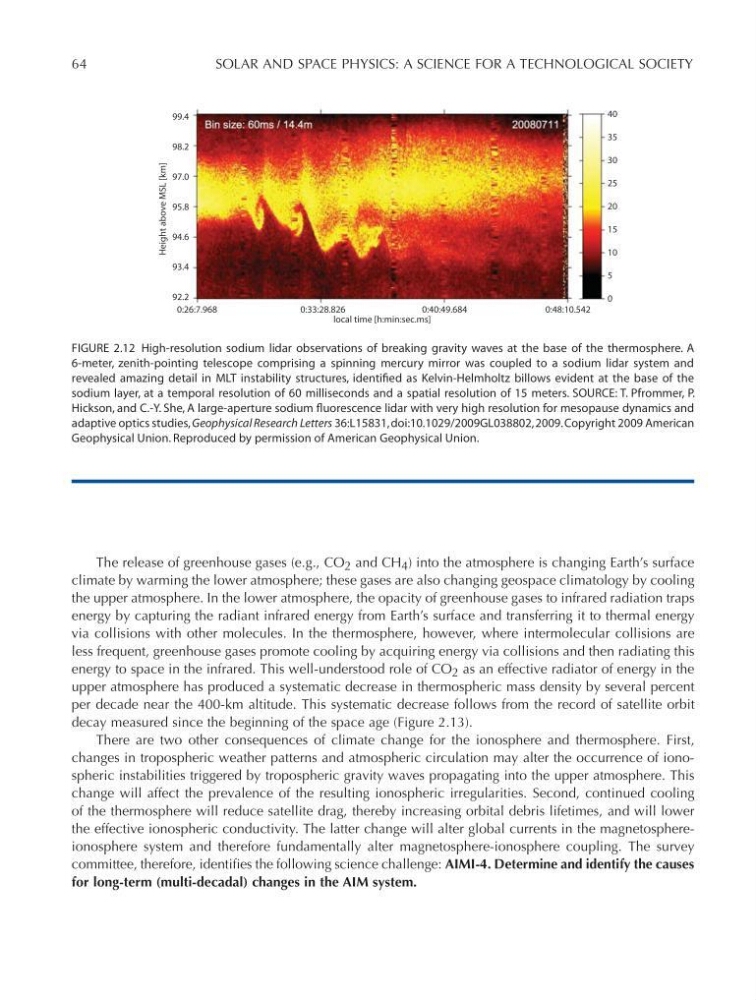
FIGURE 2.12 High-resolution sodium lidar observations of breaking gravity waves at the base of the thermosphere. A
6-meter, zenith-pointing telescope comprising a spinning mercury mirror was coupled to a sodium lidar system and
revealed amazing detail in MLT instability structures, identified as Kelvin-Helmholtz billows evident at the base of the
sodium layer, at a temporal resolution of 60 milliseconds and a spatial resolution of 15 meters. SOURCE: T. Pfrommer, P.
Hickson, and C.-Y. She, A large-aperture sodium fluorescence lidar with very high resolution for mesopause dynamics and
adaptive optics studies, Geophysical Research Letters 36:L15831, doi:10.1029/2009GL038802, 2009. Copyright 2009 American
Geophysical Union. Reproduced by permission of American Geophysical Union.
Figure 2-12 and 8-23
40
35
30
25
20
15
10
5
0
local time [h:min:sec.ms]
0:26:7.968
0:33:28.826
0:40:49.684
0:48:10.542
99.4
98.2
97.0
95.8
94.6
93.4
92.2
Height above MSL [km]
Solar and Space Physics: A Science for a Technological Society
64
SOLAR AND SPACE PHYSICS: A SCIENCE FOR A TECHNOLOGICAL SOCIETY
The release of greenhouse gases (e.g., CO 2 and CH 4 ) into the atmosphere is changing Earth’s surface
climate by warming the lower atmosphere; these gases are also changing geospace climatology by cooling
the upper atmosphere. In the lower atmosphere, the opacity of greenhouse gases to infrared radiation traps
energy by capturing the radiant infrared energy from Earth’s surface and transferring it to thermal energy
via collisions with other molecules. In the thermosphere, however, where intermolecular collisions are
less frequent, greenhouse gases promote cooling by acquiring energy via collisions and then radiating this
energy to space in the infrared. This well-understood role of CO 2 as an effective radiator of energy in the
upper atmosphere has produced a systematic decrease in thermospheric mass density by several percent
per decade near the 400-km altitude. This systematic decrease follows from the record of satellite orbit
decay measured since the beginning of the space age (Figure 2.13).
There are two other consequences of climate change for the ionosphere and thermosphere. First,
changes in tropospheric weather patterns and atmospheric circulation may alter the occurrence of ionospheric instabilities triggered by tropospheric gravity waves propagating into the upper atmosphere. This
change will affect the prevalence of the resulting ionospheric irregularities. Second, continued cooling
of the thermosphere will reduce satellite drag, thereby increasing orbital debris lifetimes, and will lower
the effective ionospheric conductivity. The latter change will alter global currents in the magnetosphereionosphere system and therefore fundamentally alter magnetosphere-ionosphere coupling. The survey
committee, therefore, identifies the following science challenge: AIMI-4. Determine and identify the causes
for long-term (multi-decadal) changes in the AIM system.
FIGURE 2.12 High-resolution sodium lidar observations of breaking gravity waves at the base of the thermosphere. A
6-meter, zenith-pointing telescope comprising a spinning mercury mirror was coupled to a sodium lidar system and
revealed amazing detail in MLT instability structures, identified as Kelvin-Helmholtz billows evident at the base of the
sodium layer, at a temporal resolution of 60 milliseconds and a spatial resolution of 15 meters. SOURCE: T. Pfrommer, P.
Hickson, and C.-Y. She, A large-aperture sodium fluorescence lidar with very high resolution for mesopause dynamics and
adaptive optics studies, Geophysical Research Letters 36:L15831, doi:10.1029/2009GL038802, 2009. Copyright 2009 American
Geophysical Union. Reproduced by permission of American Geophysical Union.
Figure 2-12 and 8-23
40
35
30
25
20
15
10
5
0
local time [h:min:sec.ms]
0:26:7.968
0:33:28.826
0:40:49.684
0:48:10.542
99.4
98.2
97.0
95.8
94.6
93.4
92.2
Height above MSL [km]