

Copyright © National Academy of Sciences. All rights reserved.
Solar and Space Physics: A Science for a Technological Society
SOLAR AND SPACE PHYSICS: RECENT DISCOVERIES, FUTURE FRONTIERS
63
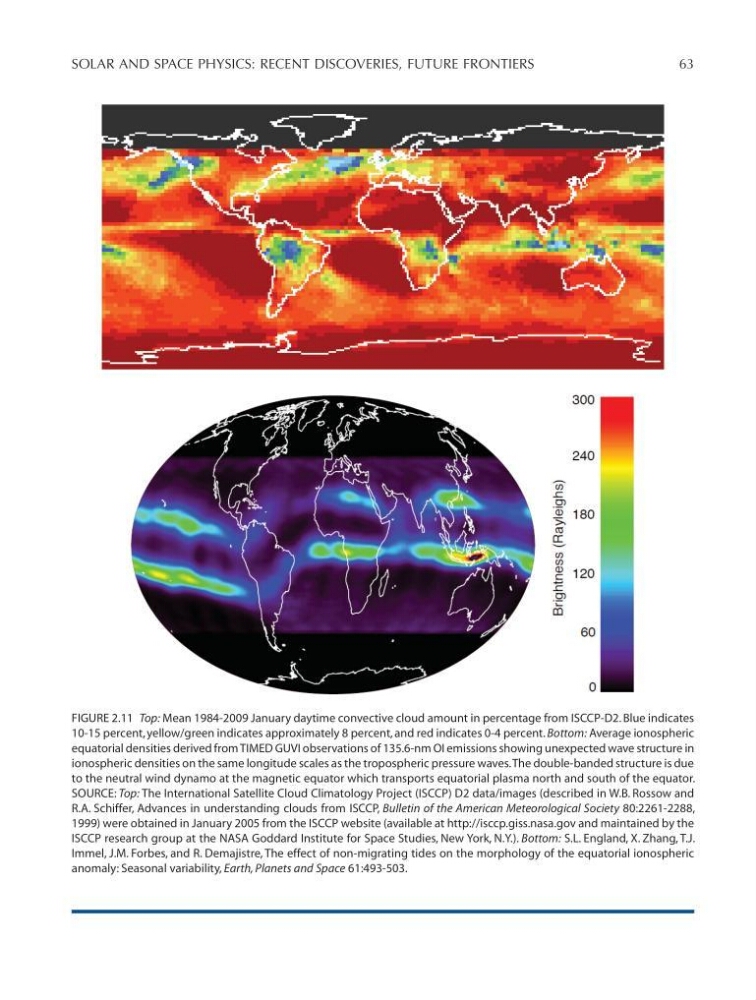
FIGURE 2.11 Top: Mean 1984-2009 January daytime convective cloud amount in percentage from ISCCP-D2. Blue indicates
10-15 percent, yellow/green indicates approximately 8 percent, and red indicates 0-4 percent. Bottom: Average ionospheric
equatorial densities derived from TIMED GUVI observations of 135.6-nm OI emissions showing unexpected wave structure in
ionospheric densities on the same longitude scales as the tropospheric pressure waves. The double-banded structure is due
to the neutral wind dynamo at the magnetic equator which transports equatorial plasma north and south of the equator.
SOURCE: Top: The International Satellite Cloud Climatology Project (ISCCP) D2 data/images (described in W.B. Rossow and
R.A. Schiffer, Advances in understanding clouds from ISCCP, Bulletin of the American Meteorological Society 80:2261-2288,
1999) were obtained in January 2005 from the ISCCP website (available at http://isccp.giss.nasa.gov and maintained by the
ISCCP research group at the NASA Goddard Institute for Space Studies, New York, N.Y.). Bottom: S.L. England, X. Zhang, T.J.
Immel, J.M. Forbes, and R. Demajistre, The effect of non-migrating tides on the morphology of the equatorial ionospheric
anomaly: Seasonal variability, Earth, Planets and Space 61:493-503.
Figure 2-11 combined
Solar and Space Physics: A Science for a Technological Society
SOLAR AND SPACE PHYSICS: RECENT DISCOVERIES, FUTURE FRONTIERS
63
FIGURE 2.11 Top: Mean 1984-2009 January daytime convective cloud amount in percentage from ISCCP-D2. Blue indicates
10-15 percent, yellow/green indicates approximately 8 percent, and red indicates 0-4 percent. Bottom: Average ionospheric
equatorial densities derived from TIMED GUVI observations of 135.6-nm OI emissions showing unexpected wave structure in
ionospheric densities on the same longitude scales as the tropospheric pressure waves. The double-banded structure is due
to the neutral wind dynamo at the magnetic equator which transports equatorial plasma north and south of the equator.
SOURCE: Top: The International Satellite Cloud Climatology Project (ISCCP) D2 data/images (described in W.B. Rossow and
R.A. Schiffer, Advances in understanding clouds from ISCCP, Bulletin of the American Meteorological Society 80:2261-2288,
1999) were obtained in January 2005 from the ISCCP website (available at http://isccp.giss.nasa.gov and maintained by the
ISCCP research group at the NASA Goddard Institute for Space Studies, New York, N.Y.). Bottom: S.L. England, X. Zhang, T.J.
Immel, J.M. Forbes, and R. Demajistre, The effect of non-migrating tides on the morphology of the equatorial ionospheric
anomaly: Seasonal variability, Earth, Planets and Space 61:493-503.
Figure 2-11 combined