

Copyright © National Academy of Sciences. All rights reserved.
Solar and Space Physics: A Science for a Technological Society
66
SOLAR AND SPACE PHYSICS: A SCIENCE FOR A TECHNOLOGICAL SOCIETY
interplanetary medium in particular motivates the continuation of these observations to support a broad
range of research in solar and space physics.
Finally, the nearly explosive growth in the ability to model complex phenomena in solar and space
physics with realistic numerical simulations suggests that the field is on the cusp of greatly expanded predictive power and fundamental understanding. The advanced state of theory and simulation also provides
a powerful opportunity to couple efforts in this area with observations, which will always remain limited
in key aspects, to realize the full potential of the observations and their implications for understanding
the underlying physical processes that they reflect. Reaching scientific closure and advancing predictive
understanding therefore depend critically on robust support for theory and modeling across the spectrum
of science challenges.
In summary, the program of solar and space physics research recommended in this report is specifically
designed to make the most effective use of the nation’s resources in a program that maximizes scientific
advances and furthers understanding of the space weather threats to a society that is increasingly reliant
on technologies that are vulnerable to solar and geospace activity.
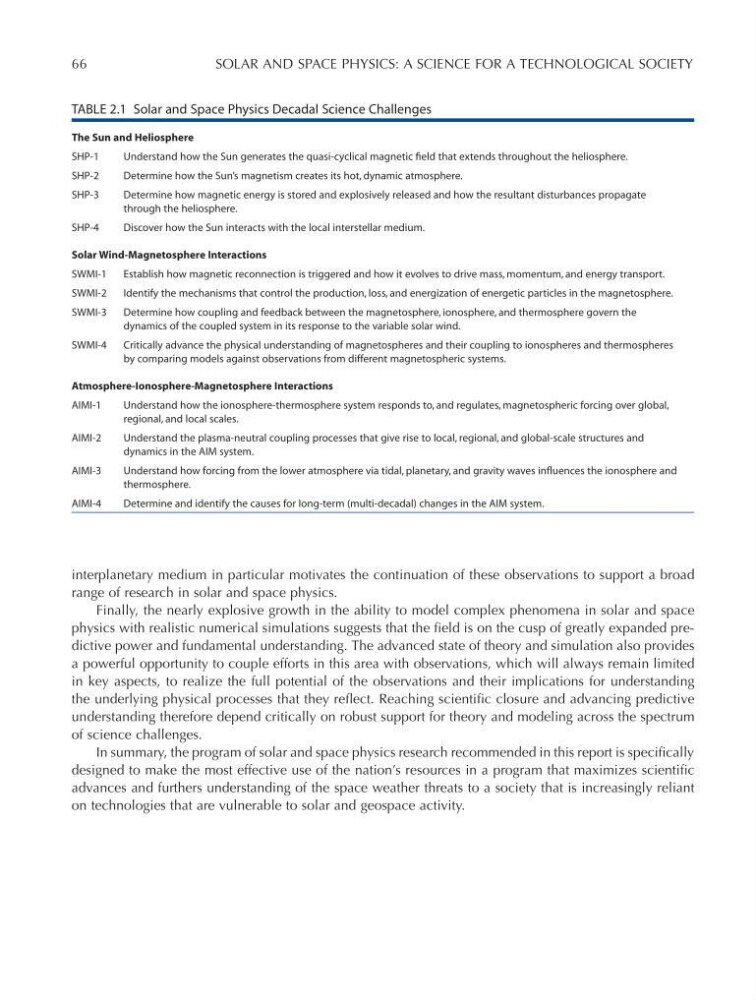
TABLE 2.1 Solar and Space Physics Decadal Science Challenges
The Sun and Heliosphere
SHP-1
Understand how the Sun generates the quasi-cyclical magnetic field that extends throughout the heliosphere.
SHP-2
Determine how the Sun’s magnetism creates its hot, dynamic atmosphere.
SHP-3
Determine how magnetic energy is stored and explosively released and how the resultant disturbances propagate
through the heliosphere.
SHP-4
Discover how the Sun interacts with the local interstellar medium.
Solar Wind-Magnetosphere Interactions
SWMI-1
Establish how magnetic reconnection is triggered and how it evolves to drive mass, momentum, and energy transport.
SWMI-2
Identify the mechanisms that control the production, loss, and energization of energetic particles in the magnetosphere.
SWMI-3
Determine how coupling and feedback between the magnetosphere, ionosphere, and thermosphere govern the
dynamics of the coupled system in its response to the variable solar wind.
SWMI-4
Critically advance the physical understanding of magnetospheres and their coupling to ionospheres and thermospheres
by comparing models against observations from different magnetospheric systems.
Atmosphere-Ionosphere-Magnetosphere Interactions
AIMI-1
Understand how the ionosphere-thermosphere system responds to, and regulates, magnetospheric forcing over global,
regional, and local scales.
AIMI-2
Understand the plasma-neutral coupling processes that give rise to local, regional, and global-scale structures and
dynamics in the AIM system.
AIMI-3
Understand how forcing from the lower atmosphere via tidal, planetary, and gravity waves influences the ionosphere and
thermosphere.
AIMI-4
Determine and identify the causes for long-term (multi-decadal) changes in the AIM system.
Solar and Space Physics: A Science for a Technological Society
66
SOLAR AND SPACE PHYSICS: A SCIENCE FOR A TECHNOLOGICAL SOCIETY
interplanetary medium in particular motivates the continuation of these observations to support a broad
range of research in solar and space physics.
Finally, the nearly explosive growth in the ability to model complex phenomena in solar and space
physics with realistic numerical simulations suggests that the field is on the cusp of greatly expanded predictive power and fundamental understanding. The advanced state of theory and simulation also provides
a powerful opportunity to couple efforts in this area with observations, which will always remain limited
in key aspects, to realize the full potential of the observations and their implications for understanding
the underlying physical processes that they reflect. Reaching scientific closure and advancing predictive
understanding therefore depend critically on robust support for theory and modeling across the spectrum
of science challenges.
In summary, the program of solar and space physics research recommended in this report is specifically
designed to make the most effective use of the nation’s resources in a program that maximizes scientific
advances and furthers understanding of the space weather threats to a society that is increasingly reliant
on technologies that are vulnerable to solar and geospace activity.
TABLE 2.1 Solar and Space Physics Decadal Science Challenges
The Sun and Heliosphere
SHP-1
Understand how the Sun generates the quasi-cyclical magnetic field that extends throughout the heliosphere.
SHP-2
Determine how the Sun’s magnetism creates its hot, dynamic atmosphere.
SHP-3
Determine how magnetic energy is stored and explosively released and how the resultant disturbances propagate
through the heliosphere.
SHP-4
Discover how the Sun interacts with the local interstellar medium.
Solar Wind-Magnetosphere Interactions
SWMI-1
Establish how magnetic reconnection is triggered and how it evolves to drive mass, momentum, and energy transport.
SWMI-2
Identify the mechanisms that control the production, loss, and energization of energetic particles in the magnetosphere.
SWMI-3
Determine how coupling and feedback between the magnetosphere, ionosphere, and thermosphere govern the
dynamics of the coupled system in its response to the variable solar wind.
SWMI-4
Critically advance the physical understanding of magnetospheres and their coupling to ionospheres and thermospheres
by comparing models against observations from different magnetospheric systems.
Atmosphere-Ionosphere-Magnetosphere Interactions
AIMI-1
Understand how the ionosphere-thermosphere system responds to, and regulates, magnetospheric forcing over global,
regional, and local scales.
AIMI-2
Understand the plasma-neutral coupling processes that give rise to local, regional, and global-scale structures and
dynamics in the AIM system.
AIMI-3
Understand how forcing from the lower atmosphere via tidal, planetary, and gravity waves influences the ionosphere and
thermosphere.
AIMI-4
Determine and identify the causes for long-term (multi-decadal) changes in the AIM system.