

Copyright © National Academy of Sciences. All rights reserved.
Solar and Space Physics: A Science for a Technological Society
48
SOLAR AND SPACE PHYSICS: A SCIENCE FOR A TECHNOLOGICAL SOCIETY
Observationally, reconnection seems to behave differently in different regions. Although reconnection
in the magnetotail and in the magnetosheath, where multiple reconnection sites have been identified,
appears to be transient and turbulent, it can, at other times, be quite steady in time and extended in space
at the dayside magnetopause and in the solar wind. Reconnection in the magnetotail produces bursts of
narrow channels of high-speed flow. Multi-spacecraft observations have revealed that these reconnectiongenerated flow channels initiate magnetospheric substorms and drive the Earth-ward convection in the
magnetotail; however, further multi-spacecraft studies may be necessary to complete the pattern of global
magnetospheric circulation predicted four decades ago. Finally, observational analyses will benefit greatly
from the inclusion of reconnection scenarios more general than the standard X-point picture, including
more general geometries identified in both theory and simulations.
Wave-particle interactions (WPIs) have been established as key drivers of particle energy gain and loss
in the radiation belts (Figure 2.6). Plasma instability theory, global simulations that include WPI processes,
and wave observations have demonstrated that the mixing of energetic and low-energy plasmas drives
instabilities distributed throughout the ring current and radiation belt. Satellite observations of radiationbelt electrons demonstrate that local acceleration due to WPIs may at times dominate acceleration due
to diffusive radial transport. Statistical analyses of satellite wave observations were used to quantify the
rates of energization and scattering. The results have been incorporated into time-dependent models of the
radiation belts and the ring current. Scientists now know that storm-time particle dynamics are the result
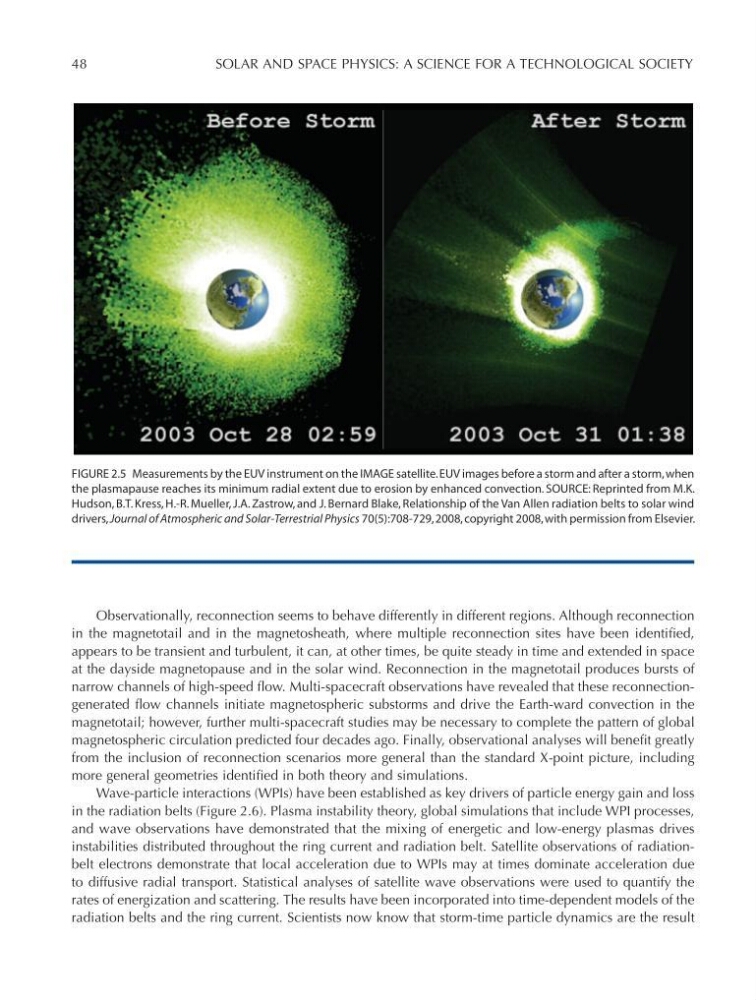
FIGURE 2.5 Measurements by the EUV instrument on the IMAGE satellite. EUV images before a storm and after a storm, when
the plasmapause reaches its minimum radial extent due to erosion by enhanced convection. SOURCE: Reprinted from M.K.
Hudson, B.T. Kress, H.-R. Mueller, J.A. Zastrow, and J. Bernard Blake, Relationship of the Van Allen radiation belts to solar wind
drivers, Journal of Atmospheric and Solar-Terrestrial Physics 70(5):708-729, 2008, copyright 2008, with permission from Elsevier.
Figure 2-5
Solar and Space Physics: A Science for a Technological Society
48
SOLAR AND SPACE PHYSICS: A SCIENCE FOR A TECHNOLOGICAL SOCIETY
Observationally, reconnection seems to behave differently in different regions. Although reconnection
in the magnetotail and in the magnetosheath, where multiple reconnection sites have been identified,
appears to be transient and turbulent, it can, at other times, be quite steady in time and extended in space
at the dayside magnetopause and in the solar wind. Reconnection in the magnetotail produces bursts of
narrow channels of high-speed flow. Multi-spacecraft observations have revealed that these reconnectiongenerated flow channels initiate magnetospheric substorms and drive the Earth-ward convection in the
magnetotail; however, further multi-spacecraft studies may be necessary to complete the pattern of global
magnetospheric circulation predicted four decades ago. Finally, observational analyses will benefit greatly
from the inclusion of reconnection scenarios more general than the standard X-point picture, including
more general geometries identified in both theory and simulations.
Wave-particle interactions (WPIs) have been established as key drivers of particle energy gain and loss
in the radiation belts (Figure 2.6). Plasma instability theory, global simulations that include WPI processes,
and wave observations have demonstrated that the mixing of energetic and low-energy plasmas drives
instabilities distributed throughout the ring current and radiation belt. Satellite observations of radiationbelt electrons demonstrate that local acceleration due to WPIs may at times dominate acceleration due
to diffusive radial transport. Statistical analyses of satellite wave observations were used to quantify the
rates of energization and scattering. The results have been incorporated into time-dependent models of the
radiation belts and the ring current. Scientists now know that storm-time particle dynamics are the result
FIGURE 2.5 Measurements by the EUV instrument on the IMAGE satellite. EUV images before a storm and after a storm, when
the plasmapause reaches its minimum radial extent due to erosion by enhanced convection. SOURCE: Reprinted from M.K.
Hudson, B.T. Kress, H.-R. Mueller, J.A. Zastrow, and J. Bernard Blake, Relationship of the Van Allen radiation belts to solar wind
drivers, Journal of Atmospheric and Solar-Terrestrial Physics 70(5):708-729, 2008, copyright 2008, with permission from Elsevier.
Figure 2-5