

Copyright © National Academy of Sciences. All rights reserved.
Solar and Space Physics: A Science for a Technological Society
SOLAR AND SPACE PHYSICS: RECENT DISCOVERIES, FUTURE FRONTIERS
49
of a delicate balance between acceleration and loss of relativistic particles mediated by waves produced
by local plasma instabilities.
Nonlinear Dynamics
In the past decade there has been tremendous improvement in understanding of how the magnetosphere responds to storm-time disturbances as a coherent system of coupled, mutually interacting plasmas.
Imaging and global simulations have played a central role by providing quantitative contextual information
that ties together single-point observations and allows assessment of the global behavior implied by local
observations. These advances were coupled with continuous measurements of the solar wind and IMF and
numerous in situ observations in space and ground-based and remote sensing networks to yield discoveries of characteristic global responses. Researchers now realize that there are multiple nonlinear dynamic
linkages whose consequences for coupled magnetosphere-ionosphere behavior are revealed only when
they are integrated together in the global system. As a result the system exhibits characteristic nonlinear,
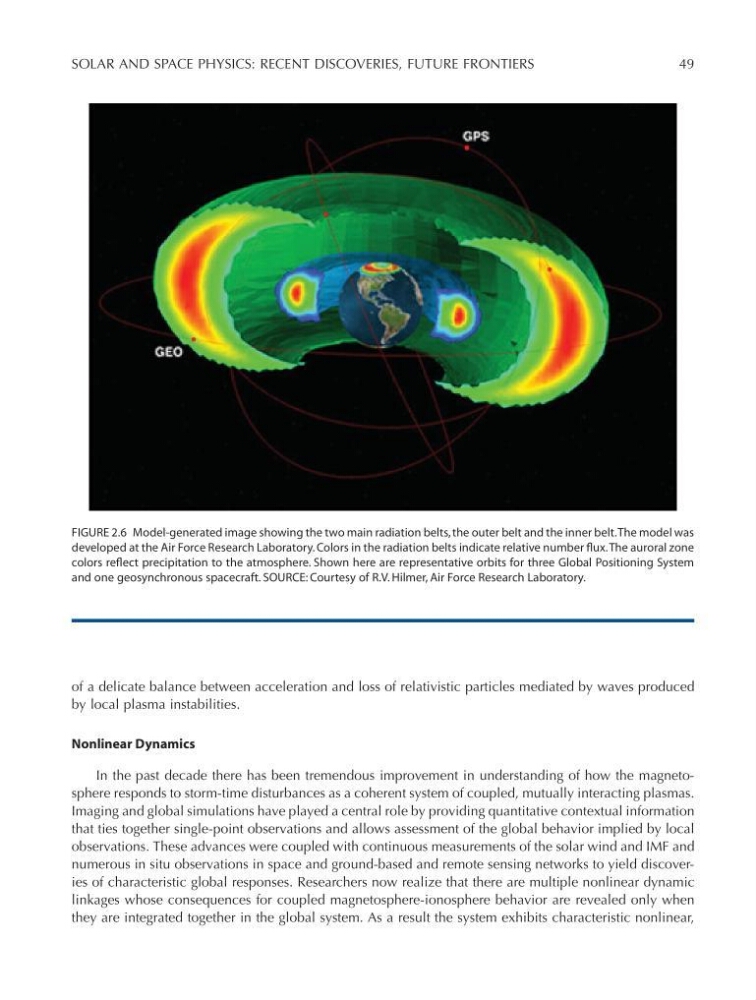
FIGURE 2.6 Model-generated image showing the two main radiation belts, the outer belt and the inner belt. The model was
developed at the Air Force Research Laboratory. Colors in the radiation belts indicate relative number flux. The auroral zone
colors reflect precipitation to the atmosphere. Shown here are representative orbits for three Global Positioning System
and one geosynchronous spacecraft. SOURCE: Courtesy of R.V. Hilmer, Air Force Research Laboratory.
Figure 2-6
Solar and Space Physics: A Science for a Technological Society
SOLAR AND SPACE PHYSICS: RECENT DISCOVERIES, FUTURE FRONTIERS
49
of a delicate balance between acceleration and loss of relativistic particles mediated by waves produced
by local plasma instabilities.
Nonlinear Dynamics
In the past decade there has been tremendous improvement in understanding of how the magnetosphere responds to storm-time disturbances as a coherent system of coupled, mutually interacting plasmas.
Imaging and global simulations have played a central role by providing quantitative contextual information
that ties together single-point observations and allows assessment of the global behavior implied by local
observations. These advances were coupled with continuous measurements of the solar wind and IMF and
numerous in situ observations in space and ground-based and remote sensing networks to yield discoveries of characteristic global responses. Researchers now realize that there are multiple nonlinear dynamic
linkages whose consequences for coupled magnetosphere-ionosphere behavior are revealed only when
they are integrated together in the global system. As a result the system exhibits characteristic nonlinear,
FIGURE 2.6 Model-generated image showing the two main radiation belts, the outer belt and the inner belt. The model was
developed at the Air Force Research Laboratory. Colors in the radiation belts indicate relative number flux. The auroral zone
colors reflect precipitation to the atmosphere. Shown here are representative orbits for three Global Positioning System
and one geosynchronous spacecraft. SOURCE: Courtesy of R.V. Hilmer, Air Force Research Laboratory.
Figure 2-6