

Copyright © National Academy of Sciences. All rights reserved.
Solar and Space Physics: A Science for a Technological Society
438
SOLAR AND SPACE PHYSICS: A SCIENCE FOR A TECHNOLOGICAL SOCIETY
RFI Response
Number
First Author
Response Title
Summary Description
267
Talaat, Elsayed R.,
et al.
Electrodynamics Observations with
Numerous Satellites
Proposes a suite of small satellites distributed
in local time at F-region altitudes with essential
instrumentation to address ion-neutral coupling
and the roles of the disturbance dynamo, tidal
dynamos, and magnetospheric penetration
electric fields in determining the global
electrodynamics.
268
Tomczyk, Steven,
et al.
COSMO—The Coronal Solar Magnetism
Observatory
Presents the science justification and technical
overview of the Coronal Solar Magnetism
Observatory (COSMO), a facility dedicated to the
measurement of magnetic fields and plasma
properties in the solar corona to advance
understanding of the Sun’s generation of space
weather.
269
Tylka, Allan J.
Heliophysics System Science and
Funding for Extended Missions
Offers suggestions and recommendations
regarding adequate funding for extended
missions concerning all areas of heliophysics
science.
270
Valladares, Cesar E.
On Understanding the Origin of Plasma
Density Variability Within the Polar Cap
Describes two ionospheric processes that
contribute to the high variability of the plasma
density within the polar cap: polar cap patches
and Sun-aligned arcs.
271
Velli, Marco, et al.
SAFARI: Solar Activity Far Side
Investigation
Proposes a mission to explore the origins of solar
magnetic activity by carrying out observations
of the velocity and magnetic fields at the solar
surface from a vantage point widely separated
from Earth in longitude.
272
Vial, Jean-Claude
Fast UV Spectro-imagery for Solar
Physics
Argues that imaging Fourier transform
spectroscopy should be pursued to measure
temperature, density, ionization, and abundance,
along with magnetic and velocity fields in the
solar atmosphere in three dimensions and time,
in the high chromosphere, corona, and the
transition region.
273
Vourlidas, Angelos,
et al.
Mission to the Sun-Earth L5 Lagrangian
Point: An Optimal Platform for
Heliophysics and Space Weather
Research
Argues that a research-to-operations approach
is the best strategy to foster the vibrancy of
the field in the next decade, spearheaded by a
mission to the L5 Lagrangian point.
274
Vourlidas, Angelos,
and A. Rymer
A Proposal to Lighten the Burden of
International Traffic in Arms Regulations
on Heliophysics Research
Describes the problem of the overly restricted
regulatory regime on science missions classified
as “defense systems” and provides a set of
recommendations to improve this situation.
275
Walterscheid,
Richard, et al.
Gravity Wave Propagation in the
Dissipative and Diffusively Separated
Thermosphere
Advocates further understanding of the upward
coupling of waves from the lower atmosphere
and new observations combined with models
of acoustic-gravity waves for thermospheric
regions where rapid dissipation and diffusive
separation prevail.
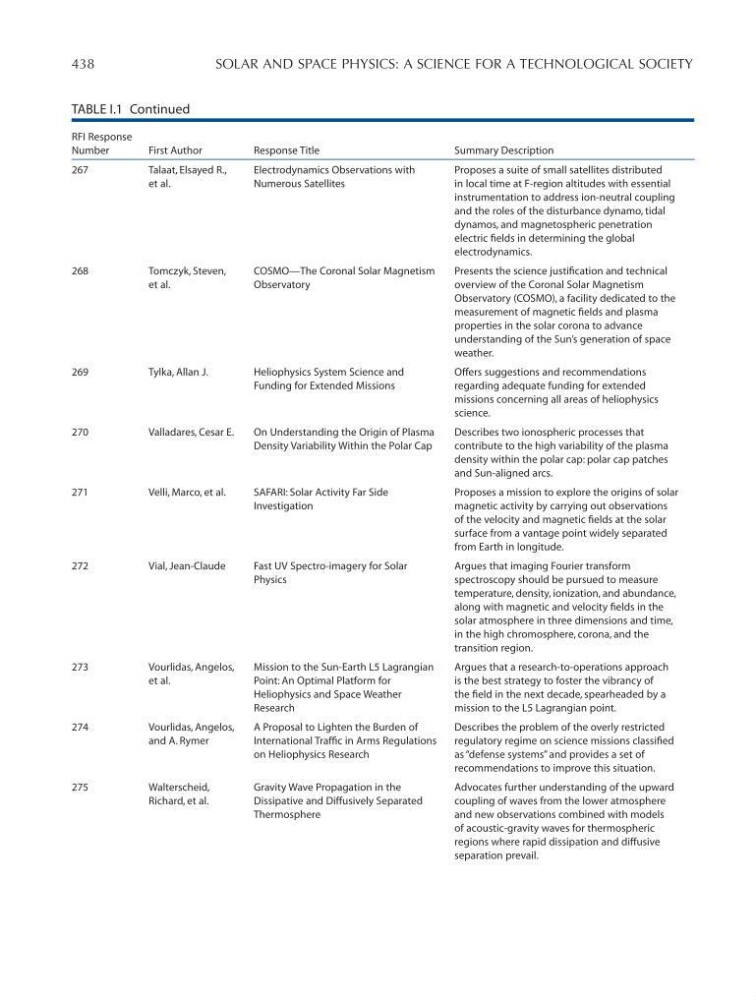
TABLE I.1 Continued
Solar and Space Physics: A Science for a Technological Society
438
SOLAR AND SPACE PHYSICS: A SCIENCE FOR A TECHNOLOGICAL SOCIETY
RFI Response
Number
First Author
Response Title
Summary Description
267
Talaat, Elsayed R.,
et al.
Electrodynamics Observations with
Numerous Satellites
Proposes a suite of small satellites distributed
in local time at F-region altitudes with essential
instrumentation to address ion-neutral coupling
and the roles of the disturbance dynamo, tidal
dynamos, and magnetospheric penetration
electric fields in determining the global
electrodynamics.
268
Tomczyk, Steven,
et al.
COSMO—The Coronal Solar Magnetism
Observatory
Presents the science justification and technical
overview of the Coronal Solar Magnetism
Observatory (COSMO), a facility dedicated to the
measurement of magnetic fields and plasma
properties in the solar corona to advance
understanding of the Sun’s generation of space
weather.
269
Tylka, Allan J.
Heliophysics System Science and
Funding for Extended Missions
Offers suggestions and recommendations
regarding adequate funding for extended
missions concerning all areas of heliophysics
science.
270
Valladares, Cesar E.
On Understanding the Origin of Plasma
Density Variability Within the Polar Cap
Describes two ionospheric processes that
contribute to the high variability of the plasma
density within the polar cap: polar cap patches
and Sun-aligned arcs.
271
Velli, Marco, et al.
SAFARI: Solar Activity Far Side
Investigation
Proposes a mission to explore the origins of solar
magnetic activity by carrying out observations
of the velocity and magnetic fields at the solar
surface from a vantage point widely separated
from Earth in longitude.
272
Vial, Jean-Claude
Fast UV Spectro-imagery for Solar
Physics
Argues that imaging Fourier transform
spectroscopy should be pursued to measure
temperature, density, ionization, and abundance,
along with magnetic and velocity fields in the
solar atmosphere in three dimensions and time,
in the high chromosphere, corona, and the
transition region.
273
Vourlidas, Angelos,
et al.
Mission to the Sun-Earth L5 Lagrangian
Point: An Optimal Platform for
Heliophysics and Space Weather
Research
Argues that a research-to-operations approach
is the best strategy to foster the vibrancy of
the field in the next decade, spearheaded by a
mission to the L5 Lagrangian point.
274
Vourlidas, Angelos,
and A. Rymer
A Proposal to Lighten the Burden of
International Traffic in Arms Regulations
on Heliophysics Research
Describes the problem of the overly restricted
regulatory regime on science missions classified
as “defense systems” and provides a set of
recommendations to improve this situation.
275
Walterscheid,
Richard, et al.
Gravity Wave Propagation in the
Dissipative and Diffusively Separated
Thermosphere
Advocates further understanding of the upward
coupling of waves from the lower atmosphere
and new observations combined with models
of acoustic-gravity waves for thermospheric
regions where rapid dissipation and diffusive
separation prevail.
TABLE I.1 Continued