

Copyright © National Academy of Sciences. All rights reserved.
Solar and Space Physics: A Science for a Technological Society
APPENDIX I
439
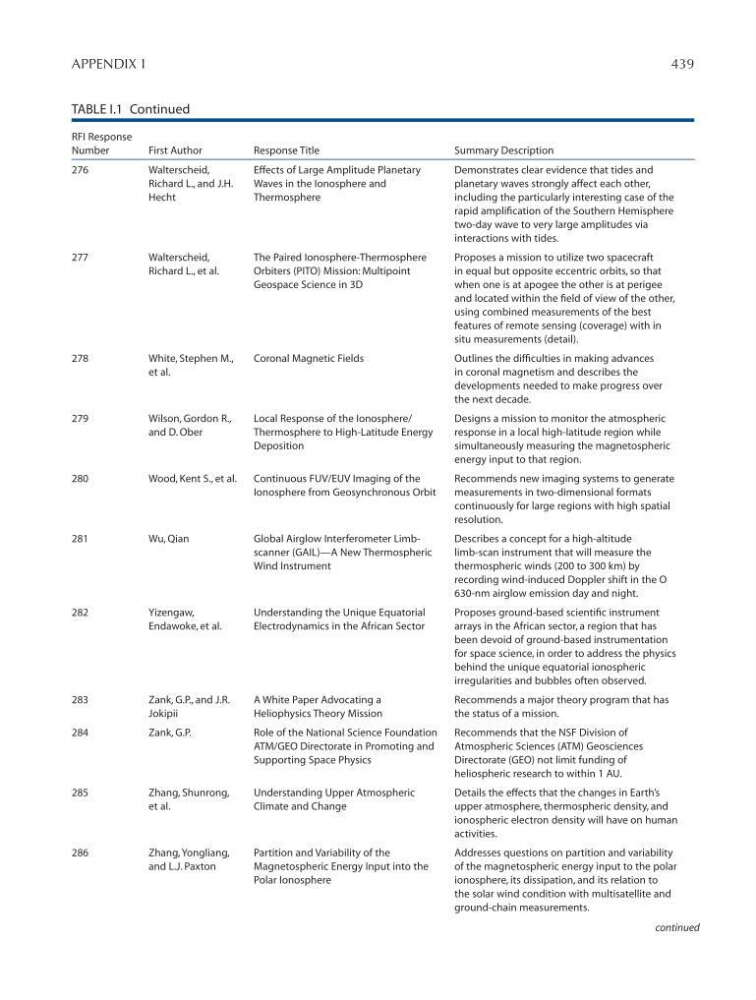
RFI Response
Number
First Author
Response Title
Summary Description
276
Walterscheid,
Richard L., and J.H.
Hecht
Effects of Large Amplitude Planetary
Waves in the Ionosphere and
Thermosphere
Demonstrates clear evidence that tides and
planetary waves strongly affect each other,
including the particularly interesting case of the
rapid amplification of the Southern Hemisphere
two-day wave to very large amplitudes via
interactions with tides.
277
Walterscheid,
Richard L., et al.
The Paired Ionosphere-Thermosphere
Orbiters (PITO) Mission: Multipoint
Geospace Science in 3D
Proposes a mission to utilize two spacecraft
in equal but opposite eccentric orbits, so that
when one is at apogee the other is at perigee
and located within the field of view of the other,
using combined measurements of the best
features of remote sensing (coverage) with in
situ measurements (detail).
278
White, Stephen M.,
et al.
Coronal Magnetic Fields
Outlines the difficulties in making advances
in coronal magnetism and describes the
developments needed to make progress over
the next decade.
279
Wilson, Gordon R.,
and D. Ober
Local Response of the Ionosphere/
Thermosphere to High-Latitude Energy
Deposition
Designs a mission to monitor the atmospheric
response in a local high-latitude region while
simultaneously measuring the magnetospheric
energy input to that region.
280
Wood, Kent S., et al.
Continuous FUV/EUV Imaging of the
Ionosphere from Geosynchronous Orbit
Recommends new imaging systems to generate
measurements in two-dimensional formats
continuously for large regions with high spatial
resolution.
281
Wu, Qian
Global Airglow Interferometer Limbscanner (GAIL)—A New Thermospheric
Wind Instrument
Describes a concept for a high-altitude
limb-scan instrument that will measure the
thermospheric winds (200 to 300 km) by
recording wind-induced Doppler shift in the O
630-nm airglow emission day and night.
282
Yizengaw,
Endawoke, et al.
Understanding the Unique Equatorial
Electrodynamics in the African Sector
Proposes ground-based scientific instrument
arrays in the African sector, a region that has
been devoid of ground-based instrumentation
for space science, in order to address the physics
behind the unique equatorial ionospheric
irregularities and bubbles often observed.
283
Zank, G.P., and J.R.
Jokipii
A White Paper Advocating a
Heliophysics Theory Mission
Recommends a major theory program that has
the status of a mission.
284
Zank, G.P.
Role of the National Science Foundation
ATM/GEO Directorate in Promoting and
Supporting Space Physics
Recommends that the NSF Division of
Atmospheric Sciences (ATM) Geosciences
Directorate (GEO) not limit funding of
heliospheric research to within 1 AU.
285
Zhang, Shunrong,
et al.
Understanding Upper Atmospheric
Climate and Change
Details the effects that the changes in Earth’s
upper atmosphere, thermospheric density, and
ionospheric electron density will have on human
activities.
286
Zhang, Yongliang,
and L.J. Paxton
Partition and Variability of the
Magnetospheric Energy Input into the
Polar Ionosphere
Addresses questions on partition and variability
of the magnetospheric energy input to the polar
ionosphere, its dissipation, and its relation to
the solar wind condition with multisatellite and
ground-chain measurements.
TABLE I.1 Continued
continued
Solar and Space Physics: A Science for a Technological Society
APPENDIX I
439
RFI Response
Number
First Author
Response Title
Summary Description
276
Walterscheid,
Richard L., and J.H.
Hecht
Effects of Large Amplitude Planetary
Waves in the Ionosphere and
Thermosphere
Demonstrates clear evidence that tides and
planetary waves strongly affect each other,
including the particularly interesting case of the
rapid amplification of the Southern Hemisphere
two-day wave to very large amplitudes via
interactions with tides.
277
Walterscheid,
Richard L., et al.
The Paired Ionosphere-Thermosphere
Orbiters (PITO) Mission: Multipoint
Geospace Science in 3D
Proposes a mission to utilize two spacecraft
in equal but opposite eccentric orbits, so that
when one is at apogee the other is at perigee
and located within the field of view of the other,
using combined measurements of the best
features of remote sensing (coverage) with in
situ measurements (detail).
278
White, Stephen M.,
et al.
Coronal Magnetic Fields
Outlines the difficulties in making advances
in coronal magnetism and describes the
developments needed to make progress over
the next decade.
279
Wilson, Gordon R.,
and D. Ober
Local Response of the Ionosphere/
Thermosphere to High-Latitude Energy
Deposition
Designs a mission to monitor the atmospheric
response in a local high-latitude region while
simultaneously measuring the magnetospheric
energy input to that region.
280
Wood, Kent S., et al.
Continuous FUV/EUV Imaging of the
Ionosphere from Geosynchronous Orbit
Recommends new imaging systems to generate
measurements in two-dimensional formats
continuously for large regions with high spatial
resolution.
281
Wu, Qian
Global Airglow Interferometer Limbscanner (GAIL)—A New Thermospheric
Wind Instrument
Describes a concept for a high-altitude
limb-scan instrument that will measure the
thermospheric winds (200 to 300 km) by
recording wind-induced Doppler shift in the O
630-nm airglow emission day and night.
282
Yizengaw,
Endawoke, et al.
Understanding the Unique Equatorial
Electrodynamics in the African Sector
Proposes ground-based scientific instrument
arrays in the African sector, a region that has
been devoid of ground-based instrumentation
for space science, in order to address the physics
behind the unique equatorial ionospheric
irregularities and bubbles often observed.
283
Zank, G.P., and J.R.
Jokipii
A White Paper Advocating a
Heliophysics Theory Mission
Recommends a major theory program that has
the status of a mission.
284
Zank, G.P.
Role of the National Science Foundation
ATM/GEO Directorate in Promoting and
Supporting Space Physics
Recommends that the NSF Division of
Atmospheric Sciences (ATM) Geosciences
Directorate (GEO) not limit funding of
heliospheric research to within 1 AU.
285
Zhang, Shunrong,
et al.
Understanding Upper Atmospheric
Climate and Change
Details the effects that the changes in Earth’s
upper atmosphere, thermospheric density, and
ionospheric electron density will have on human
activities.
286
Zhang, Yongliang,
and L.J. Paxton
Partition and Variability of the
Magnetospheric Energy Input into the
Polar Ionosphere
Addresses questions on partition and variability
of the magnetospheric energy input to the polar
ionosphere, its dissipation, and its relation to
the solar wind condition with multisatellite and
ground-chain measurements.
TABLE I.1 Continued
continued