

Copyright © National Academy of Sciences. All rights reserved.
Solar and Space Physics: A Science for a Technological Society
APPENDIX I
437
RFI Response
Number
First Author
Response Title
Summary Description
258
Stephan, Andrew
W., et al.
Global Ionosphere-ThermosphereMesosphere (ITM) Mapping Across
Temporal and Spatial Scales
Provides a robust method for obtaining
necessary routine space weather maps of the
near-Earth space weather volume for both
scientific inquiry and operational users by
combining global imaging and low-altitude
sensors measuring ultraviolet airglow.
259
Stevens, Michael
H., et al.
Direct Observations of Global-Scale
Transport in the Lower Thermosphere
Describes a mission to study global-scale
dynamics by observing tracers injected
by vehicles launched from a satellite in
geosynchronous orbit.
260
Stoneback, Russell
A.
Effective Aperture Behavior on the
Earth and Sun
Proposes continued research on a model to
investigate the apparent equivalence between
high-latitude currents on both Earth and the
Sun and currents used to calculate the diffracted
field produced by an aperture.
261
Streltsov, Anatoly V.
Multi-scale Electrodynamics of
Magnetosphere-Ionosphere Interactions
Proposes comprehensive, multi-fluid, waveparticle numerical models with predictive
capabilities to address observations from
satellites, sounding rockets, and radars
conducted in the high-latitude magnetosphere
and the ionosphere, which frequently measure
intense unexplained electromagnetic fields and
currents.
262
Strong, Keith T.,
et al.
4PI: A Global Understanding of the Solar
Cycle
Proposes a mission to provide the first
continuous view of the solar magnetic field
and plasma dynamics mapped from below the
surface into the corona, over all solar longitudes
with extended polar coverage, and tracks the
evolution of the dynamo(s) throughout at least
a solar cycle.
263
Swenson, Charles
M., et al.
CubeSats in Heliophysics Research
Emphasizes that CubeSat technologies
represent a significant opportunity for achieving
multipoint observations from within the space
environment.
264
Swenson, Gary R.
Remote Sensing the Upper Atmosphere
with Lidar from Space
Advocates development of lidar technology
for remote sensing of the upper atmosphere/
ionosphere.
265
Szabo, Adam, et al.
Solar Wind Kinetic Physics: High Time
Resolution Solar Wind Measurements
from the DSCOVR Mission
Advocates refurbishment of the DSCOVR
spacecraft to obtain unprecedented high time
resolution solar wind measurements from the
Sun-Earth L1 Lagrange point at minimal NASA
cost.
266
Szabo, Adam, et al.
Energetic Particle Propagation and
Coronal Mass Ejection Evolution in the
Inner Heliosphere: Multi-point In-Situ
Solar Sentinels Observations
Proposes the Solar Sentinels mission to provide
in situ particle and field observations to answer
questions of solar energetic particle transport
and interplanetary coronal mass ejection
evolution in the inner heliosphere.
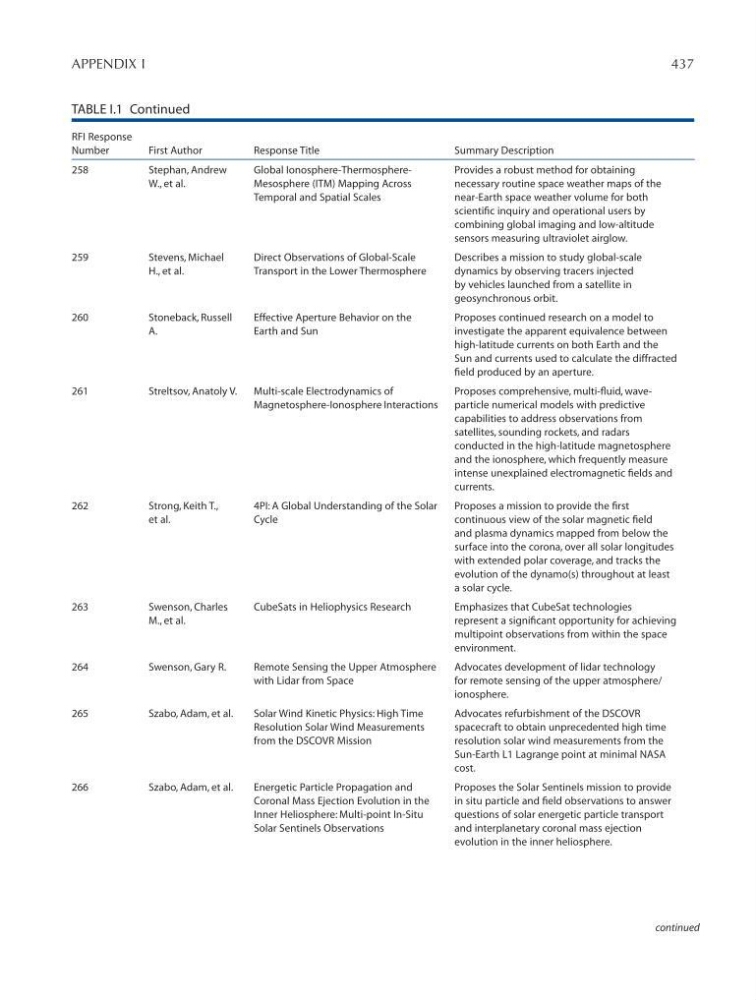
TABLE I.1 Continued
continued
Solar and Space Physics: A Science for a Technological Society
APPENDIX I
437
RFI Response
Number
First Author
Response Title
Summary Description
258
Stephan, Andrew
W., et al.
Global Ionosphere-ThermosphereMesosphere (ITM) Mapping Across
Temporal and Spatial Scales
Provides a robust method for obtaining
necessary routine space weather maps of the
near-Earth space weather volume for both
scientific inquiry and operational users by
combining global imaging and low-altitude
sensors measuring ultraviolet airglow.
259
Stevens, Michael
H., et al.
Direct Observations of Global-Scale
Transport in the Lower Thermosphere
Describes a mission to study global-scale
dynamics by observing tracers injected
by vehicles launched from a satellite in
geosynchronous orbit.
260
Stoneback, Russell
A.
Effective Aperture Behavior on the
Earth and Sun
Proposes continued research on a model to
investigate the apparent equivalence between
high-latitude currents on both Earth and the
Sun and currents used to calculate the diffracted
field produced by an aperture.
261
Streltsov, Anatoly V.
Multi-scale Electrodynamics of
Magnetosphere-Ionosphere Interactions
Proposes comprehensive, multi-fluid, waveparticle numerical models with predictive
capabilities to address observations from
satellites, sounding rockets, and radars
conducted in the high-latitude magnetosphere
and the ionosphere, which frequently measure
intense unexplained electromagnetic fields and
currents.
262
Strong, Keith T.,
et al.
4PI: A Global Understanding of the Solar
Cycle
Proposes a mission to provide the first
continuous view of the solar magnetic field
and plasma dynamics mapped from below the
surface into the corona, over all solar longitudes
with extended polar coverage, and tracks the
evolution of the dynamo(s) throughout at least
a solar cycle.
263
Swenson, Charles
M., et al.
CubeSats in Heliophysics Research
Emphasizes that CubeSat technologies
represent a significant opportunity for achieving
multipoint observations from within the space
environment.
264
Swenson, Gary R.
Remote Sensing the Upper Atmosphere
with Lidar from Space
Advocates development of lidar technology
for remote sensing of the upper atmosphere/
ionosphere.
265
Szabo, Adam, et al.
Solar Wind Kinetic Physics: High Time
Resolution Solar Wind Measurements
from the DSCOVR Mission
Advocates refurbishment of the DSCOVR
spacecraft to obtain unprecedented high time
resolution solar wind measurements from the
Sun-Earth L1 Lagrange point at minimal NASA
cost.
266
Szabo, Adam, et al.
Energetic Particle Propagation and
Coronal Mass Ejection Evolution in the
Inner Heliosphere: Multi-point In-Situ
Solar Sentinels Observations
Proposes the Solar Sentinels mission to provide
in situ particle and field observations to answer
questions of solar energetic particle transport
and interplanetary coronal mass ejection
evolution in the inner heliosphere.
TABLE I.1 Continued
continued