

Copyright © National Academy of Sciences. All rights reserved.
Solar and Space Physics: A Science for a Technological Society
436
SOLAR AND SPACE PHYSICS: A SCIENCE FOR A TECHNOLOGICAL SOCIETY
RFI Response
Number
First Author
Response Title
Summary Description
248
Smith, Steven M.
Gravity Wave Coupling Processes
Between the Lower Atmosphere
and the Mesosphere and Lower
Thermosphere
Proposes a research strategy to forecast space
weather phenomena with a fundamental
understanding of the dynamics (e.g., energy
and momentum flux budgets, chemistry, etc.) of
Earth’s atmosphere as a whole system.
249
Smith, Steven M.
Neutral Temperature and Wind
Measurements of Earth’s Thermosphere
Discusses the need for more accurate neutral
temperature and wind climatologies of Earth’s
lower thermosphere in the altitude range 100300 km.
250
Snow, Martin A.,
et al.
The Importance of Solar EUV and FUV
Irradiance Measurements for Space
Weather and Atmospheric Modeling
Argues that extending the data record of solar
extreme ultraviolet (EUV) and far ultraviolet
(FUV) irradiances should continue to be a
priority of the heliophysics community for
understanding both the long-term (climate) and
short-term (space weather) influence of the Sun
on the atmosphere.
251
Sojka, Jan J.
Adoption of a Paradigm Shift for Space
Exploration
Presents a case for collaboration between all
space science funding agencies to support
synergistic activities that benefit all and provides
the links between science and applications that
will produce the expected societal benefits.
252
Solomon, Stanley
C., and L. Qian
Modeling and Measurement of Upper
Atmosphere Climate Change
Proposes a program of model development and
space-based measurements for understanding
and quantifying the increasing temperatures of
the upper atmosphere.
253
Spann, James F.,
et al.
A Cross-Agency Enabling Effort Focused
on Space Weather Observations and
Research-to-Operation Transition
Presents an approach to address the lack of
a robust national coordinated research-toapplication program for space weather and a
lack of sufficient relevant space- and groundbased observations by proposing a joint federal
agency program involving NASA, NOAA, and NSF.
254
Spann, James F.,
et al.
A NASA Applied Spaceflight
Environments Office Concept
Presents a solution to the NASA problem that
there is no coordinated activity to harness the
valuable knowledge and products across the
field centers related to spaceflight environments,
which includes space weather.
255
Spann, James F.,
et al.
Dynamic Geospace Coupling Mission
Addresses fundamental questions related to
plasma processes that determine how energy
and momentum from the solar wind propagate
downward through geospace to Earth and
proposes a multi-spacecraft implementation
with imaging and in situ instruments.
256
St. Cyr, O.C., et al.
Space Weather Diamond: A 10x
Improvement in Real-Time Forecasting
Promotes an applied heliophysics mission
concept to facilitate the connection between
science and societal needs (e.g., improvements
in space weather prediction) by providing an
order of magnitude improvement over presentday L1 monitors.
257
St. Cyr, O.C., et al.
Solar Orbiter: Exploring the SunHeliosphere Connection
Describes the ESA/NASA Solar Orbiter mission,
including the science and mission design.
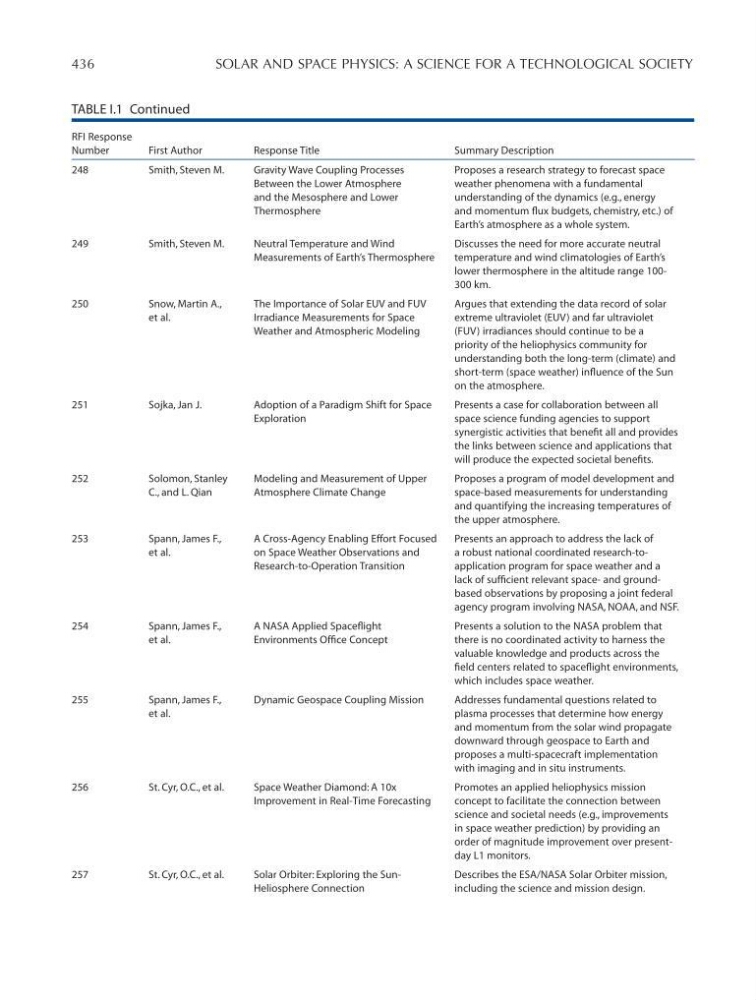
TABLE I.1 Continued
Solar and Space Physics: A Science for a Technological Society
436
SOLAR AND SPACE PHYSICS: A SCIENCE FOR A TECHNOLOGICAL SOCIETY
RFI Response
Number
First Author
Response Title
Summary Description
248
Smith, Steven M.
Gravity Wave Coupling Processes
Between the Lower Atmosphere
and the Mesosphere and Lower
Thermosphere
Proposes a research strategy to forecast space
weather phenomena with a fundamental
understanding of the dynamics (e.g., energy
and momentum flux budgets, chemistry, etc.) of
Earth’s atmosphere as a whole system.
249
Smith, Steven M.
Neutral Temperature and Wind
Measurements of Earth’s Thermosphere
Discusses the need for more accurate neutral
temperature and wind climatologies of Earth’s
lower thermosphere in the altitude range 100300 km.
250
Snow, Martin A.,
et al.
The Importance of Solar EUV and FUV
Irradiance Measurements for Space
Weather and Atmospheric Modeling
Argues that extending the data record of solar
extreme ultraviolet (EUV) and far ultraviolet
(FUV) irradiances should continue to be a
priority of the heliophysics community for
understanding both the long-term (climate) and
short-term (space weather) influence of the Sun
on the atmosphere.
251
Sojka, Jan J.
Adoption of a Paradigm Shift for Space
Exploration
Presents a case for collaboration between all
space science funding agencies to support
synergistic activities that benefit all and provides
the links between science and applications that
will produce the expected societal benefits.
252
Solomon, Stanley
C., and L. Qian
Modeling and Measurement of Upper
Atmosphere Climate Change
Proposes a program of model development and
space-based measurements for understanding
and quantifying the increasing temperatures of
the upper atmosphere.
253
Spann, James F.,
et al.
A Cross-Agency Enabling Effort Focused
on Space Weather Observations and
Research-to-Operation Transition
Presents an approach to address the lack of
a robust national coordinated research-toapplication program for space weather and a
lack of sufficient relevant space- and groundbased observations by proposing a joint federal
agency program involving NASA, NOAA, and NSF.
254
Spann, James F.,
et al.
A NASA Applied Spaceflight
Environments Office Concept
Presents a solution to the NASA problem that
there is no coordinated activity to harness the
valuable knowledge and products across the
field centers related to spaceflight environments,
which includes space weather.
255
Spann, James F.,
et al.
Dynamic Geospace Coupling Mission
Addresses fundamental questions related to
plasma processes that determine how energy
and momentum from the solar wind propagate
downward through geospace to Earth and
proposes a multi-spacecraft implementation
with imaging and in situ instruments.
256
St. Cyr, O.C., et al.
Space Weather Diamond: A 10x
Improvement in Real-Time Forecasting
Promotes an applied heliophysics mission
concept to facilitate the connection between
science and societal needs (e.g., improvements
in space weather prediction) by providing an
order of magnitude improvement over presentday L1 monitors.
257
St. Cyr, O.C., et al.
Solar Orbiter: Exploring the SunHeliosphere Connection
Describes the ESA/NASA Solar Orbiter mission,
including the science and mission design.
TABLE I.1 Continued