

Copyright © National Academy of Sciences. All rights reserved.
Solar and Space Physics: A Science for a Technological Society
APPENDIX I
435
RFI Response
Number
First Author
Response Title
Summary Description
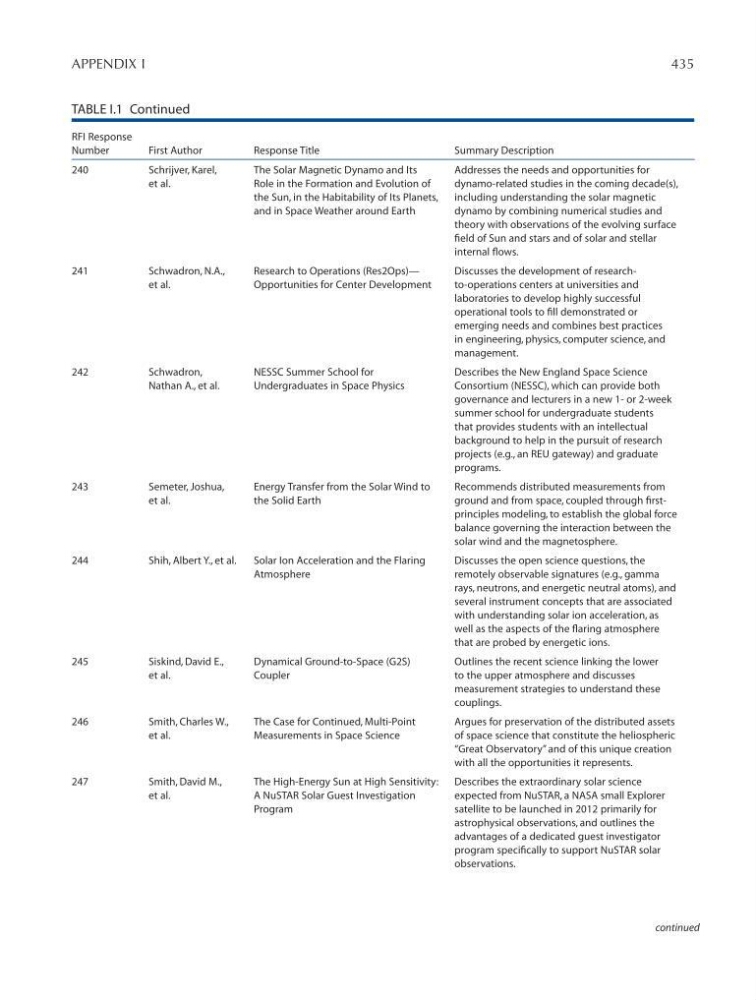
240
Schrijver, Karel,
et al.
The Solar Magnetic Dynamo and Its
Role in the Formation and Evolution of
the Sun, in the Habitability of Its Planets,
and in Space Weather around Earth
Addresses the needs and opportunities for
dynamo-related studies in the coming decade(s),
including understanding the solar magnetic
dynamo by combining numerical studies and
theory with observations of the evolving surface
field of Sun and stars and of solar and stellar
internal flows.
241
Schwadron, N.A.,
et al.
Research to Operations (Res2Ops)—
Opportunities for Center Development
Discusses the development of researchto-operations centers at universities and
laboratories to develop highly successful
operational tools to fill demonstrated or
emerging needs and combines best practices
in engineering, physics, computer science, and
management.
242
Schwadron,
Nathan A., et al.
NESSC Summer School for
Undergraduates in Space Physics
Describes the New England Space Science
Consortium (NESSC), which can provide both
governance and lecturers in a new 1- or 2-week
summer school for undergraduate students
that provides students with an intellectual
background to help in the pursuit of research
projects (e.g., an REU gateway) and graduate
programs.
243
Semeter, Joshua,
et al.
Energy Transfer from the Solar Wind to
the Solid Earth
Recommends distributed measurements from
ground and from space, coupled through firstprinciples modeling, to establish the global force
balance governing the interaction between the
solar wind and the magnetosphere.
244
Shih, Albert Y., et al.
Solar Ion Acceleration and the Flaring
Atmosphere
Discusses the open science questions, the
remotely observable signatures (e.g., gamma
rays, neutrons, and energetic neutral atoms), and
several instrument concepts that are associated
with understanding solar ion acceleration, as
well as the aspects of the flaring atmosphere
that are probed by energetic ions.
245
Siskind, David E.,
et al.
Dynamical Ground-to-Space (G2S)
Coupler
Outlines the recent science linking the lower
to the upper atmosphere and discusses
measurement strategies to understand these
couplings.
246
Smith, Charles W.,
et al.
The Case for Continued, Multi-Point
Measurements in Space Science
Argues for preservation of the distributed assets
of space science that constitute the heliospheric
“Great Observatory” and of this unique creation
with all the opportunities it represents.
247
Smith, David M.,
et al.
The High-Energy Sun at High Sensitivity:
A NuSTAR Solar Guest Investigation
Program
Describes the extraordinary solar science
expected from NuSTAR, a NASA small Explorer
satellite to be launched in 2012 primarily for
astrophysical observations, and outlines the
advantages of a dedicated guest investigator
program specifically to support NuSTAR solar
observations.
TABLE I.1 Continued
continued
Solar and Space Physics: A Science for a Technological Society
APPENDIX I
435
RFI Response
Number
First Author
Response Title
Summary Description
240
Schrijver, Karel,
et al.
The Solar Magnetic Dynamo and Its
Role in the Formation and Evolution of
the Sun, in the Habitability of Its Planets,
and in Space Weather around Earth
Addresses the needs and opportunities for
dynamo-related studies in the coming decade(s),
including understanding the solar magnetic
dynamo by combining numerical studies and
theory with observations of the evolving surface
field of Sun and stars and of solar and stellar
internal flows.
241
Schwadron, N.A.,
et al.
Research to Operations (Res2Ops)—
Opportunities for Center Development
Discusses the development of researchto-operations centers at universities and
laboratories to develop highly successful
operational tools to fill demonstrated or
emerging needs and combines best practices
in engineering, physics, computer science, and
management.
242
Schwadron,
Nathan A., et al.
NESSC Summer School for
Undergraduates in Space Physics
Describes the New England Space Science
Consortium (NESSC), which can provide both
governance and lecturers in a new 1- or 2-week
summer school for undergraduate students
that provides students with an intellectual
background to help in the pursuit of research
projects (e.g., an REU gateway) and graduate
programs.
243
Semeter, Joshua,
et al.
Energy Transfer from the Solar Wind to
the Solid Earth
Recommends distributed measurements from
ground and from space, coupled through firstprinciples modeling, to establish the global force
balance governing the interaction between the
solar wind and the magnetosphere.
244
Shih, Albert Y., et al.
Solar Ion Acceleration and the Flaring
Atmosphere
Discusses the open science questions, the
remotely observable signatures (e.g., gamma
rays, neutrons, and energetic neutral atoms), and
several instrument concepts that are associated
with understanding solar ion acceleration, as
well as the aspects of the flaring atmosphere
that are probed by energetic ions.
245
Siskind, David E.,
et al.
Dynamical Ground-to-Space (G2S)
Coupler
Outlines the recent science linking the lower
to the upper atmosphere and discusses
measurement strategies to understand these
couplings.
246
Smith, Charles W.,
et al.
The Case for Continued, Multi-Point
Measurements in Space Science
Argues for preservation of the distributed assets
of space science that constitute the heliospheric
“Great Observatory” and of this unique creation
with all the opportunities it represents.
247
Smith, David M.,
et al.
The High-Energy Sun at High Sensitivity:
A NuSTAR Solar Guest Investigation
Program
Describes the extraordinary solar science
expected from NuSTAR, a NASA small Explorer
satellite to be launched in 2012 primarily for
astrophysical observations, and outlines the
advantages of a dedicated guest investigator
program specifically to support NuSTAR solar
observations.
TABLE I.1 Continued
continued