

Copyright © National Academy of Sciences. All rights reserved.
Solar and Space Physics: A Science for a Technological Society
434
SOLAR AND SPACE PHYSICS: A SCIENCE FOR A TECHNOLOGICAL SOCIETY
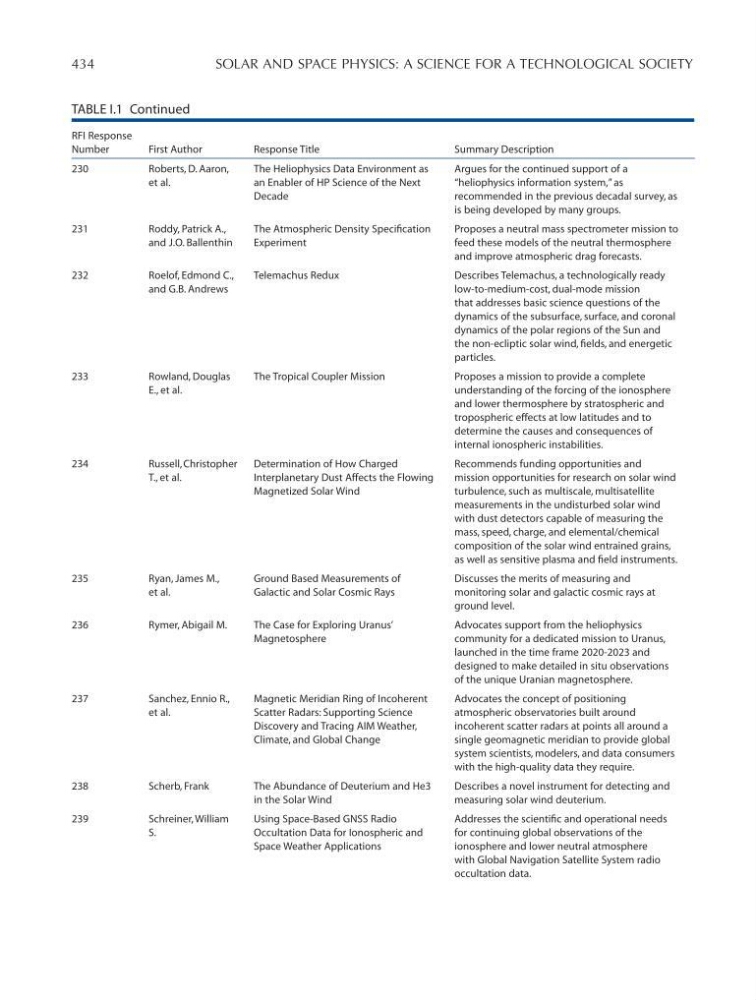
RFI Response
Number
First Author
Response Title
Summary Description
230
Roberts, D. Aaron,
et al.
The Heliophysics Data Environment as
an Enabler of HP Science of the Next
Decade
Argues for the continued support of a
“heliophysics information system,” as
recommended in the previous decadal survey, as
is being developed by many groups.
231
Roddy, Patrick A.,
and J.O. Ballenthin
The Atmospheric Density Specification
Experiment
Proposes a neutral mass spectrometer mission to
feed these models of the neutral thermosphere
and improve atmospheric drag forecasts.
232
Roelof, Edmond C.,
and G.B. Andrews
Telemachus Redux
Describes Telemachus, a technologically ready
low-to-medium-cost, dual-mode mission
that addresses basic science questions of the
dynamics of the subsurface, surface, and coronal
dynamics of the polar regions of the Sun and
the non-ecliptic solar wind, fields, and energetic
particles.
233
Rowland, Douglas
E., et al.
The Tropical Coupler Mission
Proposes a mission to provide a complete
understanding of the forcing of the ionosphere
and lower thermosphere by stratospheric and
tropospheric effects at low latitudes and to
determine the causes and consequences of
internal ionospheric instabilities.
234
Russell, Christopher
T., et al.
Determination of How Charged
Interplanetary Dust Affects the Flowing
Magnetized Solar Wind
Recommends funding opportunities and
mission opportunities for research on solar wind
turbulence, such as multiscale, multisatellite
measurements in the undisturbed solar wind
with dust detectors capable of measuring the
mass, speed, charge, and elemental/chemical
composition of the solar wind entrained grains,
as well as sensitive plasma and field instruments.
235
Ryan, James M.,
et al.
Ground Based Measurements of
Galactic and Solar Cosmic Rays
Discusses the merits of measuring and
monitoring solar and galactic cosmic rays at
ground level.
236
Rymer, Abigail M.
The Case for Exploring Uranus’
Magnetosphere
Advocates support from the heliophysics
community for a dedicated mission to Uranus,
launched in the time frame 2020-2023 and
designed to make detailed in situ observations
of the unique Uranian magnetosphere.
237
Sanchez, Ennio R.,
et al.
Magnetic Meridian Ring of Incoherent
Scatter Radars: Supporting Science
Discovery and Tracing AIM Weather,
Climate, and Global Change
Advocates the concept of positioning
atmospheric observatories built around
incoherent scatter radars at points all around a
single geomagnetic meridian to provide global
system scientists, modelers, and data consumers
with the high-quality data they require.
238
Scherb, Frank
The Abundance of Deuterium and He3
in the Solar Wind
Describes a novel instrument for detecting and
measuring solar wind deuterium.
239
Schreiner, William
S.
Using Space-Based GNSS Radio
Occultation Data for Ionospheric and
Space Weather Applications
Addresses the scientific and operational needs
for continuing global observations of the
ionosphere and lower neutral atmosphere
with Global Navigation Satellite System radio
occultation data.
TABLE I.1 Continued
Solar and Space Physics: A Science for a Technological Society
434
SOLAR AND SPACE PHYSICS: A SCIENCE FOR A TECHNOLOGICAL SOCIETY
RFI Response
Number
First Author
Response Title
Summary Description
230
Roberts, D. Aaron,
et al.
The Heliophysics Data Environment as
an Enabler of HP Science of the Next
Decade
Argues for the continued support of a
“heliophysics information system,” as
recommended in the previous decadal survey, as
is being developed by many groups.
231
Roddy, Patrick A.,
and J.O. Ballenthin
The Atmospheric Density Specification
Experiment
Proposes a neutral mass spectrometer mission to
feed these models of the neutral thermosphere
and improve atmospheric drag forecasts.
232
Roelof, Edmond C.,
and G.B. Andrews
Telemachus Redux
Describes Telemachus, a technologically ready
low-to-medium-cost, dual-mode mission
that addresses basic science questions of the
dynamics of the subsurface, surface, and coronal
dynamics of the polar regions of the Sun and
the non-ecliptic solar wind, fields, and energetic
particles.
233
Rowland, Douglas
E., et al.
The Tropical Coupler Mission
Proposes a mission to provide a complete
understanding of the forcing of the ionosphere
and lower thermosphere by stratospheric and
tropospheric effects at low latitudes and to
determine the causes and consequences of
internal ionospheric instabilities.
234
Russell, Christopher
T., et al.
Determination of How Charged
Interplanetary Dust Affects the Flowing
Magnetized Solar Wind
Recommends funding opportunities and
mission opportunities for research on solar wind
turbulence, such as multiscale, multisatellite
measurements in the undisturbed solar wind
with dust detectors capable of measuring the
mass, speed, charge, and elemental/chemical
composition of the solar wind entrained grains,
as well as sensitive plasma and field instruments.
235
Ryan, James M.,
et al.
Ground Based Measurements of
Galactic and Solar Cosmic Rays
Discusses the merits of measuring and
monitoring solar and galactic cosmic rays at
ground level.
236
Rymer, Abigail M.
The Case for Exploring Uranus’
Magnetosphere
Advocates support from the heliophysics
community for a dedicated mission to Uranus,
launched in the time frame 2020-2023 and
designed to make detailed in situ observations
of the unique Uranian magnetosphere.
237
Sanchez, Ennio R.,
et al.
Magnetic Meridian Ring of Incoherent
Scatter Radars: Supporting Science
Discovery and Tracing AIM Weather,
Climate, and Global Change
Advocates the concept of positioning
atmospheric observatories built around
incoherent scatter radars at points all around a
single geomagnetic meridian to provide global
system scientists, modelers, and data consumers
with the high-quality data they require.
238
Scherb, Frank
The Abundance of Deuterium and He3
in the Solar Wind
Describes a novel instrument for detecting and
measuring solar wind deuterium.
239
Schreiner, William
S.
Using Space-Based GNSS Radio
Occultation Data for Ionospheric and
Space Weather Applications
Addresses the scientific and operational needs
for continuing global observations of the
ionosphere and lower neutral atmosphere
with Global Navigation Satellite System radio
occultation data.
TABLE I.1 Continued