

Copyright © National Academy of Sciences. All rights reserved.
Solar and Space Physics: A Science for a Technological Society
APPENDIX I
433
RFI Response
Number
First Author
Response Title
Summary Description
219
Pfaff, Robert, et al.
Understanding Geospace on a
Grand Scale: The Global Ionosphere/
Thermosphere Constellation
Proposes a Frontier mission consisting of a
constellation of observing platforms that would
sample the ionosphere and thermosphere at
all local times and latitudes and hence provide
a revolutionary advance for understanding
the processes that define this critical region of
geospace.
220
Pfaff, Robert, et al.
Sounding Rockets as Indispensable
Research Platforms for Heliophysics
Research and Development of a High
Altitude Sounding Rocket
Provides an overview of the sounding rocket
program’s capabilities, which are critical for
heliophysics research, and describes the High
Altitude Sounding Rocket initiative.
221
Pilewskie, Peter,
et al.
The Total and Spectral Solar Irradiance
Sensor: Response to the National
Academy of Science Decadal Strategy
for Solar and Space Physics
Recommends continuity of the measurements of
total and spectral solar irradiance from space.
222
Podesta, John, et al. High-resolution, High-accuracy
Plasma, Electric, and Magnetic Field
Measurements for Discovery of Kinetic
Plasma Structures and Processes in the
Evolving Solar Wind
Addresses the need for high-cadence, highaccuracy plasma and field measurements to
diagnose kinetic scale processes in the solar
wind and interplanetary medium.
223
Rast, Mark P., et al.
Next Steps in Solar Spectral Irradiance
Studies
To understand the solar spectral output and its
coupling to climate is a challenge in the next
decade with full-disk radiometric imaging of the
Sun, high-resolution observation and modeling
of globally unresolved dynamics, and coupling
to models of radiative and dynamical processes
at Earth.
224
Reardon, Kevin P.,
et al.
Approaches to Optimize Scientific
Productivity of Ground-based Solar
Telescopes
Explains the value in the broader use of highresolution, ground-based solar observations and
the need for university programs to train young
scientists in the analysis of such data.
225
Rempel, Matthias,
et al.
Modeling of Magnetic Flux Emergence
Across Scales
Summarizes recent progress in modeling flux
emergence from the base of the convection
zone into the solar corona and details the need
for modeling capabilities and large coordinated
teams of investigators that are currently not
supported through available programs.
226
Retterer, John M.
Next Gen IT Modeling Infrastructure for
Space Weather Forecasting
Describes new infrastructure required for
progress in ionosphere/thermosphere modeling,
both for scientific progress and operational
utility.
227
Richardson, John
D., et al.
The Heliospheric Interaction with the
LISM: Observations and Models
Emphasizes the scientific progress to be made
by continuation of the Voyager mission with
appropriate theoretical and modeling support.
228
Rickard, Lee J., et al.
The Long Wavelength Array (LWA): A
Large HF/VHF Array for Solar Physics,
Ionospheric Science, and Solar Radar
Provides a new approach for studying the SunEarth environment from the surface of the Sun
through Earth’s ionosphere.
229
Ridley, Aaron J.,
et al.
A Constellation Mission to Understand
the Thermospheric Reaction to Energy
Input Across Scales
Proposes an ionosphere/thermosphere
constellation mission utilizing micro-satellites
to study the dynamics of the upper atmosphere
after energy input.
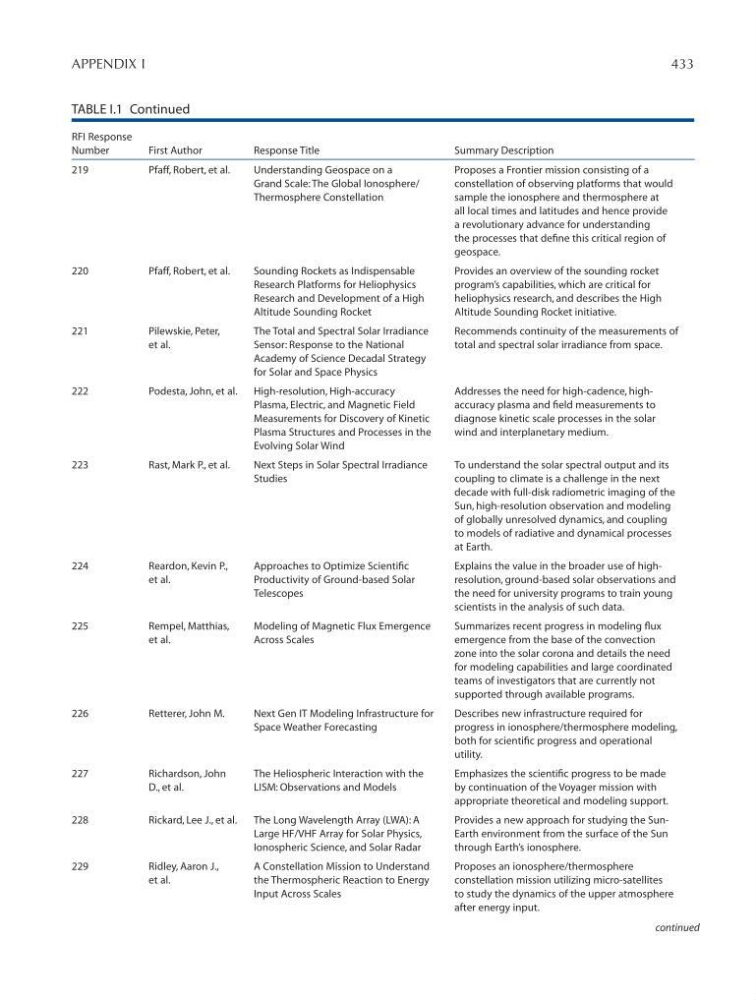
TABLE I.1 Continued
continued
Solar and Space Physics: A Science for a Technological Society
APPENDIX I
433
RFI Response
Number
First Author
Response Title
Summary Description
219
Pfaff, Robert, et al.
Understanding Geospace on a
Grand Scale: The Global Ionosphere/
Thermosphere Constellation
Proposes a Frontier mission consisting of a
constellation of observing platforms that would
sample the ionosphere and thermosphere at
all local times and latitudes and hence provide
a revolutionary advance for understanding
the processes that define this critical region of
geospace.
220
Pfaff, Robert, et al.
Sounding Rockets as Indispensable
Research Platforms for Heliophysics
Research and Development of a High
Altitude Sounding Rocket
Provides an overview of the sounding rocket
program’s capabilities, which are critical for
heliophysics research, and describes the High
Altitude Sounding Rocket initiative.
221
Pilewskie, Peter,
et al.
The Total and Spectral Solar Irradiance
Sensor: Response to the National
Academy of Science Decadal Strategy
for Solar and Space Physics
Recommends continuity of the measurements of
total and spectral solar irradiance from space.
222
Podesta, John, et al. High-resolution, High-accuracy
Plasma, Electric, and Magnetic Field
Measurements for Discovery of Kinetic
Plasma Structures and Processes in the
Evolving Solar Wind
Addresses the need for high-cadence, highaccuracy plasma and field measurements to
diagnose kinetic scale processes in the solar
wind and interplanetary medium.
223
Rast, Mark P., et al.
Next Steps in Solar Spectral Irradiance
Studies
To understand the solar spectral output and its
coupling to climate is a challenge in the next
decade with full-disk radiometric imaging of the
Sun, high-resolution observation and modeling
of globally unresolved dynamics, and coupling
to models of radiative and dynamical processes
at Earth.
224
Reardon, Kevin P.,
et al.
Approaches to Optimize Scientific
Productivity of Ground-based Solar
Telescopes
Explains the value in the broader use of highresolution, ground-based solar observations and
the need for university programs to train young
scientists in the analysis of such data.
225
Rempel, Matthias,
et al.
Modeling of Magnetic Flux Emergence
Across Scales
Summarizes recent progress in modeling flux
emergence from the base of the convection
zone into the solar corona and details the need
for modeling capabilities and large coordinated
teams of investigators that are currently not
supported through available programs.
226
Retterer, John M.
Next Gen IT Modeling Infrastructure for
Space Weather Forecasting
Describes new infrastructure required for
progress in ionosphere/thermosphere modeling,
both for scientific progress and operational
utility.
227
Richardson, John
D., et al.
The Heliospheric Interaction with the
LISM: Observations and Models
Emphasizes the scientific progress to be made
by continuation of the Voyager mission with
appropriate theoretical and modeling support.
228
Rickard, Lee J., et al.
The Long Wavelength Array (LWA): A
Large HF/VHF Array for Solar Physics,
Ionospheric Science, and Solar Radar
Provides a new approach for studying the SunEarth environment from the surface of the Sun
through Earth’s ionosphere.
229
Ridley, Aaron J.,
et al.
A Constellation Mission to Understand
the Thermospheric Reaction to Energy
Input Across Scales
Proposes an ionosphere/thermosphere
constellation mission utilizing micro-satellites
to study the dynamics of the upper atmosphere
after energy input.
TABLE I.1 Continued
continued