

Copyright © National Academy of Sciences. All rights reserved.
Solar and Space Physics: A Science for a Technological Society
430
SOLAR AND SPACE PHYSICS: A SCIENCE FOR A TECHNOLOGICAL SOCIETY
RFI Response
Number
First Author
Response Title
Summary Description
189
McConnell, Mark
L., et al.
X-Ray and Gamma-Ray Polarimetry of
Solar Flares
Reviews the study of polarization at X-ray and
gamma-ray energies for a greater understanding
of particle acceleration in solar flares.
190
McCormack,
John P., and S.
Eckermann
High Altitude Data Assimilation:
Characterizing the Effects of Solar
Variability from the Ground to the
Thermosphere
Proposes a high-altitude data assimilation
system capable of exploiting satellite- and
ground-based observations using state-ofthe-art assimilation techniques to improve
the observational characterization of the
atmospheric response to solar variations.
191
McDonald, Sarah
E., et al.
The Importance of Thermospheric
Winds for Ionospheric Modeling
Presents specific examples where neutral wind
measurements are needed to enable reliable
ionospheric modeling due to variations in the
neutral wind, which drive a complex system
of ionospheric currents and electric fields,
profoundly influencing the structure and
composition of the ionosphere.
192
McHarg, Matthew
G., and D. Knipp
Measuring Energy Inputs and ITM
Response Using a Constellation of Small
Satellites
Proposes a constellation of inexpensive
small satellites to provide measurements for
understanding the fundamental physics that will
enable ionosphere-thermosphere-mesosphere
forecasting.
193
McIntosh, Scott W.,
et al.
The Solar Chromosphere: The Inner
Frontier of the Heliospheric System
Discusses the status of chromospheric physics
and the frontiers that are opening up following
recent observational discoveries.
194
McIntosh, Scott W.,
et al.
ChroMag: The Community Synoptic
Chromospheric Magnetograph
Proposes a chromospheric magnetometry
mission to provide a comprehensive, synoptic
spectro-polarimetric observational data set from
spectral lines formed at multiple “heights” of the
chromosphere and the very base of the corona.
195
McNutt, Ralph L.,
Jr., et al.
Interstellar Probe
Proposes an interstellar probe that can be
launched during the coming decade.
196
Merkin, Viacheslav
G., et al.
Synergy Between Large Data Sets, FirstPrinciples and Empirical Models of the
Magnetosphere
Advocates for the need of support for
programs that build on synergy between
currently available and future large data sets of
ionospheric and magnetospheric measurements
and physics-based models of the ionospherethermosphere-magnetosphere system.
197
Mertens,
Christopher J., et al.
Nowcast of Atmospheric Ionizing
Radiation for Aviation Safety
Describes the Nowcast of Atmospheric Ionizing
Radiation for Aviation Safety, a prototype
operational model for predicting commercial
aircraft radiation exposure from galactic and
solar cosmic rays.
198
Mertens,
Christopher J., et al.
Ionospheric E-Region Chemistry and
Energetics
Proposes an Earth-observing, multisatellite
science mission to explore the last remaining
frontier in upper atmospheric research—the
ionospheric E-region.
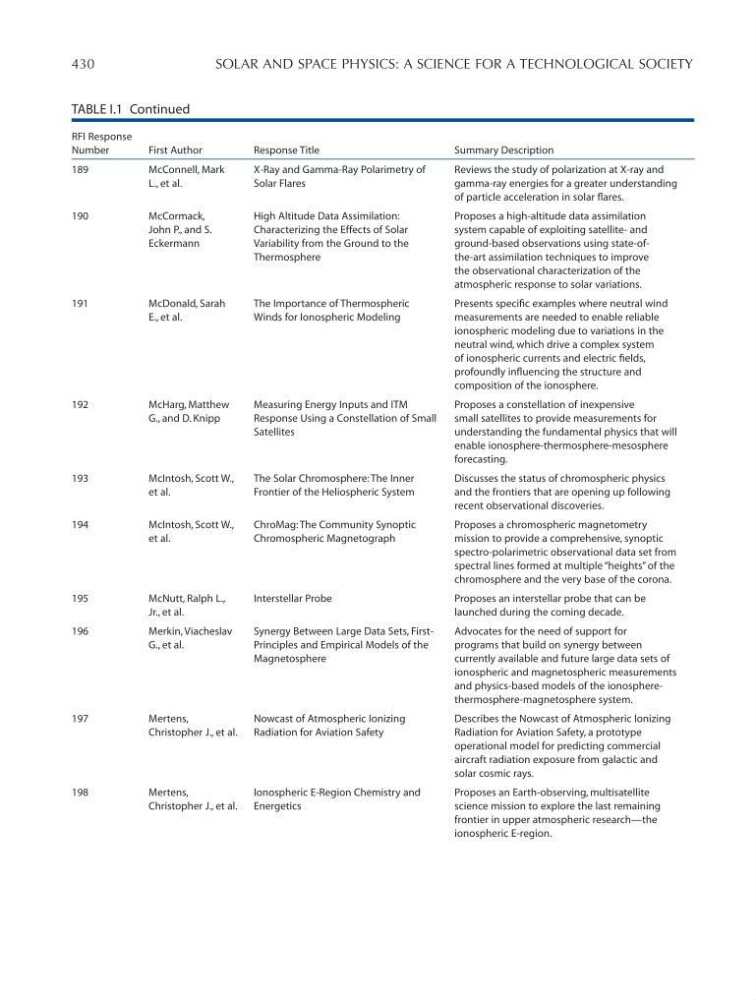
TABLE I.1 Continued
Solar and Space Physics: A Science for a Technological Society
430
SOLAR AND SPACE PHYSICS: A SCIENCE FOR A TECHNOLOGICAL SOCIETY
RFI Response
Number
First Author
Response Title
Summary Description
189
McConnell, Mark
L., et al.
X-Ray and Gamma-Ray Polarimetry of
Solar Flares
Reviews the study of polarization at X-ray and
gamma-ray energies for a greater understanding
of particle acceleration in solar flares.
190
McCormack,
John P., and S.
Eckermann
High Altitude Data Assimilation:
Characterizing the Effects of Solar
Variability from the Ground to the
Thermosphere
Proposes a high-altitude data assimilation
system capable of exploiting satellite- and
ground-based observations using state-ofthe-art assimilation techniques to improve
the observational characterization of the
atmospheric response to solar variations.
191
McDonald, Sarah
E., et al.
The Importance of Thermospheric
Winds for Ionospheric Modeling
Presents specific examples where neutral wind
measurements are needed to enable reliable
ionospheric modeling due to variations in the
neutral wind, which drive a complex system
of ionospheric currents and electric fields,
profoundly influencing the structure and
composition of the ionosphere.
192
McHarg, Matthew
G., and D. Knipp
Measuring Energy Inputs and ITM
Response Using a Constellation of Small
Satellites
Proposes a constellation of inexpensive
small satellites to provide measurements for
understanding the fundamental physics that will
enable ionosphere-thermosphere-mesosphere
forecasting.
193
McIntosh, Scott W.,
et al.
The Solar Chromosphere: The Inner
Frontier of the Heliospheric System
Discusses the status of chromospheric physics
and the frontiers that are opening up following
recent observational discoveries.
194
McIntosh, Scott W.,
et al.
ChroMag: The Community Synoptic
Chromospheric Magnetograph
Proposes a chromospheric magnetometry
mission to provide a comprehensive, synoptic
spectro-polarimetric observational data set from
spectral lines formed at multiple “heights” of the
chromosphere and the very base of the corona.
195
McNutt, Ralph L.,
Jr., et al.
Interstellar Probe
Proposes an interstellar probe that can be
launched during the coming decade.
196
Merkin, Viacheslav
G., et al.
Synergy Between Large Data Sets, FirstPrinciples and Empirical Models of the
Magnetosphere
Advocates for the need of support for
programs that build on synergy between
currently available and future large data sets of
ionospheric and magnetospheric measurements
and physics-based models of the ionospherethermosphere-magnetosphere system.
197
Mertens,
Christopher J., et al.
Nowcast of Atmospheric Ionizing
Radiation for Aviation Safety
Describes the Nowcast of Atmospheric Ionizing
Radiation for Aviation Safety, a prototype
operational model for predicting commercial
aircraft radiation exposure from galactic and
solar cosmic rays.
198
Mertens,
Christopher J., et al.
Ionospheric E-Region Chemistry and
Energetics
Proposes an Earth-observing, multisatellite
science mission to explore the last remaining
frontier in upper atmospheric research—the
ionospheric E-region.
TABLE I.1 Continued