

Copyright © National Academy of Sciences. All rights reserved.
Solar and Space Physics: A Science for a Technological Society
APPENDIX I
431
RFI Response
Number
First Author
Response Title
Summary Description
199
Miesch, Mark S.,
et al.
The Importance of Polar Observations
in Understanding the Solar Dynamo
Supports an out-of-ecliptic heliophysics mission
that focuses on observations of the magnetic
structure, dynamics, and solar-cycle evolution
of the polar regions of the Sun that will provide
data of critical importance for understanding the
solar dynamo mechanism and the cyclic nature
of solar activity.
200
Millan, Robyn M.,
et al.
NASA’s Balloon Program: Providing
World-Class Science, Technology
Development, and Vital Training of the
Next Generation of Space Physicists
Summarizes examples of balloon-based science
accomplishments and future opportunities and
advocates continued support of the Ultra Long
Duration Balloon Program, increased support
for small and mid-sized payloads and balloon
flotillas, and appropriately scaled funding for
development of new experiments.
201
Miller, Ethan S.
Initiation of Irregularities in the
Equatorial F-Region Ionosphere
Explores several theories and a variety of
space- and ground-based measurements that
will be useful to test theories on the initiation
of irregularities in the equatorial F region
ionosphere.
202
Mitchell, Donald
G., et al.
Geospace Magnetosphere-IonosphereNeutral Interaction (GEMINI)
Describes GEMINI, which uses two identical
spacecraft in an 8 R E circular polar orbit for
global, continuous imaging of the ring current,
plasma sphere, atmospheric ultraviolet, and
auroral emissions.
203
Mitchell, Elizabeth
J.
Center for Magnetosphere and
Ionosphere Decoupling Investigations
Outlines an initiative to correct the erroneous
assumption of polar cap symmetry in ring
current and radiation belt models.
204
Mlynczak, Martin
G., et al.
Spectral Signatures of Geospace
Climate Change
Proposes continued measurement of infrared
spectral signatures of the energy balance of the
geospace environment in order to identify and
attribute causes and consequences of geospace
climate change.
205
Moebius, Eberhard,
et al.
NASA’s Explorer Program as a Vital
Element to Further Heliophysics
Research
Details the importance of Explorers to a mix
of large and small mission opportunities for
heliophysics in maintaining innovative research
and a diverse infrastructure and in training the
future workforce.
206
Moore, Thomas E.,
et al.
Mechanisms of Energetic Mass Ejection
(MEME)
Proposes MEME to achieve the overarching
objective of the 2009 Heliophysics Roadmap:
Origins of Near Earth Plasmas—to understand
the transport of terrestrial gas and plasma from
its atmospheric source into the Magnetosphere
and downstream Solar Wind.
207
Moore, Thomas E.
Laboratory for Active Space Experiment
Research (LASER) Program
Presents a case for the resumption of active
space experimentation in heliophysics.
208
Moses, J.D.
Magnetic Properties of the Solar
Atmosphere (SolmeX Cosmic Vision
Mission)
Summarizes the Solar Magnetism Explorer
(SolmeX) mission proposal being submitted to
the 2010 ESA Cosmic Vision call, which proposes
to overcome the observational gap in the
measurements of the coronal magnetic field.
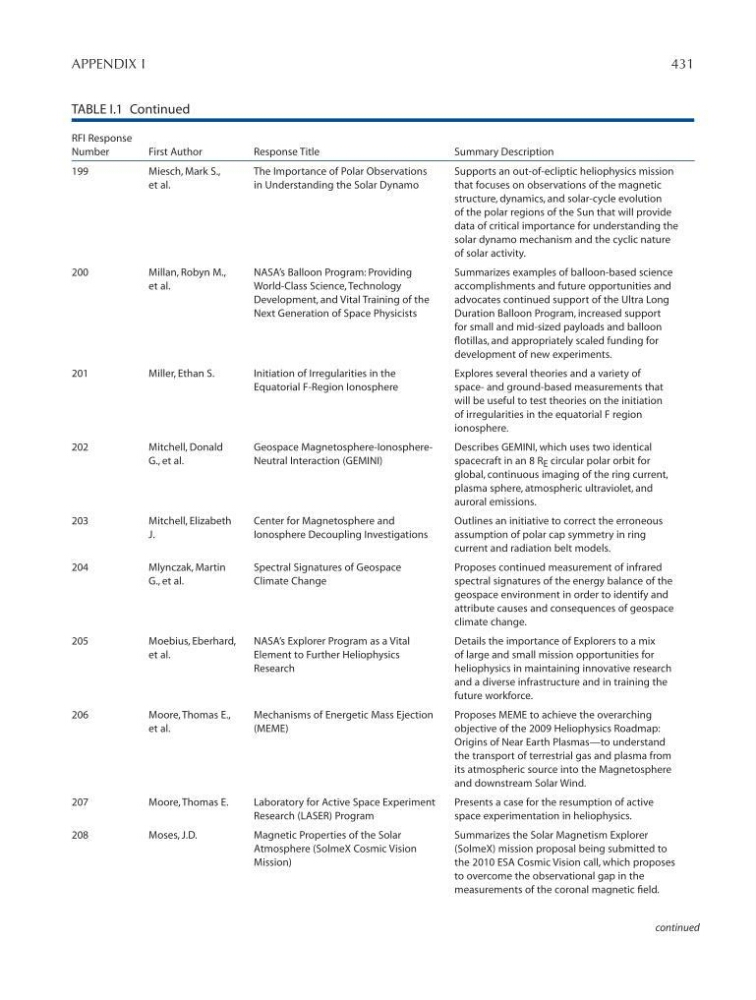
TABLE I.1 Continued
continued
Solar and Space Physics: A Science for a Technological Society
APPENDIX I
431
RFI Response
Number
First Author
Response Title
Summary Description
199
Miesch, Mark S.,
et al.
The Importance of Polar Observations
in Understanding the Solar Dynamo
Supports an out-of-ecliptic heliophysics mission
that focuses on observations of the magnetic
structure, dynamics, and solar-cycle evolution
of the polar regions of the Sun that will provide
data of critical importance for understanding the
solar dynamo mechanism and the cyclic nature
of solar activity.
200
Millan, Robyn M.,
et al.
NASA’s Balloon Program: Providing
World-Class Science, Technology
Development, and Vital Training of the
Next Generation of Space Physicists
Summarizes examples of balloon-based science
accomplishments and future opportunities and
advocates continued support of the Ultra Long
Duration Balloon Program, increased support
for small and mid-sized payloads and balloon
flotillas, and appropriately scaled funding for
development of new experiments.
201
Miller, Ethan S.
Initiation of Irregularities in the
Equatorial F-Region Ionosphere
Explores several theories and a variety of
space- and ground-based measurements that
will be useful to test theories on the initiation
of irregularities in the equatorial F region
ionosphere.
202
Mitchell, Donald
G., et al.
Geospace Magnetosphere-IonosphereNeutral Interaction (GEMINI)
Describes GEMINI, which uses two identical
spacecraft in an 8 R E circular polar orbit for
global, continuous imaging of the ring current,
plasma sphere, atmospheric ultraviolet, and
auroral emissions.
203
Mitchell, Elizabeth
J.
Center for Magnetosphere and
Ionosphere Decoupling Investigations
Outlines an initiative to correct the erroneous
assumption of polar cap symmetry in ring
current and radiation belt models.
204
Mlynczak, Martin
G., et al.
Spectral Signatures of Geospace
Climate Change
Proposes continued measurement of infrared
spectral signatures of the energy balance of the
geospace environment in order to identify and
attribute causes and consequences of geospace
climate change.
205
Moebius, Eberhard,
et al.
NASA’s Explorer Program as a Vital
Element to Further Heliophysics
Research
Details the importance of Explorers to a mix
of large and small mission opportunities for
heliophysics in maintaining innovative research
and a diverse infrastructure and in training the
future workforce.
206
Moore, Thomas E.,
et al.
Mechanisms of Energetic Mass Ejection
(MEME)
Proposes MEME to achieve the overarching
objective of the 2009 Heliophysics Roadmap:
Origins of Near Earth Plasmas—to understand
the transport of terrestrial gas and plasma from
its atmospheric source into the Magnetosphere
and downstream Solar Wind.
207
Moore, Thomas E.
Laboratory for Active Space Experiment
Research (LASER) Program
Presents a case for the resumption of active
space experimentation in heliophysics.
208
Moses, J.D.
Magnetic Properties of the Solar
Atmosphere (SolmeX Cosmic Vision
Mission)
Summarizes the Solar Magnetism Explorer
(SolmeX) mission proposal being submitted to
the 2010 ESA Cosmic Vision call, which proposes
to overcome the observational gap in the
measurements of the coronal magnetic field.
TABLE I.1 Continued
continued