

Copyright © National Academy of Sciences. All rights reserved.
Solar and Space Physics: A Science for a Technological Society
APPENDIX I
429
RFI Response
Number
First Author
Response Title
Summary Description
176
Mannucci, Anthony
J., et al.
GNSS Geospace Constellation (GGC):
A CubeSat Space Weather Mission
Concept
Recommends technology investment in
miniaturized GPS receivers that can be deployed
on CubeSats for ionospheric remote sensing.
177
Mannucci, Anthony
J., et al.
Estimating the Forces That Drive
Ionosphere and Thermosphere
Variability: Continuous Data and
Assimilative Modeling
Advocates for developing a model-based
approach to retrieving the driving forces from
measurements of electron density structure and
dynamics.
178
Marshall, Robert A.
Ionospheric Forcing from Below: Effects
of Lightning
Demonstrates that extension of single-discharge
studies to global effects are required to quantify
the coupling in ionosphere forcing.
179
Marshall, Robert A.
Ground-based Space Weather
Instrument Suites
Proposes that the geoscience community foster
a class of instrumentation that involves multiinstrument, ground-based suites similar to
satellite instrumentation.
180
Martinis, Carlos
Neutral Winds in the Upper Atmosphere
Discusses the need to measure neutral winds
in the upper atmosphere in a global spatial and
temporal scale to understand many processes
involving electro-dynamics and ion-neutral
coupling.
181
Matthaeus, William
H., et al.
Turbulence and Nonlinear Dynamics
and Its Many Effects in Solar and
Heliospheric Physics
Calls attention to the broad implications of
nonlinearity and turbulence within the complex,
coupled solar and heliospheric system.
182
Mauel, Michael E.,
et al.
Development and Validation of Space
Weather Models Using Laboratory
Dipole Experiments
Describes the value of laboratory dipole
experiments to develop and validate space
weather models of magnetospheric dynamics.
183
Mazur, Joseph E.
Ultra-Heavy Nuclei in Solar Flare: The
Rarest Elements in the Sun
Discusses the measurement of ultraheavy energetic particles to understand
nucleosynthesis and further processing of
matter in flare acceleration, interplanetary
acceleration, and transport.
184
Mazur, Joseph E.
Low-Impact Space Environment Sensors
Required on Every NASA Space Vehicle
Recommends that space vehicles be required
to include low-impact sensors and that the data
be collected and synthesized in a centralized
repository.
185
Mazur, Joseph E.
Need to Measure Solar Energetic
Particle Ionization States from ~1 to
Above 100 MeV/nucleon
Proposes one or more charged particle sensors
in low-Earth polar orbit to infer the ionization
state using the geomagnetic cutoff technique.
186
Mazur, Joseph E.
Unintended Effects of Increasing
Reliance on Science Requirements
Details the unintended consequences of the
practice of tracking NASA science missions with
project management systems that establish and
monitor requirements for science.
187
Mazur, Joseph E.
Unexploited Heliophysics Data Sets
Explains the value of the particle and plasma
data sets collected from highly inclined and
low-Earth-orbit research into the sources
and dynamics of the near-Earth trapped and
precipitating particle environments.
188
McComas, David
J., et al.
Interstellar Mapping Probe (IMAP)
Mission Concept: Illuminating the Dark
Boundaries at the Edge of Our Solar
System
Proposes the IMAP mission concept for
the discovery of the detailed processes of
the heliosphere/local interstellar medium
interaction.
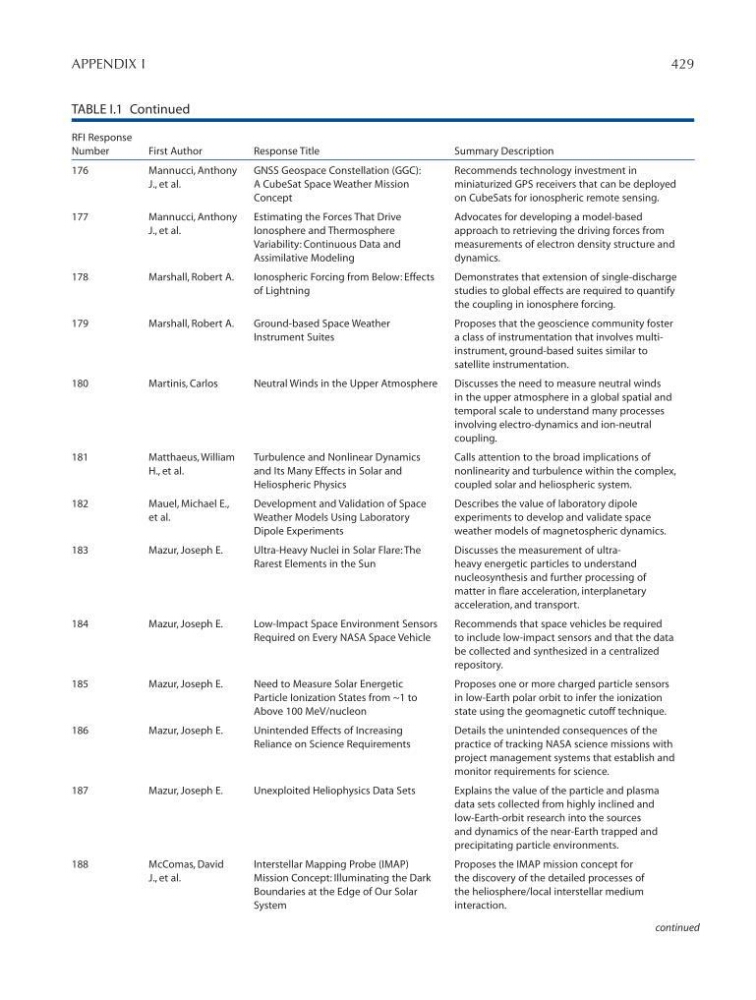
TABLE I.1 Continued
continued
Solar and Space Physics: A Science for a Technological Society
APPENDIX I
429
RFI Response
Number
First Author
Response Title
Summary Description
176
Mannucci, Anthony
J., et al.
GNSS Geospace Constellation (GGC):
A CubeSat Space Weather Mission
Concept
Recommends technology investment in
miniaturized GPS receivers that can be deployed
on CubeSats for ionospheric remote sensing.
177
Mannucci, Anthony
J., et al.
Estimating the Forces That Drive
Ionosphere and Thermosphere
Variability: Continuous Data and
Assimilative Modeling
Advocates for developing a model-based
approach to retrieving the driving forces from
measurements of electron density structure and
dynamics.
178
Marshall, Robert A.
Ionospheric Forcing from Below: Effects
of Lightning
Demonstrates that extension of single-discharge
studies to global effects are required to quantify
the coupling in ionosphere forcing.
179
Marshall, Robert A.
Ground-based Space Weather
Instrument Suites
Proposes that the geoscience community foster
a class of instrumentation that involves multiinstrument, ground-based suites similar to
satellite instrumentation.
180
Martinis, Carlos
Neutral Winds in the Upper Atmosphere
Discusses the need to measure neutral winds
in the upper atmosphere in a global spatial and
temporal scale to understand many processes
involving electro-dynamics and ion-neutral
coupling.
181
Matthaeus, William
H., et al.
Turbulence and Nonlinear Dynamics
and Its Many Effects in Solar and
Heliospheric Physics
Calls attention to the broad implications of
nonlinearity and turbulence within the complex,
coupled solar and heliospheric system.
182
Mauel, Michael E.,
et al.
Development and Validation of Space
Weather Models Using Laboratory
Dipole Experiments
Describes the value of laboratory dipole
experiments to develop and validate space
weather models of magnetospheric dynamics.
183
Mazur, Joseph E.
Ultra-Heavy Nuclei in Solar Flare: The
Rarest Elements in the Sun
Discusses the measurement of ultraheavy energetic particles to understand
nucleosynthesis and further processing of
matter in flare acceleration, interplanetary
acceleration, and transport.
184
Mazur, Joseph E.
Low-Impact Space Environment Sensors
Required on Every NASA Space Vehicle
Recommends that space vehicles be required
to include low-impact sensors and that the data
be collected and synthesized in a centralized
repository.
185
Mazur, Joseph E.
Need to Measure Solar Energetic
Particle Ionization States from ~1 to
Above 100 MeV/nucleon
Proposes one or more charged particle sensors
in low-Earth polar orbit to infer the ionization
state using the geomagnetic cutoff technique.
186
Mazur, Joseph E.
Unintended Effects of Increasing
Reliance on Science Requirements
Details the unintended consequences of the
practice of tracking NASA science missions with
project management systems that establish and
monitor requirements for science.
187
Mazur, Joseph E.
Unexploited Heliophysics Data Sets
Explains the value of the particle and plasma
data sets collected from highly inclined and
low-Earth-orbit research into the sources
and dynamics of the near-Earth trapped and
precipitating particle environments.
188
McComas, David
J., et al.
Interstellar Mapping Probe (IMAP)
Mission Concept: Illuminating the Dark
Boundaries at the Edge of Our Solar
System
Proposes the IMAP mission concept for
the discovery of the detailed processes of
the heliosphere/local interstellar medium
interaction.
TABLE I.1 Continued
continued