

Copyright © National Academy of Sciences. All rights reserved.
Solar and Space Physics: A Science for a Technological Society
428
SOLAR AND SPACE PHYSICS: A SCIENCE FOR A TECHNOLOGICAL SOCIETY
RFI Response
Number
First Author
Response Title
Summary Description
165
Love, Jeffrey J.
Long- term Coordinated Ground and
Satellite Monitoring of the Ring Current
Proposes improved, long-term, low-latitude
ground- and space-based magnetometer
monitoring for at least an entire solar cycle.
166
Luhmann, Janet G.,
et al.
Guest Investigator and Participating
Scientist Programs
Expresses that Guest Investigator and
Participating Scientist programs and mission
modeling and theory teams provide major
enhancements to the science potential of NASA’s
missions.
167
Luhmann, Janet G.,
et al.
Extended Missions: Engines of
Heliophysics System Science
Summarizes arguments for supporting the
Heliophysics Systems Observatory, the engine of
heliospheric systems science.
168
Lyons, Larry R.
Conceptual Framework for Space
Weather Dynamics: An Interplay
of Large and Mesoscale Structure
within the Nightside MagnetosphereIonosphere-Thermosphere System
Describes a concept to allow for unprecedented
comprehensive interdisciplinary study of
the coupled magnetosphere-ionospherethermosphere system with new facilities and
model development and to coordinate the
use of these capabilities for transformational
understanding of structure, dynamics, and
disturbances.
169
Lystrup, Makenzie,
et al.
A Multi-Spacecraft Jupiter Space Plasma
Explorer
Proposes a multi-spacecraft Jupiter explorer
mission to measure the jovispace plasma
environment in key locations simultaneously—
within and without the magnetosphere, in the
plasma disc, in boundary regions, in the dawn
and dusk flanks—all while monitoring solar wind
and auroral energy output.
170
Mabie, Justin J.
A Comprehensive and Continuous
Record of Ground Based Space Weather
Observations
Recommends steps to modernize a
comprehensive climatology of ground-based
space weather observations collected from
magnetometers, ionosondes, and other methods.
171
MacDonald,
Elizabeth A., et al.
A Science Mission Concept to Actively
Probe Magnetosphere-Ionosphere
Coupling
Describes how directly mapping magnetic
field lines from a magnetospheric satellite
to their ionospheric footpoints using an
on-board electron emitter and groundimaging techniques can answer long-standing
fundamental questions of magnetosphereionosphere coupling.
172
MacDowall, Robert
J., et al.
A Radio Observatory on the Lunar
Surface for Solar Studies (ROLSS)
Proposes an observatory to image solar radio
bursts at frequencies <10 MHz with a lunarbased radio telescope.
173
Makela, Jonathan
J., et al.
A North American Thermosphere
Ionosphere Observation Network
Recommends a network of ground-based multiinstrument sites to understand fundamental
spatio-temporal processes in Earth’s ionosphere/
thermosphere/mesosphere system.
174
Mannucci, Anthony
J.
Global Ionospheric Storms
Discusses global ionospheric storms as an
important subfield of study within solar and
space physics.
175
Mannucci, Anthony
J.
Research to Operations: Continuous
Improvement
Suggests a path forward that, over time, will lead
to steadily improving operational capabilities in
space weather.
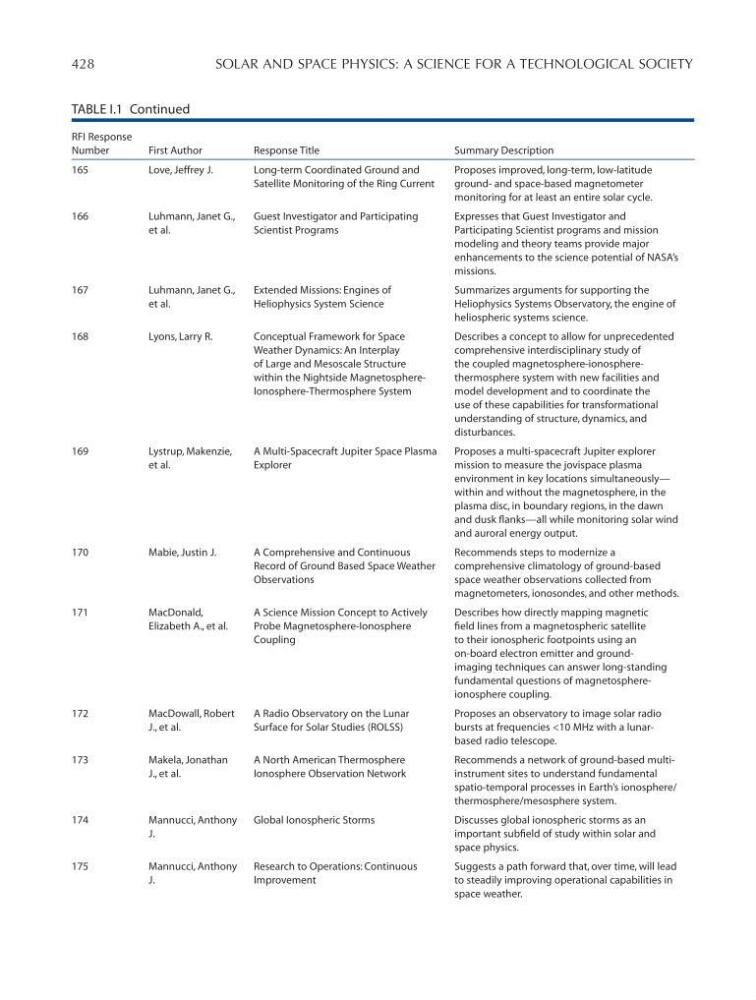
TABLE I.1 Continued
Solar and Space Physics: A Science for a Technological Society
428
SOLAR AND SPACE PHYSICS: A SCIENCE FOR A TECHNOLOGICAL SOCIETY
RFI Response
Number
First Author
Response Title
Summary Description
165
Love, Jeffrey J.
Long- term Coordinated Ground and
Satellite Monitoring of the Ring Current
Proposes improved, long-term, low-latitude
ground- and space-based magnetometer
monitoring for at least an entire solar cycle.
166
Luhmann, Janet G.,
et al.
Guest Investigator and Participating
Scientist Programs
Expresses that Guest Investigator and
Participating Scientist programs and mission
modeling and theory teams provide major
enhancements to the science potential of NASA’s
missions.
167
Luhmann, Janet G.,
et al.
Extended Missions: Engines of
Heliophysics System Science
Summarizes arguments for supporting the
Heliophysics Systems Observatory, the engine of
heliospheric systems science.
168
Lyons, Larry R.
Conceptual Framework for Space
Weather Dynamics: An Interplay
of Large and Mesoscale Structure
within the Nightside MagnetosphereIonosphere-Thermosphere System
Describes a concept to allow for unprecedented
comprehensive interdisciplinary study of
the coupled magnetosphere-ionospherethermosphere system with new facilities and
model development and to coordinate the
use of these capabilities for transformational
understanding of structure, dynamics, and
disturbances.
169
Lystrup, Makenzie,
et al.
A Multi-Spacecraft Jupiter Space Plasma
Explorer
Proposes a multi-spacecraft Jupiter explorer
mission to measure the jovispace plasma
environment in key locations simultaneously—
within and without the magnetosphere, in the
plasma disc, in boundary regions, in the dawn
and dusk flanks—all while monitoring solar wind
and auroral energy output.
170
Mabie, Justin J.
A Comprehensive and Continuous
Record of Ground Based Space Weather
Observations
Recommends steps to modernize a
comprehensive climatology of ground-based
space weather observations collected from
magnetometers, ionosondes, and other methods.
171
MacDonald,
Elizabeth A., et al.
A Science Mission Concept to Actively
Probe Magnetosphere-Ionosphere
Coupling
Describes how directly mapping magnetic
field lines from a magnetospheric satellite
to their ionospheric footpoints using an
on-board electron emitter and groundimaging techniques can answer long-standing
fundamental questions of magnetosphereionosphere coupling.
172
MacDowall, Robert
J., et al.
A Radio Observatory on the Lunar
Surface for Solar Studies (ROLSS)
Proposes an observatory to image solar radio
bursts at frequencies <10 MHz with a lunarbased radio telescope.
173
Makela, Jonathan
J., et al.
A North American Thermosphere
Ionosphere Observation Network
Recommends a network of ground-based multiinstrument sites to understand fundamental
spatio-temporal processes in Earth’s ionosphere/
thermosphere/mesosphere system.
174
Mannucci, Anthony
J.
Global Ionospheric Storms
Discusses global ionospheric storms as an
important subfield of study within solar and
space physics.
175
Mannucci, Anthony
J.
Research to Operations: Continuous
Improvement
Suggests a path forward that, over time, will lead
to steadily improving operational capabilities in
space weather.
TABLE I.1 Continued