

Copyright © National Academy of Sciences. All rights reserved.
Solar and Space Physics: A Science for a Technological Society
APPENDIX I
427
RFI Response
Number
First Author
Response Title
Summary Description
153
Lewis, Laurel M.
The Determination of the Effects of
Major Impacts on Global Geophysical
and Geological Parameters
Proposes the study of global geologic and
geophysical parameters in response to solar/
galactic fields in order to better understand the
past influence impact has had on Earth history
as well as to better determine the probability of
future events.
154
Li, Gang, et al.
A “Swarm” Mission to Study Particle
Acceleration at Interplanetary Shocks
Proposes a mission to study particle acceleration
at interplanetary shocks via a swarm of
spacecraft.
155
Li, Xinlin, et al.
Energetic Particles from a Highly
Inclined Constellation (EPIC)
Addresses solar flares and solar energetic
particles reaching at Earth, the loss rate of
Earth’s radiation belt electrons, and the effect
of these energetic particles on the chemistry
and dynamics of Earth’s middle and upper
atmosphere.
156
Liewer, Paulett C.,
et al.
Solar Polar Imager: Observing Solar
Activity from a New Perspective
Proposes a mission to target the unexplored
polar regions by enabling crucial observations
not possible from lower latitudes with a 0.48-AU
orbit with an inclination of 75º and a solar sail.
157
Lin, Chin S., and F.A.
Marcos
Predict Neutral Density
Proposes research to improve predictions of
satellite drag with physics-based atmospheric
density models.
158
Lin, Chin S., and F.A.
Marcos
Research-to-Operation of Predicting
Neutral Density
Proposes research to use physics-based
atmospheric density models to improve
research-to-operation of predicting satellite.
159
Lin, Chin S., and F.A.
Marcos
CubeSat Orbital Drag Experiment
Proposes an experiment to exploit the CubeSat
opportunity, which provides the unprecedented
capability of long-term, routine, high-accuracy
measurements of thermospheric variability by
accelerometers.
160
Lin, Robert P., et al.
Expansion of the Heliophysics Explorer
Program
Points out that Heliophysics Explorer missions
have the best success record in all respects of
any space missions.
161
Lin, Robert P., et al.
The Multi-Spacecraft Inner Heliosphere
Explorer (HELIX)
Proposes a five-spacecraft mission to study
large-scale solar transients in the inner
heliosphere and their acceleration of particles to
high energies.
162
Lin, Robert P., et al.
Solar Eruptive Events (SEE) 2020 Mission
Concept
Proposes a complement of advanced new
instruments that focus on the coronal energy
release and particle acceleration sites of major
solar eruptive events.
163
Lind, Frank D.
Next Generation Space Science with the
Geospace Array
Addresses science topics from the lower
atmosphere through the ionosphere and
heliosphere and to the surface of the Sun and
beyond with a globally deployed geospace array.
164
Livi, Stefano A.,
et al.
Solar Wind Ion Composition
Measurements
Proposes an instrument to establish physical
links between the outward transport of solar
energy and the solar wind by providing direct
measurements of solar eruption products in
coronal mass ejections.
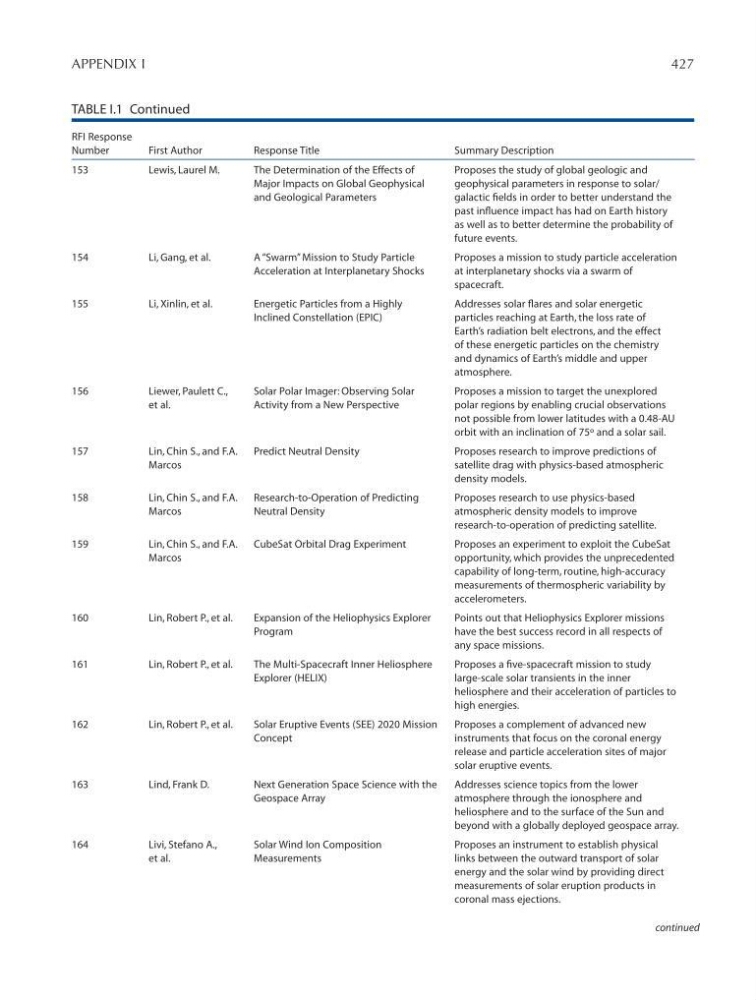
TABLE I.1 Continued
continued
Solar and Space Physics: A Science for a Technological Society
APPENDIX I
427
RFI Response
Number
First Author
Response Title
Summary Description
153
Lewis, Laurel M.
The Determination of the Effects of
Major Impacts on Global Geophysical
and Geological Parameters
Proposes the study of global geologic and
geophysical parameters in response to solar/
galactic fields in order to better understand the
past influence impact has had on Earth history
as well as to better determine the probability of
future events.
154
Li, Gang, et al.
A “Swarm” Mission to Study Particle
Acceleration at Interplanetary Shocks
Proposes a mission to study particle acceleration
at interplanetary shocks via a swarm of
spacecraft.
155
Li, Xinlin, et al.
Energetic Particles from a Highly
Inclined Constellation (EPIC)
Addresses solar flares and solar energetic
particles reaching at Earth, the loss rate of
Earth’s radiation belt electrons, and the effect
of these energetic particles on the chemistry
and dynamics of Earth’s middle and upper
atmosphere.
156
Liewer, Paulett C.,
et al.
Solar Polar Imager: Observing Solar
Activity from a New Perspective
Proposes a mission to target the unexplored
polar regions by enabling crucial observations
not possible from lower latitudes with a 0.48-AU
orbit with an inclination of 75º and a solar sail.
157
Lin, Chin S., and F.A.
Marcos
Predict Neutral Density
Proposes research to improve predictions of
satellite drag with physics-based atmospheric
density models.
158
Lin, Chin S., and F.A.
Marcos
Research-to-Operation of Predicting
Neutral Density
Proposes research to use physics-based
atmospheric density models to improve
research-to-operation of predicting satellite.
159
Lin, Chin S., and F.A.
Marcos
CubeSat Orbital Drag Experiment
Proposes an experiment to exploit the CubeSat
opportunity, which provides the unprecedented
capability of long-term, routine, high-accuracy
measurements of thermospheric variability by
accelerometers.
160
Lin, Robert P., et al.
Expansion of the Heliophysics Explorer
Program
Points out that Heliophysics Explorer missions
have the best success record in all respects of
any space missions.
161
Lin, Robert P., et al.
The Multi-Spacecraft Inner Heliosphere
Explorer (HELIX)
Proposes a five-spacecraft mission to study
large-scale solar transients in the inner
heliosphere and their acceleration of particles to
high energies.
162
Lin, Robert P., et al.
Solar Eruptive Events (SEE) 2020 Mission
Concept
Proposes a complement of advanced new
instruments that focus on the coronal energy
release and particle acceleration sites of major
solar eruptive events.
163
Lind, Frank D.
Next Generation Space Science with the
Geospace Array
Addresses science topics from the lower
atmosphere through the ionosphere and
heliosphere and to the surface of the Sun and
beyond with a globally deployed geospace array.
164
Livi, Stefano A.,
et al.
Solar Wind Ion Composition
Measurements
Proposes an instrument to establish physical
links between the outward transport of solar
energy and the solar wind by providing direct
measurements of solar eruption products in
coronal mass ejections.
TABLE I.1 Continued
continued