

Copyright © National Academy of Sciences. All rights reserved.
Solar and Space Physics: A Science for a Technological Society
426
SOLAR AND SPACE PHYSICS: A SCIENCE FOR A TECHNOLOGICAL SOCIETY
RFI Response
Number
First Author
Response Title
Summary Description
143
Kucharek, Harald,
et al.
Multi-Scale Investigations of
Fundamental Physical Processes
Proposes research to understand the role of
coupling between different scales in particle
acceleration, energy dissipation, and plasma
transport in shocks, reconnection, and
turbulence.
144
Laming, J. Martin,
et al.
Science Objectives for an X-Ray
Microcalorimeter Observing the Sun
Presents the science case for a broadband X-ray
imager with high-resolution spectroscopy,
including simulations of X-ray spectral
diagnostics of both active regions and solar
flares.
145
Laming, J. Martin,
et al.
Understanding the Coronal Abundance
Anomalies of the Sun
Emphasizes the importance of the first
ionization potential abundance anomaly in
regions of the solar corona and wind, especially
for the insight it provides into wave-particle
interactions in the solar atmosphere and how
these might inform models of coronal heating.
146
Larsen, Miguel F.,
and G. Lemacher
Diffusion and Transport Near the
Turbopause
Addresses the poorly understood turbulent
diffusion and transport processes in the lower
thermosphere and the need for more extensive
in situ observations of the neutral dynamics in
the region.
147
Lawrence, David
J., et al.
Using Solar Neutrons to Understand
Solar Acceleration Processes
Explains the need for robust neutron
measurements in concert with coordinated
observations of gamma rays, energetic ions, and
electrons, extreme ultraviolet, and radio waves to
fully understand solar acceleration mechanisms.
148
Lazio, Joseph, et al.
Magnetospheric Emission from
Extrasolar Planets
Describes the effort needed to detect and use
magnetospheric emissions from extrasolar
planets to help with understanding the nature
of planets and magnetospheres.
149
Lehmacher, Gerald
Small-Scale Neutral-Ion Coupling in the
Mesosphere
Addresses the fundamental science questions,
What governs the coupling of neutral and
ionized species in the mesosphere? and
What is responsible for the variability of the
ionization layers in the mesosphere?, and urges
mesospheric investigations for the revitalization
of the sounding rocket program.
150
Lemon, Colby L.,
et al.
The Importance of Ion Composition
and Charge State Measurements for
Magnetospheric Physics
Advocates for more ion composition instruments
in the magnetosphere on future missions in
order to resolve outstanding questions in
magnetospheric physics.
151
Lepri, Susan T., et al. Solar Wind and Suprathermal Ion
Composition Measurements: An
Essential Element of Current and Future
Space Missions
Discusses the vital role of solar wind and
suprathermal composition measurements in
resolving major outstanding science questions
regarding reconnection, particle acceleration,
and improving space weather predictions.
152
Lessard, Marc R.,
et al.
The Importance of GroundObservations and the Role of
Distributed Arrays in Polar Regions
Describes the importance of high-latitude
ground-based observations, emphasizing
the importance of instrument development,
distributed arrays of instruments, and multiinstrument observations.
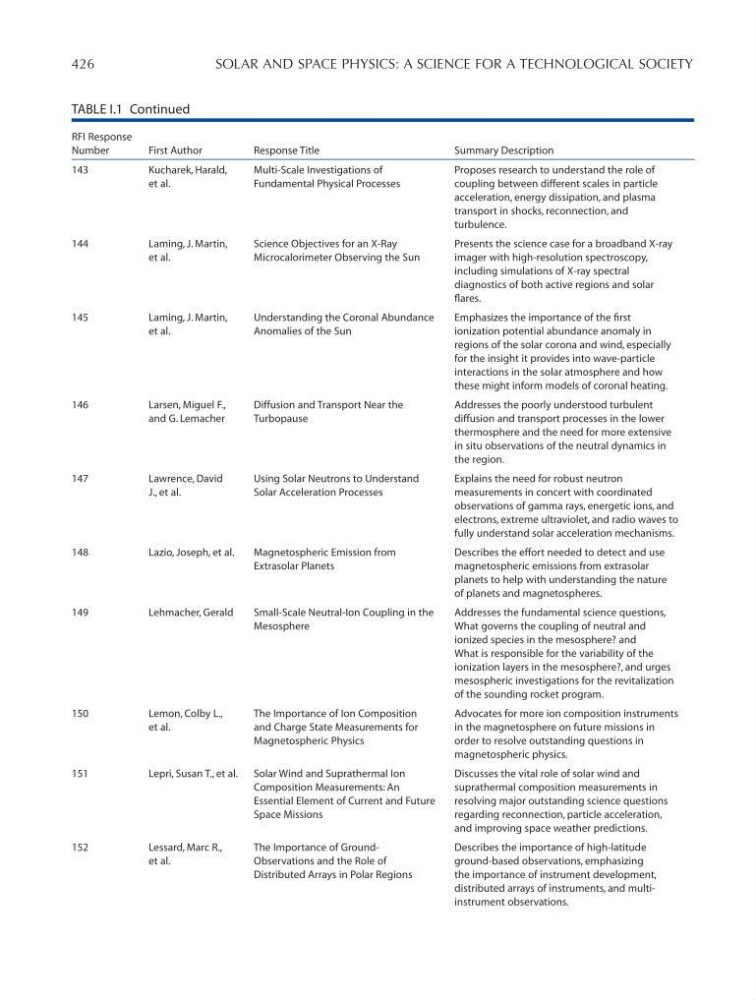
TABLE I.1 Continued
Solar and Space Physics: A Science for a Technological Society
426
SOLAR AND SPACE PHYSICS: A SCIENCE FOR A TECHNOLOGICAL SOCIETY
RFI Response
Number
First Author
Response Title
Summary Description
143
Kucharek, Harald,
et al.
Multi-Scale Investigations of
Fundamental Physical Processes
Proposes research to understand the role of
coupling between different scales in particle
acceleration, energy dissipation, and plasma
transport in shocks, reconnection, and
turbulence.
144
Laming, J. Martin,
et al.
Science Objectives for an X-Ray
Microcalorimeter Observing the Sun
Presents the science case for a broadband X-ray
imager with high-resolution spectroscopy,
including simulations of X-ray spectral
diagnostics of both active regions and solar
flares.
145
Laming, J. Martin,
et al.
Understanding the Coronal Abundance
Anomalies of the Sun
Emphasizes the importance of the first
ionization potential abundance anomaly in
regions of the solar corona and wind, especially
for the insight it provides into wave-particle
interactions in the solar atmosphere and how
these might inform models of coronal heating.
146
Larsen, Miguel F.,
and G. Lemacher
Diffusion and Transport Near the
Turbopause
Addresses the poorly understood turbulent
diffusion and transport processes in the lower
thermosphere and the need for more extensive
in situ observations of the neutral dynamics in
the region.
147
Lawrence, David
J., et al.
Using Solar Neutrons to Understand
Solar Acceleration Processes
Explains the need for robust neutron
measurements in concert with coordinated
observations of gamma rays, energetic ions, and
electrons, extreme ultraviolet, and radio waves to
fully understand solar acceleration mechanisms.
148
Lazio, Joseph, et al.
Magnetospheric Emission from
Extrasolar Planets
Describes the effort needed to detect and use
magnetospheric emissions from extrasolar
planets to help with understanding the nature
of planets and magnetospheres.
149
Lehmacher, Gerald
Small-Scale Neutral-Ion Coupling in the
Mesosphere
Addresses the fundamental science questions,
What governs the coupling of neutral and
ionized species in the mesosphere? and
What is responsible for the variability of the
ionization layers in the mesosphere?, and urges
mesospheric investigations for the revitalization
of the sounding rocket program.
150
Lemon, Colby L.,
et al.
The Importance of Ion Composition
and Charge State Measurements for
Magnetospheric Physics
Advocates for more ion composition instruments
in the magnetosphere on future missions in
order to resolve outstanding questions in
magnetospheric physics.
151
Lepri, Susan T., et al. Solar Wind and Suprathermal Ion
Composition Measurements: An
Essential Element of Current and Future
Space Missions
Discusses the vital role of solar wind and
suprathermal composition measurements in
resolving major outstanding science questions
regarding reconnection, particle acceleration,
and improving space weather predictions.
152
Lessard, Marc R.,
et al.
The Importance of GroundObservations and the Role of
Distributed Arrays in Polar Regions
Describes the importance of high-latitude
ground-based observations, emphasizing
the importance of instrument development,
distributed arrays of instruments, and multiinstrument observations.
TABLE I.1 Continued