

Copyright © National Academy of Sciences. All rights reserved.
Solar and Space Physics: A Science for a Technological Society
APPENDIX I
425
RFI Response
Number
First Author
Response Title
Summary Description
135
Klimchuk, James A.
Maximizing NASA’s Science Productivity
Argues that the science productivity of
NASA’s Heliophysics Science Division is not
maximized by the current program balance and
recommends that research and analysis (R&A)
funding be gradually increased by 10% of the
Heliophysics Science Division budget to an
eventual target of 20-25% of the total budget.
136
Klumpar, David M.,
et al.
The Technological Case for TinySats
(CubeSats and Nanosatellites) in
Support of Heliophysics Research and
the National Space Weather Program
Establishs that rapid developments in electronics
miniaturization, new manufacturing techniques,
and new materials and the development of a
cadre of commercial suppliers of small satellite
subsystems fortify the technical readiness of
CubeSats for heliophysics research.
137
Ko, Yuan-Kuen et al. Breakthrough Toward Understanding
the Solar Wind Origin
Argues that a breakthrough in the next decade
toward understanding the origin of the solar
wind will require the continued collection and
analysis of solar spectroscopic and in situ solar
wind ion composition data, and future mission
designs that address the solar wind origins
need to take into account the coexistence and
coordination of these two types of instruments.
138
Ko, Yuan-Kuen, and
G.A. Doschek
Systematic Science for Future Missions
Examines strategies for future fleets of space
missions to achieve systematic, optimal science,
identifies key measurements that should not
be sacrificed, and proposes coordination of the
locations and timing of data availability.
139
Komjathy, Attila,
et al.
Detecting Tsunami Generated
Ionospheric Perturbations Using GPS
Measurements
Argues for a concept of ionospheric sounding
that would provide a method of tsunami
confirmation using NASA’s global network of
real-time GPS receivers.
140
Korendyke,
Clarence M., et al.
Fine-Scale Advanced Coronal and
Transition Region Spectrometer (FACTS)
Mission: An Imaging Spectroscopy
Mission to Observe Physical Processes
of the Solar Chromosphere, Transition
Region, and Corona
Proposes a mission to determine and
characterize the dominant physical processes
responsible for the structure, dynamics, and
evolution of the upper solar atmosphere.
141
Kosovichev,
Alexander, et al.
Solar Dynamo
Proposes that a significant breakthrough can be
made to advance understanding of the physical
mechanisms of magnetic field generation
and formation of magnetic structures on
the Sun with the help of targeted funding to
support coordinated interdisciplinary groups
of observers, theorists, and modelers, working
together on solar dynamo as a single complex
problem.
142
Krall, Jonathan, and
J.D. Huba
Physics-Based Modeling of the
Plasmasphere
Argues the case that a key priority of U.S. space
physics enterprise should be to develop a
physics-based numerical model of the coupled
magnetosphere-ionosphere system that will
describe the plasmasphere and its interactions
with the ionosphere, magnetosphere, and ring
current.
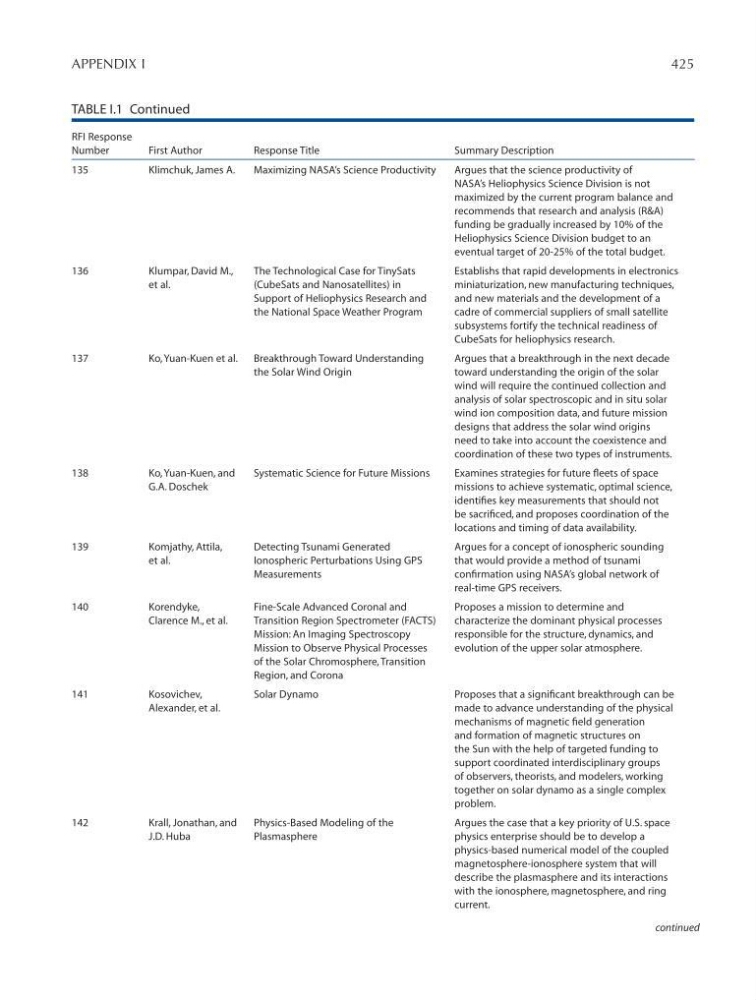
TABLE I.1 Continued
continued
Solar and Space Physics: A Science for a Technological Society
APPENDIX I
425
RFI Response
Number
First Author
Response Title
Summary Description
135
Klimchuk, James A.
Maximizing NASA’s Science Productivity
Argues that the science productivity of
NASA’s Heliophysics Science Division is not
maximized by the current program balance and
recommends that research and analysis (R&A)
funding be gradually increased by 10% of the
Heliophysics Science Division budget to an
eventual target of 20-25% of the total budget.
136
Klumpar, David M.,
et al.
The Technological Case for TinySats
(CubeSats and Nanosatellites) in
Support of Heliophysics Research and
the National Space Weather Program
Establishs that rapid developments in electronics
miniaturization, new manufacturing techniques,
and new materials and the development of a
cadre of commercial suppliers of small satellite
subsystems fortify the technical readiness of
CubeSats for heliophysics research.
137
Ko, Yuan-Kuen et al. Breakthrough Toward Understanding
the Solar Wind Origin
Argues that a breakthrough in the next decade
toward understanding the origin of the solar
wind will require the continued collection and
analysis of solar spectroscopic and in situ solar
wind ion composition data, and future mission
designs that address the solar wind origins
need to take into account the coexistence and
coordination of these two types of instruments.
138
Ko, Yuan-Kuen, and
G.A. Doschek
Systematic Science for Future Missions
Examines strategies for future fleets of space
missions to achieve systematic, optimal science,
identifies key measurements that should not
be sacrificed, and proposes coordination of the
locations and timing of data availability.
139
Komjathy, Attila,
et al.
Detecting Tsunami Generated
Ionospheric Perturbations Using GPS
Measurements
Argues for a concept of ionospheric sounding
that would provide a method of tsunami
confirmation using NASA’s global network of
real-time GPS receivers.
140
Korendyke,
Clarence M., et al.
Fine-Scale Advanced Coronal and
Transition Region Spectrometer (FACTS)
Mission: An Imaging Spectroscopy
Mission to Observe Physical Processes
of the Solar Chromosphere, Transition
Region, and Corona
Proposes a mission to determine and
characterize the dominant physical processes
responsible for the structure, dynamics, and
evolution of the upper solar atmosphere.
141
Kosovichev,
Alexander, et al.
Solar Dynamo
Proposes that a significant breakthrough can be
made to advance understanding of the physical
mechanisms of magnetic field generation
and formation of magnetic structures on
the Sun with the help of targeted funding to
support coordinated interdisciplinary groups
of observers, theorists, and modelers, working
together on solar dynamo as a single complex
problem.
142
Krall, Jonathan, and
J.D. Huba
Physics-Based Modeling of the
Plasmasphere
Argues the case that a key priority of U.S. space
physics enterprise should be to develop a
physics-based numerical model of the coupled
magnetosphere-ionosphere system that will
describe the plasmasphere and its interactions
with the ionosphere, magnetosphere, and ring
current.
TABLE I.1 Continued
continued