

Copyright © National Academy of Sciences. All rights reserved.
Solar and Space Physics: A Science for a Technological Society
424
SOLAR AND SPACE PHYSICS: A SCIENCE FOR A TECHNOLOGICAL SOCIETY
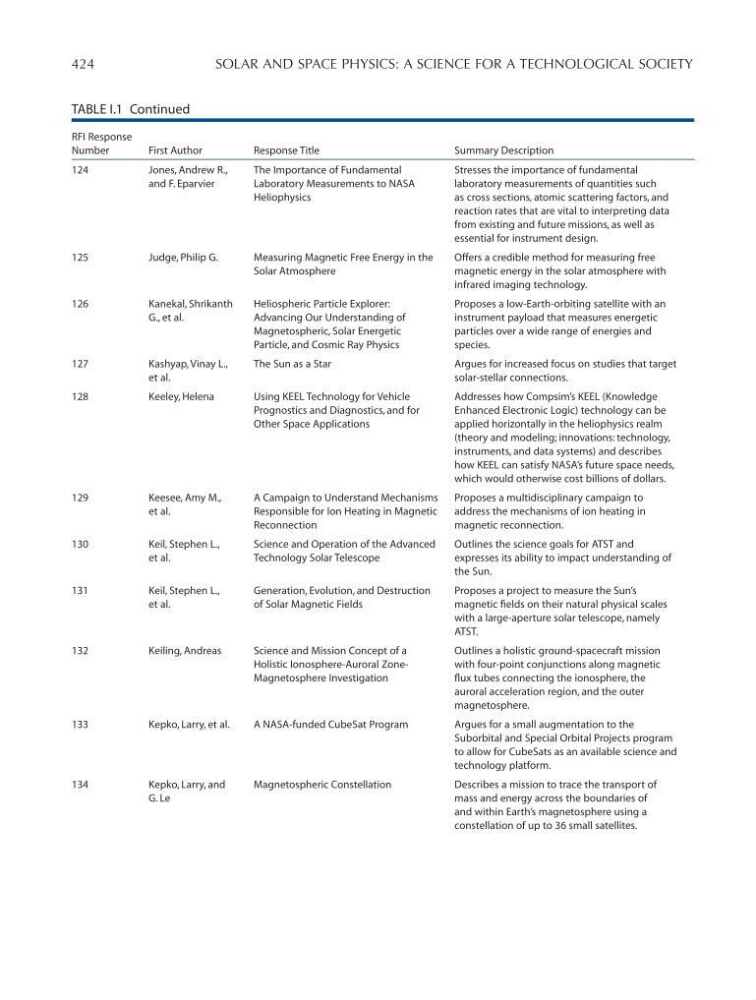
RFI Response
Number
First Author
Response Title
Summary Description
124
Jones, Andrew R.,
and F. Eparvier
The Importance of Fundamental
Laboratory Measurements to NASA
Heliophysics
Stresses the importance of fundamental
laboratory measurements of quantities such
as cross sections, atomic scattering factors, and
reaction rates that are vital to interpreting data
from existing and future missions, as well as
essential for instrument design.
125
Judge, Philip G.
Measuring Magnetic Free Energy in the
Solar Atmosphere
Offers a credible method for measuring free
magnetic energy in the solar atmosphere with
infrared imaging technology.
126
Kanekal, Shrikanth
G., et al.
Heliospheric Particle Explorer:
Advancing Our Understanding of
Magnetospheric, Solar Energetic
Particle, and Cosmic Ray Physics
Proposes a low-Earth-orbiting satellite with an
instrument payload that measures energetic
particles over a wide range of energies and
species.
127
Kashyap, Vinay L.,
et al.
The Sun as a Star
Argues for increased focus on studies that target
solar-stellar connections.
128
Keeley, Helena
Using KEEL Technology for Vehicle
Prognostics and Diagnostics, and for
Other Space Applications
Addresses how Compsim’s KEEL (Knowledge
Enhanced Electronic Logic) technology can be
applied horizontally in the heliophysics realm
(theory and modeling; innovations: technology,
instruments, and data systems) and describes
how KEEL can satisfy NASA’s future space needs,
which would otherwise cost billions of dollars.
129
Keesee, Amy M.,
et al.
A Campaign to Understand Mechanisms
Responsible for Ion Heating in Magnetic
Reconnection
Proposes a multidisciplinary campaign to
address the mechanisms of ion heating in
magnetic reconnection.
130
Keil, Stephen L.,
et al.
Science and Operation of the Advanced
Technology Solar Telescope
Outlines the science goals for ATST and
expresses its ability to impact understanding of
the Sun.
131
Keil, Stephen L.,
et al.
Generation, Evolution, and Destruction
of Solar Magnetic Fields
Proposes a project to measure the Sun’s
magnetic fields on their natural physical scales
with a large-aperture solar telescope, namely
ATST.
132
Keiling, Andreas
Science and Mission Concept of a
Holistic Ionosphere-Auroral ZoneMagnetosphere Investigation
Outlines a holistic ground-spacecraft mission
with four-point conjunctions along magnetic
flux tubes connecting the ionosphere, the
auroral acceleration region, and the outer
magnetosphere.
133
Kepko, Larry, et al.
A NASA-funded CubeSat Program
Argues for a small augmentation to the
Suborbital and Special Orbital Projects program
to allow for CubeSats as an available science and
technology platform.
134
Kepko, Larry, and
G. Le
Magnetospheric Constellation
Describes a mission to trace the transport of
mass and energy across the boundaries of
and within Earth’s magnetosphere using a
constellation of up to 36 small satellites.
TABLE I.1 Continued
Solar and Space Physics: A Science for a Technological Society
424
SOLAR AND SPACE PHYSICS: A SCIENCE FOR A TECHNOLOGICAL SOCIETY
RFI Response
Number
First Author
Response Title
Summary Description
124
Jones, Andrew R.,
and F. Eparvier
The Importance of Fundamental
Laboratory Measurements to NASA
Heliophysics
Stresses the importance of fundamental
laboratory measurements of quantities such
as cross sections, atomic scattering factors, and
reaction rates that are vital to interpreting data
from existing and future missions, as well as
essential for instrument design.
125
Judge, Philip G.
Measuring Magnetic Free Energy in the
Solar Atmosphere
Offers a credible method for measuring free
magnetic energy in the solar atmosphere with
infrared imaging technology.
126
Kanekal, Shrikanth
G., et al.
Heliospheric Particle Explorer:
Advancing Our Understanding of
Magnetospheric, Solar Energetic
Particle, and Cosmic Ray Physics
Proposes a low-Earth-orbiting satellite with an
instrument payload that measures energetic
particles over a wide range of energies and
species.
127
Kashyap, Vinay L.,
et al.
The Sun as a Star
Argues for increased focus on studies that target
solar-stellar connections.
128
Keeley, Helena
Using KEEL Technology for Vehicle
Prognostics and Diagnostics, and for
Other Space Applications
Addresses how Compsim’s KEEL (Knowledge
Enhanced Electronic Logic) technology can be
applied horizontally in the heliophysics realm
(theory and modeling; innovations: technology,
instruments, and data systems) and describes
how KEEL can satisfy NASA’s future space needs,
which would otherwise cost billions of dollars.
129
Keesee, Amy M.,
et al.
A Campaign to Understand Mechanisms
Responsible for Ion Heating in Magnetic
Reconnection
Proposes a multidisciplinary campaign to
address the mechanisms of ion heating in
magnetic reconnection.
130
Keil, Stephen L.,
et al.
Science and Operation of the Advanced
Technology Solar Telescope
Outlines the science goals for ATST and
expresses its ability to impact understanding of
the Sun.
131
Keil, Stephen L.,
et al.
Generation, Evolution, and Destruction
of Solar Magnetic Fields
Proposes a project to measure the Sun’s
magnetic fields on their natural physical scales
with a large-aperture solar telescope, namely
ATST.
132
Keiling, Andreas
Science and Mission Concept of a
Holistic Ionosphere-Auroral ZoneMagnetosphere Investigation
Outlines a holistic ground-spacecraft mission
with four-point conjunctions along magnetic
flux tubes connecting the ionosphere, the
auroral acceleration region, and the outer
magnetosphere.
133
Kepko, Larry, et al.
A NASA-funded CubeSat Program
Argues for a small augmentation to the
Suborbital and Special Orbital Projects program
to allow for CubeSats as an available science and
technology platform.
134
Kepko, Larry, and
G. Le
Magnetospheric Constellation
Describes a mission to trace the transport of
mass and energy across the boundaries of
and within Earth’s magnetosphere using a
constellation of up to 36 small satellites.
TABLE I.1 Continued