

Copyright © National Academy of Sciences. All rights reserved.
Solar and Space Physics: A Science for a Technological Society
APPENDIX I
423
RFI Response
Number
First Author
Response Title
Summary Description
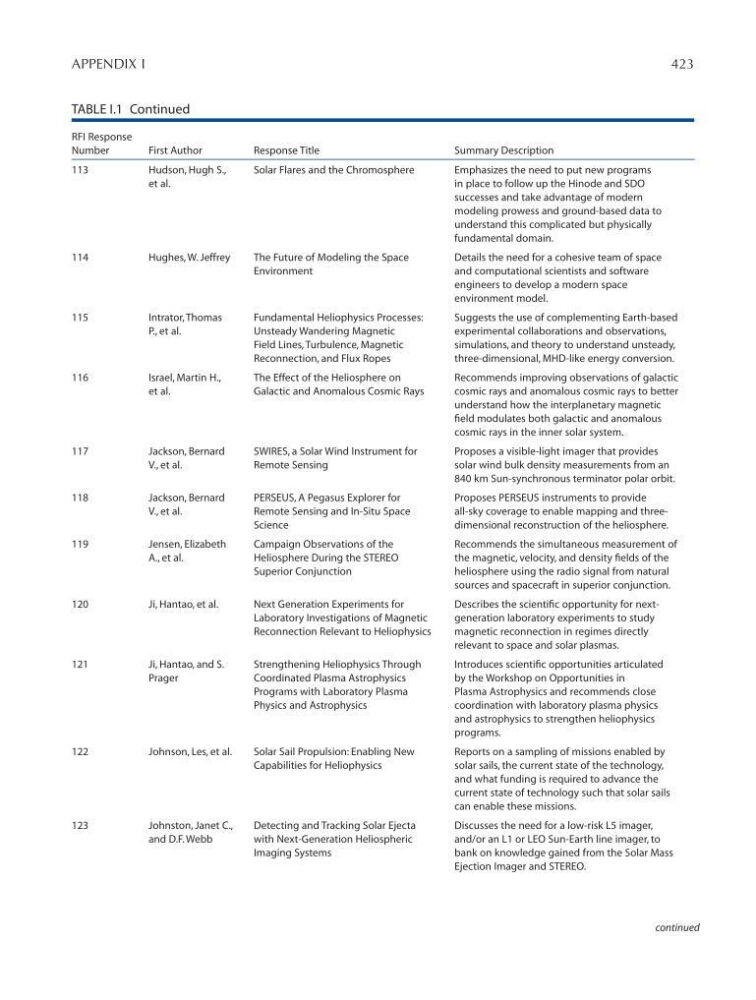
113
Hudson, Hugh S.,
et al.
Solar Flares and the Chromosphere
Emphasizes the need to put new programs
in place to follow up the Hinode and SDO
successes and take advantage of modern
modeling prowess and ground-based data to
understand this complicated but physically
fundamental domain.
114
Hughes, W. Jeffrey
The Future of Modeling the Space
Environment
Details the need for a cohesive team of space
and computational scientists and software
engineers to develop a modern space
environment model.
115
Intrator, Thomas
P., et al.
Fundamental Heliophysics Processes:
Unsteady Wandering Magnetic
Field Lines, Turbulence, Magnetic
Reconnection, and Flux Ropes
Suggests the use of complementing Earth-based
experimental collaborations and observations,
simulations, and theory to understand unsteady,
three-dimensional, MHD-like energy conversion.
116
Israel, Martin H.,
et al.
The Effect of the Heliosphere on
Galactic and Anomalous Cosmic Rays
Recommends improving observations of galactic
cosmic rays and anomalous cosmic rays to better
understand how the interplanetary magnetic
field modulates both galactic and anomalous
cosmic rays in the inner solar system.
117
Jackson, Bernard
V., et al.
SWIRES, a Solar Wind Instrument for
Remote Sensing
Proposes a visible-light imager that provides
solar wind bulk density measurements from an
840 km Sun-synchronous terminator polar orbit.
118
Jackson, Bernard
V., et al.
PERSEUS, A Pegasus Explorer for
Remote Sensing and In-Situ Space
Science
Proposes PERSEUS instruments to provide
all-sky coverage to enable mapping and threedimensional reconstruction of the heliosphere.
119
Jensen, Elizabeth
A., et al.
Campaign Observations of the
Heliosphere During the STEREO
Superior Conjunction
Recommends the simultaneous measurement of
the magnetic, velocity, and density fields of the
heliosphere using the radio signal from natural
sources and spacecraft in superior conjunction.
120
Ji, Hantao, et al.
Next Generation Experiments for
Laboratory Investigations of Magnetic
Reconnection Relevant to Heliophysics
Describes the scientific opportunity for nextgeneration laboratory experiments to study
magnetic reconnection in regimes directly
relevant to space and solar plasmas.
121
Ji, Hantao, and S.
Prager
Strengthening Heliophysics Through
Coordinated Plasma Astrophysics
Programs with Laboratory Plasma
Physics and Astrophysics
Introduces scientific opportunities articulated
by the Workshop on Opportunities in
Plasma Astrophysics and recommends close
coordination with laboratory plasma physics
and astrophysics to strengthen heliophysics
programs.
122
Johnson, Les, et al.
Solar Sail Propulsion: Enabling New
Capabilities for Heliophysics
Reports on a sampling of missions enabled by
solar sails, the current state of the technology,
and what funding is required to advance the
current state of technology such that solar sails
can enable these missions.
123
Johnston, Janet C.,
and D.F. Webb
Detecting and Tracking Solar Ejecta
with Next-Generation Heliospheric
Imaging Systems
Discusses the need for a low-risk L5 imager,
and/or an L1 or LEO Sun-Earth line imager, to
bank on knowledge gained from the Solar Mass
Ejection Imager and STEREO.
TABLE I.1 Continued
continued
Solar and Space Physics: A Science for a Technological Society
APPENDIX I
423
RFI Response
Number
First Author
Response Title
Summary Description
113
Hudson, Hugh S.,
et al.
Solar Flares and the Chromosphere
Emphasizes the need to put new programs
in place to follow up the Hinode and SDO
successes and take advantage of modern
modeling prowess and ground-based data to
understand this complicated but physically
fundamental domain.
114
Hughes, W. Jeffrey
The Future of Modeling the Space
Environment
Details the need for a cohesive team of space
and computational scientists and software
engineers to develop a modern space
environment model.
115
Intrator, Thomas
P., et al.
Fundamental Heliophysics Processes:
Unsteady Wandering Magnetic
Field Lines, Turbulence, Magnetic
Reconnection, and Flux Ropes
Suggests the use of complementing Earth-based
experimental collaborations and observations,
simulations, and theory to understand unsteady,
three-dimensional, MHD-like energy conversion.
116
Israel, Martin H.,
et al.
The Effect of the Heliosphere on
Galactic and Anomalous Cosmic Rays
Recommends improving observations of galactic
cosmic rays and anomalous cosmic rays to better
understand how the interplanetary magnetic
field modulates both galactic and anomalous
cosmic rays in the inner solar system.
117
Jackson, Bernard
V., et al.
SWIRES, a Solar Wind Instrument for
Remote Sensing
Proposes a visible-light imager that provides
solar wind bulk density measurements from an
840 km Sun-synchronous terminator polar orbit.
118
Jackson, Bernard
V., et al.
PERSEUS, A Pegasus Explorer for
Remote Sensing and In-Situ Space
Science
Proposes PERSEUS instruments to provide
all-sky coverage to enable mapping and threedimensional reconstruction of the heliosphere.
119
Jensen, Elizabeth
A., et al.
Campaign Observations of the
Heliosphere During the STEREO
Superior Conjunction
Recommends the simultaneous measurement of
the magnetic, velocity, and density fields of the
heliosphere using the radio signal from natural
sources and spacecraft in superior conjunction.
120
Ji, Hantao, et al.
Next Generation Experiments for
Laboratory Investigations of Magnetic
Reconnection Relevant to Heliophysics
Describes the scientific opportunity for nextgeneration laboratory experiments to study
magnetic reconnection in regimes directly
relevant to space and solar plasmas.
121
Ji, Hantao, and S.
Prager
Strengthening Heliophysics Through
Coordinated Plasma Astrophysics
Programs with Laboratory Plasma
Physics and Astrophysics
Introduces scientific opportunities articulated
by the Workshop on Opportunities in
Plasma Astrophysics and recommends close
coordination with laboratory plasma physics
and astrophysics to strengthen heliophysics
programs.
122
Johnson, Les, et al.
Solar Sail Propulsion: Enabling New
Capabilities for Heliophysics
Reports on a sampling of missions enabled by
solar sails, the current state of the technology,
and what funding is required to advance the
current state of technology such that solar sails
can enable these missions.
123
Johnston, Janet C.,
and D.F. Webb
Detecting and Tracking Solar Ejecta
with Next-Generation Heliospheric
Imaging Systems
Discusses the need for a low-risk L5 imager,
and/or an L1 or LEO Sun-Earth line imager, to
bank on knowledge gained from the Solar Mass
Ejection Imager and STEREO.
TABLE I.1 Continued
continued