

Copyright © National Academy of Sciences. All rights reserved.
Solar and Space Physics: A Science for a Technological Society
422
SOLAR AND SPACE PHYSICS: A SCIENCE FOR A TECHNOLOGICAL SOCIETY
RFI Response
Number
First Author
Response Title
Summary Description
103
Habbal, Shadia R.,
et al.
Exploring the Physics of the Corona
with Total Solar Eclipse Observations
Supports total solar eclipse observations in the
visible and near infrared wavelength range to
explore the physics of the corona, in particular
on August 21, 2017.
104
Heelis, Rod
Magnetosphere Atmosphere Coupling
Mission (MACM)
Proposes a mission to discover the spatial and
temporal scales over which the ionosphere
and thermosphere respond to magnetospheric
energy inputs and determine how
magnetospheric sources and wind dynamos
contribute to the electric field in the ionosphere
and thermosphere.
105
Heelis, Rod
Space-Atmosphere Boundary Layer
Electrodynamics (SABLE)
Proposes a mission to uncover the pathways
through which energy from the magnetosphere
and solar wind is redistributed in Earth’s
atmosphere.
106
Hess, Sebastien
L.G., et al.
Exploration of the Uranus
Magnetosphere
Proposes a middle-size mission to explore the
Uranus magnetosphere with a minimal set of
instruments that are necessary to address the
most compelling questions about the Uranus
magnetosphere and to improve understanding
of the solar wind-magnetosphere interactions
in general.
107
Hill, Frank, et al.
Helioseismology
Supports ground-based multi-wavelength
observations and space-based multi-viewpoint
measurements in order to further understanding
of space physics.
108
Hill, Frank, et al.
The Need for Synoptic Optical Solar
Observations from the Ground
Discusses the value of long-term observations in
understanding the Sun and its activity cycle and
the importance of providing sufficient resources
to obtain and improve the measurements.
109
Holzworth, Robert
H.
Lightning Influence on Ionosphere and
Magnetosphere Plasma
Discusses the influence of lightning on
ionoshere and magnetosphere processes, gives
history behind current knowledge, and suggests
that lightning-generated plasma waves may be
much more important to magnetospheric and
ionospheric physics than is realized.
110
Horanyi, Mihaly,
et al.
iDUST: Interstellar and Interplanetary
Dust Near Earth: A Mission Concept for
“Dust Tomography” of the Heliosphere
Proposes a mission to observe the inward
transport of interstellar dust and the outflow
of near-solar dust and explore dusty plasma
processes throughout the heliosphere.
111
Huang, Cheryl
A Satellite Mission Concept to Study
Thermosphere-Ionosphere Coupling
Presents a satellite mission concept to study
ion-neutral coupling with an improvement in
satellite drag modelling.
112
Huba, Joseph D.,
et al.
A Comprehensive, First-Principles Model
of Equatorial Ionospheric Irregularities
and Turbulence
Discusses the development of a new
modeling capability that describes the onset
and development of equatorial ionospheric
irregularities covering a spatial range of tens of
centimeters to thousands of kilometers.
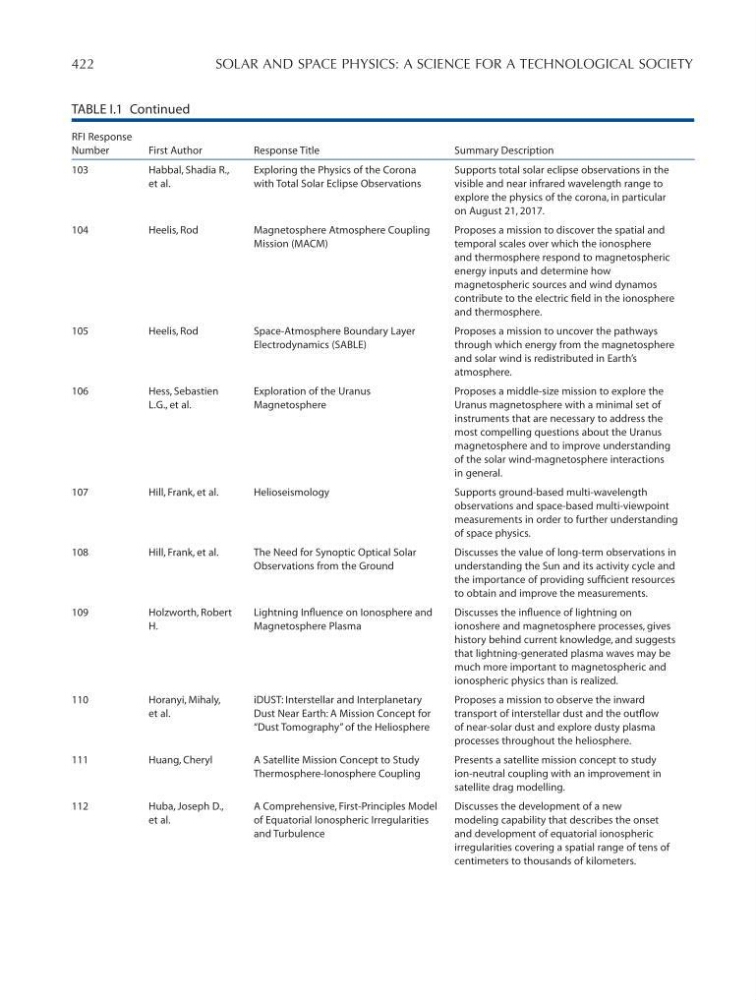
TABLE I.1 Continued
Solar and Space Physics: A Science for a Technological Society
422
SOLAR AND SPACE PHYSICS: A SCIENCE FOR A TECHNOLOGICAL SOCIETY
RFI Response
Number
First Author
Response Title
Summary Description
103
Habbal, Shadia R.,
et al.
Exploring the Physics of the Corona
with Total Solar Eclipse Observations
Supports total solar eclipse observations in the
visible and near infrared wavelength range to
explore the physics of the corona, in particular
on August 21, 2017.
104
Heelis, Rod
Magnetosphere Atmosphere Coupling
Mission (MACM)
Proposes a mission to discover the spatial and
temporal scales over which the ionosphere
and thermosphere respond to magnetospheric
energy inputs and determine how
magnetospheric sources and wind dynamos
contribute to the electric field in the ionosphere
and thermosphere.
105
Heelis, Rod
Space-Atmosphere Boundary Layer
Electrodynamics (SABLE)
Proposes a mission to uncover the pathways
through which energy from the magnetosphere
and solar wind is redistributed in Earth’s
atmosphere.
106
Hess, Sebastien
L.G., et al.
Exploration of the Uranus
Magnetosphere
Proposes a middle-size mission to explore the
Uranus magnetosphere with a minimal set of
instruments that are necessary to address the
most compelling questions about the Uranus
magnetosphere and to improve understanding
of the solar wind-magnetosphere interactions
in general.
107
Hill, Frank, et al.
Helioseismology
Supports ground-based multi-wavelength
observations and space-based multi-viewpoint
measurements in order to further understanding
of space physics.
108
Hill, Frank, et al.
The Need for Synoptic Optical Solar
Observations from the Ground
Discusses the value of long-term observations in
understanding the Sun and its activity cycle and
the importance of providing sufficient resources
to obtain and improve the measurements.
109
Holzworth, Robert
H.
Lightning Influence on Ionosphere and
Magnetosphere Plasma
Discusses the influence of lightning on
ionoshere and magnetosphere processes, gives
history behind current knowledge, and suggests
that lightning-generated plasma waves may be
much more important to magnetospheric and
ionospheric physics than is realized.
110
Horanyi, Mihaly,
et al.
iDUST: Interstellar and Interplanetary
Dust Near Earth: A Mission Concept for
“Dust Tomography” of the Heliosphere
Proposes a mission to observe the inward
transport of interstellar dust and the outflow
of near-solar dust and explore dusty plasma
processes throughout the heliosphere.
111
Huang, Cheryl
A Satellite Mission Concept to Study
Thermosphere-Ionosphere Coupling
Presents a satellite mission concept to study
ion-neutral coupling with an improvement in
satellite drag modelling.
112
Huba, Joseph D.,
et al.
A Comprehensive, First-Principles Model
of Equatorial Ionospheric Irregularities
and Turbulence
Discusses the development of a new
modeling capability that describes the onset
and development of equatorial ionospheric
irregularities covering a spatial range of tens of
centimeters to thousands of kilometers.
TABLE I.1 Continued