

Copyright © National Academy of Sciences. All rights reserved.
Solar and Space Physics: A Science for a Technological Society
APPENDIX I
421
RFI Response
Number
First Author
Response Title
Summary Description
91
Giampapa, Mark
S., et al.
Asteroseismology: The Next Frontier in
Solar-Stellar Physics
Recommends comparative studies of the
influence of parameters such as rotation and
convection zone structure on dynamo-related
magnetic activity at all relevant timescales.
92
Giampapa, Mark,
S., et al.
Causes of Solar Activity
Emphasizes the critical importance of a
sustained program of long-term, high-continuity
observations of the solar magnetic field by
a network of ground-based synoptic-type
instruments.
93
Gilbert, Jason A.
What Composition Measurements
Could Have Done for Solar Probe Plus
Examines the science benefits that composition
data would have brought to the Solar Probe Plus
missions, which explore the source regions of
the solar wind and of inner-source pickup ions.
94
Gjerloev, Jesper W.,
et al.
Auroral Forms and Their Role in the
Dungey Convection Cycle
Urges the committee to include the
fundamental science objectives: What is the
role of meso-scale auroral forms in the Dungey
global convection cycle?
95
Gjerloev, Jesper W.,
et al.
SuperMAG: The Global Ground Based
Magnetometer Initiative
Urges the decadal survey committee to
acknowledge the strength of the ground-based
magnetometer data set and the need for global
collaborations such as SuperMAG.
96
Golub, Leon, et al.
RAM: The Reconnection and Microscale
Mission
Outlines a new approach to understanding the
dynamic activity of hot, magnetized plasmas
using the best example available, the solar
corona, with the goals of determining the
configurations that lead to energy release and
locating sources of high-energy particles.
97
Goncharenko,
Larisa P., et al.
Coupling Through Planetary Waves:
From the Stratosphere to Ionospheric
Irregularities
Proposes an observational strategy that would
investigate potential effects of planetary waves
on irregularities.
98
Goode, Philip
The 1.6 m Clear Aperture Optical Solar
Telescope in Big Bear—The NST
Describes how the largest aperture (1.6 m) solar
telescope will provide an essential complement
to SDO, Hinode, and other satellite data,
especially as a probe of the space weather.
99
Gopalswamy, Nat,
et al.
Earth-Affecting Solar Causes
Observatory (EASCO): A New View from
Sun-Earth L5
Outlines the concept of a mission that will make
remote sensing and in situ measurements from
the Sun-Earth Lagrange point L5 to understand
the origin and evolution of large-scale solar
disturbances such as coronal mass ejections and
corotating interaction regions.
100
Gross, Nicholas,
and J. Sojka
Value and Need of Helio and Space
Physics Summer Schools
Highlights the value of space physics summer
schools and encourages the continued funding
of similar efforts.
101
Gross, Nicholas
Value of Enhanced Mentoring in Space
and Helio Physics
Outlines the value of enhancing mentoring that
a center provides through exposure of students
to a broad range of mentors and activities.
102
Grotheer,
Emmanuel B., et al.
Determination of Optical Spectra and
G-values for Negative Ions of Low-Mass
Atoms and Molecules
Recommends research to determine negative
ions’ emission spectra and g-values and
discusses interactions of solar wind with
Mercury’s magnetosphere and surface.
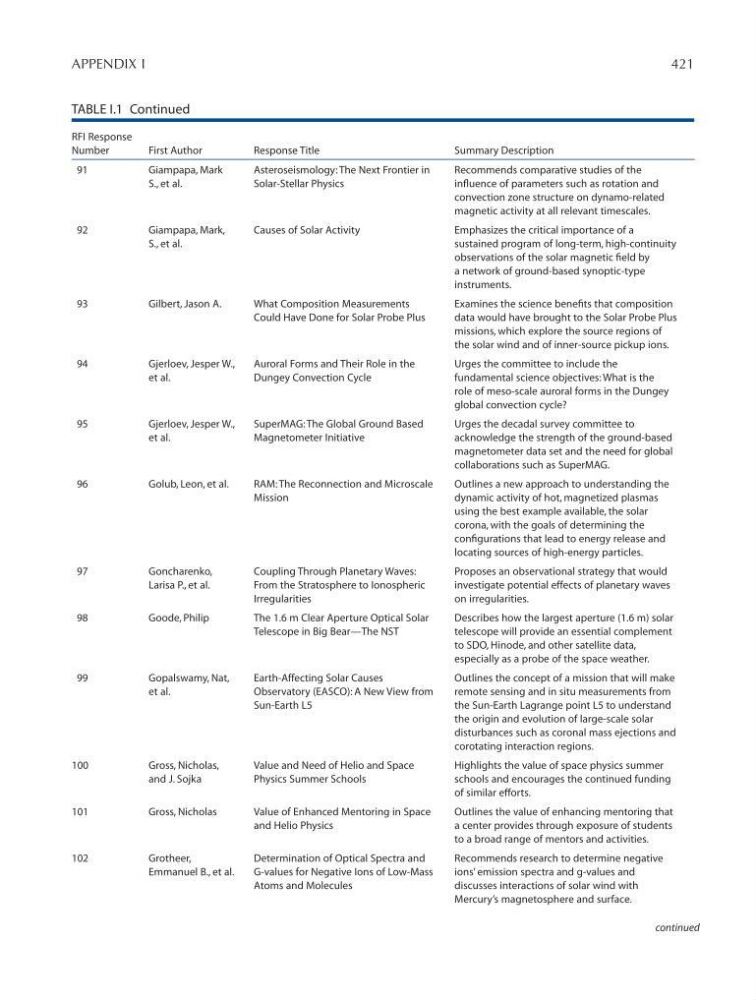
TABLE I.1 Continued
continued
Solar and Space Physics: A Science for a Technological Society
APPENDIX I
421
RFI Response
Number
First Author
Response Title
Summary Description
91
Giampapa, Mark
S., et al.
Asteroseismology: The Next Frontier in
Solar-Stellar Physics
Recommends comparative studies of the
influence of parameters such as rotation and
convection zone structure on dynamo-related
magnetic activity at all relevant timescales.
92
Giampapa, Mark,
S., et al.
Causes of Solar Activity
Emphasizes the critical importance of a
sustained program of long-term, high-continuity
observations of the solar magnetic field by
a network of ground-based synoptic-type
instruments.
93
Gilbert, Jason A.
What Composition Measurements
Could Have Done for Solar Probe Plus
Examines the science benefits that composition
data would have brought to the Solar Probe Plus
missions, which explore the source regions of
the solar wind and of inner-source pickup ions.
94
Gjerloev, Jesper W.,
et al.
Auroral Forms and Their Role in the
Dungey Convection Cycle
Urges the committee to include the
fundamental science objectives: What is the
role of meso-scale auroral forms in the Dungey
global convection cycle?
95
Gjerloev, Jesper W.,
et al.
SuperMAG: The Global Ground Based
Magnetometer Initiative
Urges the decadal survey committee to
acknowledge the strength of the ground-based
magnetometer data set and the need for global
collaborations such as SuperMAG.
96
Golub, Leon, et al.
RAM: The Reconnection and Microscale
Mission
Outlines a new approach to understanding the
dynamic activity of hot, magnetized plasmas
using the best example available, the solar
corona, with the goals of determining the
configurations that lead to energy release and
locating sources of high-energy particles.
97
Goncharenko,
Larisa P., et al.
Coupling Through Planetary Waves:
From the Stratosphere to Ionospheric
Irregularities
Proposes an observational strategy that would
investigate potential effects of planetary waves
on irregularities.
98
Goode, Philip
The 1.6 m Clear Aperture Optical Solar
Telescope in Big Bear—The NST
Describes how the largest aperture (1.6 m) solar
telescope will provide an essential complement
to SDO, Hinode, and other satellite data,
especially as a probe of the space weather.
99
Gopalswamy, Nat,
et al.
Earth-Affecting Solar Causes
Observatory (EASCO): A New View from
Sun-Earth L5
Outlines the concept of a mission that will make
remote sensing and in situ measurements from
the Sun-Earth Lagrange point L5 to understand
the origin and evolution of large-scale solar
disturbances such as coronal mass ejections and
corotating interaction regions.
100
Gross, Nicholas,
and J. Sojka
Value and Need of Helio and Space
Physics Summer Schools
Highlights the value of space physics summer
schools and encourages the continued funding
of similar efforts.
101
Gross, Nicholas
Value of Enhanced Mentoring in Space
and Helio Physics
Outlines the value of enhancing mentoring that
a center provides through exposure of students
to a broad range of mentors and activities.
102
Grotheer,
Emmanuel B., et al.
Determination of Optical Spectra and
G-values for Negative Ions of Low-Mass
Atoms and Molecules
Recommends research to determine negative
ions’ emission spectra and g-values and
discusses interactions of solar wind with
Mercury’s magnetosphere and surface.
TABLE I.1 Continued
continued