

Copyright © National Academy of Sciences. All rights reserved.
Solar and Space Physics: A Science for a Technological Society
420
SOLAR AND SPACE PHYSICS: A SCIENCE FOR A TECHNOLOGICAL SOCIETY
RFI Response
Number
First Author
Response Title
Summary Description
81
Fritz, Theodore, A.,
and B.M. Walsh
Particle Acceleration and Entry of Solar
Wind Energy into the Magnetosphere
Recommends the investigation of energetic
particle acceleration in the cusp and the
contributions of such a population to the plasma
sheet and radiation belt.
82
Fry, Dan J., et al.
Solar Proton Event Risk Modeling for
Variable Duration Human Spaceflight
Proposes a strategy that will utilize agency
science to feed the development of needed
near-term probabilistic models that assess solar
proton event risk for long-duration human
exploration.
83
Fuller-Rowell, Tim,
et al.
Forecasting Ionospheric Irregularities
Discusses the pressing need to develop a
capability to forecast the likely occurrence of
ionospheric irregularities and their detrimental
impact on communications and navigation.
84
Fung, Shing F., et al.
Magnetosphere-Ionosphere
Connector (MAGIC): Investigation of
Magnetosphere-Ionosphere Coupling
from High-to-Low Latitudes
Proposes a mission with a high-altitude
satellite for auroral and plasmaspheric imaging
and multiple lower-orbiting spacecraft for
simultaneous in situ and radio sounding
measurements.
85
Fuselier, Stephen
A., et al.
Stereo Magnetospheric Imaging (SMI)
Mission
Proposes energetic neutral atom (ENA) imaging
mission using two spacecraft at the lunar L4
and L5 Lagrange points to investigate plasma
processes at the bow shock and magnetopause,
and in the cusps and magnetotail, lunar
interactions, and heliospheric and interstellar
phenomena.
86
Gary, Dale E., et al.
The Frequency-Agile Solar
Radiotelescope (FASR)
Proposes that a wide range of science goals
can be addressed with a solar-dedicated
radio telescope in a high state of readiness,
with superior imaging capability and broad
frequency coverage.
87
Gary, Dale E., et al.
Particle Acceleration and Transport on
the Sun
Describes the comprehensive observations
required to understand particle acceleration and
particle transport on the Sun.
88
Gentile, L.C., et al.
Scintillation and Energy Input for Space
Situational Awareness and Monitoring
the Environment (SESSAME)
Provides a new generation of space
environmental monitoring instruments to
measure high-latitude energy input and
scintillation at both high and equatorial
latitudes.
89
Gentile, L.C., et al.
Constellation for Heliospheric and
Ionospheric Equatorial Forecasting of
Scintillation (CHIEFS)
Proposes to advance understanding of
ionospheric effects on communication and
navigation systems with a constellation of
small, dedicated satellites orbiting the equator,
combined with data from ground-based
instruments.
90
Gentile, L.C., et al.
Polar and Equatorial Communication
Outage Satellites (PECOS)
Gives a low-cost solution that meets many
current space weather objectives with three
paired constellations of small satellites flying in
multiple orbits.
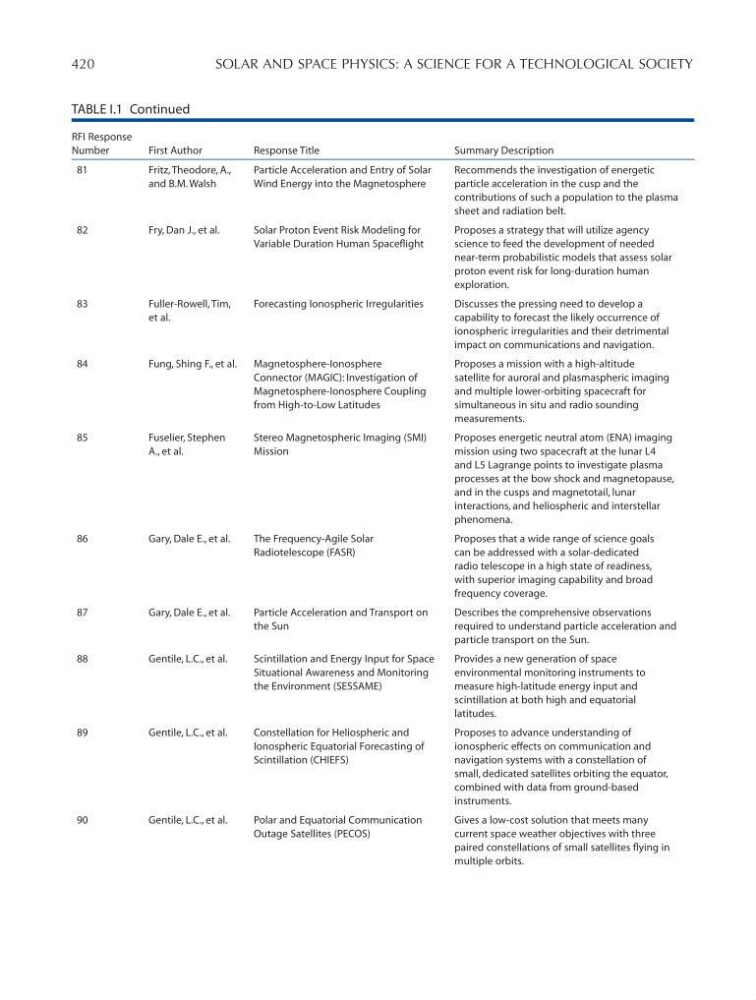
TABLE I.1 Continued
Solar and Space Physics: A Science for a Technological Society
420
SOLAR AND SPACE PHYSICS: A SCIENCE FOR A TECHNOLOGICAL SOCIETY
RFI Response
Number
First Author
Response Title
Summary Description
81
Fritz, Theodore, A.,
and B.M. Walsh
Particle Acceleration and Entry of Solar
Wind Energy into the Magnetosphere
Recommends the investigation of energetic
particle acceleration in the cusp and the
contributions of such a population to the plasma
sheet and radiation belt.
82
Fry, Dan J., et al.
Solar Proton Event Risk Modeling for
Variable Duration Human Spaceflight
Proposes a strategy that will utilize agency
science to feed the development of needed
near-term probabilistic models that assess solar
proton event risk for long-duration human
exploration.
83
Fuller-Rowell, Tim,
et al.
Forecasting Ionospheric Irregularities
Discusses the pressing need to develop a
capability to forecast the likely occurrence of
ionospheric irregularities and their detrimental
impact on communications and navigation.
84
Fung, Shing F., et al.
Magnetosphere-Ionosphere
Connector (MAGIC): Investigation of
Magnetosphere-Ionosphere Coupling
from High-to-Low Latitudes
Proposes a mission with a high-altitude
satellite for auroral and plasmaspheric imaging
and multiple lower-orbiting spacecraft for
simultaneous in situ and radio sounding
measurements.
85
Fuselier, Stephen
A., et al.
Stereo Magnetospheric Imaging (SMI)
Mission
Proposes energetic neutral atom (ENA) imaging
mission using two spacecraft at the lunar L4
and L5 Lagrange points to investigate plasma
processes at the bow shock and magnetopause,
and in the cusps and magnetotail, lunar
interactions, and heliospheric and interstellar
phenomena.
86
Gary, Dale E., et al.
The Frequency-Agile Solar
Radiotelescope (FASR)
Proposes that a wide range of science goals
can be addressed with a solar-dedicated
radio telescope in a high state of readiness,
with superior imaging capability and broad
frequency coverage.
87
Gary, Dale E., et al.
Particle Acceleration and Transport on
the Sun
Describes the comprehensive observations
required to understand particle acceleration and
particle transport on the Sun.
88
Gentile, L.C., et al.
Scintillation and Energy Input for Space
Situational Awareness and Monitoring
the Environment (SESSAME)
Provides a new generation of space
environmental monitoring instruments to
measure high-latitude energy input and
scintillation at both high and equatorial
latitudes.
89
Gentile, L.C., et al.
Constellation for Heliospheric and
Ionospheric Equatorial Forecasting of
Scintillation (CHIEFS)
Proposes to advance understanding of
ionospheric effects on communication and
navigation systems with a constellation of
small, dedicated satellites orbiting the equator,
combined with data from ground-based
instruments.
90
Gentile, L.C., et al.
Polar and Equatorial Communication
Outage Satellites (PECOS)
Gives a low-cost solution that meets many
current space weather objectives with three
paired constellations of small satellites flying in
multiple orbits.
TABLE I.1 Continued