

Copyright © National Academy of Sciences. All rights reserved.
Solar and Space Physics: A Science for a Technological Society
APPENDIX I
419
RFI Response
Number
First Author
Response Title
Summary Description
70
Erickson, Philip J.,
et al.
Investigations of Plasmasphere
Boundary Layer Processes in the
Coupled Earth-Sun Geospace System
Proposes a focused attack on advancing
knowledge of ionospheric structuring and space
weather effects driven by magnetosphere/
ionosphere coupling in the critically important
subauroral plasmasphere boundary layer,
through use of multipoint measurement
networks in both the American and Australian
sectors.
71
Fennell, J.F., et al.
The Magnetospheric Constellation
Mission
Reconsiders the original Magnetospheric
Constellation Mission concept for
implementation in the next decade.
72
Fennell, J.F., and P.T.
O’Brien
Mission to Understand Electron Pitch
Angle Diffusion and Characterize
Precipitation Bands and Spikes
Proposes a mission to understand the processes
and answer the questions raised by observations
of precipitation bands.
73
Fennell, J.F.
Enhancement of POES Instruments to
Provide Better Space Weather Electron
Data
Encourages the National Oceanic and
Atmospheric Administration (NOAA) to seriously
consider flying an electron sensor that measures
the precipitating and trapped electron fluxes in
the 40-2000 keV energy range on a continuous
basis to fulfill operational and science needs
discussed.
74
Fennell, J.F., et al.
Transition Region Exploration (TREx)
Mission
Describes the science need for a mission that
spans the L* region from 4.5 to 8.5 in the
equatorial plane.
75
Fleishman, Gregory
D., et al.
Uncovering Mechanisms of Coronal
Magnetism via Advanced 3D Modeling
of Flares and Active Regions
Recommends capitalizing on new (or soon to
be available) facilities such as Solar Dynamic
Observatory (SDO), the Advanced Technology
Solar Telescope (ATST), and the Frequency-Agile
Solar Radiotelescope and the challenges they
present.
76
Florinski, Vladimir,
et al.
The Outer Heliosphere—Solar System’s
Final Frontier
Discusses the need for a dedicated theoretical
program to study the physics of the outer
heliosphere and identifies four main thrust areas:
global structure, pickup ions and anomalous
cosmic rays, galactic cosmic rays, and physics of
the termination shock and heliopause.
77
Foster, John
DASI: Distributed Arrays of Scientific
Instruments for Geospace and Space
Weather Research
Demonstrates the importance of a largerperspective point of view to appreciate how the
individual features of geospace come together.
78
Frahm, Rudy A.
Interaction of the Solar Wind with a
Partially Magnetized Planet
Proposes a spacecraft experiment that deals
with our nearest neighbor planet, Mars, and its
interaction with the space environment.
79
Frazier, Jr., Jesse R.
Alternate Magnetic Thermodynamics
Presents the author’s unconventional views on
magnetism and energy.
80
Fritts, Dave, et al.
Solar Forcing of the Thermosphere and
Ionosphere from Below: Coupling via
Neutral Wave Dynamics
Describes the motivations for a mission
addressing neutral atmosphere-ionosphere
coupling via neutral waves propagating into the
thermosphere and ionosphere from the lower
atmosphere and the auroral zone.
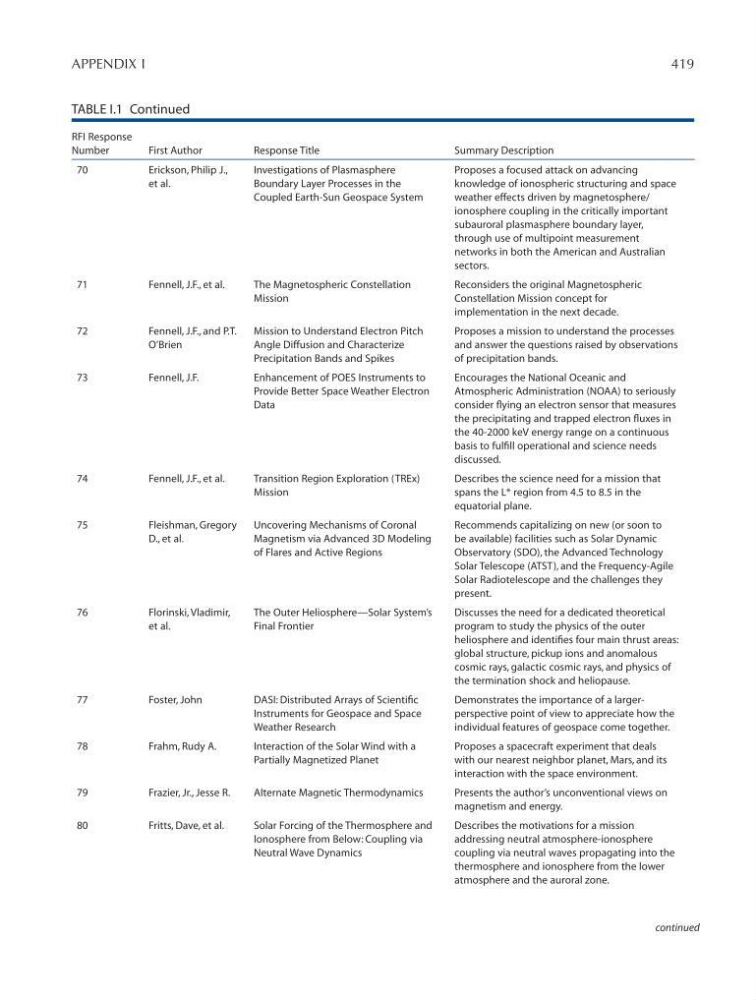
TABLE I.1 Continued
continued
Solar and Space Physics: A Science for a Technological Society
APPENDIX I
419
RFI Response
Number
First Author
Response Title
Summary Description
70
Erickson, Philip J.,
et al.
Investigations of Plasmasphere
Boundary Layer Processes in the
Coupled Earth-Sun Geospace System
Proposes a focused attack on advancing
knowledge of ionospheric structuring and space
weather effects driven by magnetosphere/
ionosphere coupling in the critically important
subauroral plasmasphere boundary layer,
through use of multipoint measurement
networks in both the American and Australian
sectors.
71
Fennell, J.F., et al.
The Magnetospheric Constellation
Mission
Reconsiders the original Magnetospheric
Constellation Mission concept for
implementation in the next decade.
72
Fennell, J.F., and P.T.
O’Brien
Mission to Understand Electron Pitch
Angle Diffusion and Characterize
Precipitation Bands and Spikes
Proposes a mission to understand the processes
and answer the questions raised by observations
of precipitation bands.
73
Fennell, J.F.
Enhancement of POES Instruments to
Provide Better Space Weather Electron
Data
Encourages the National Oceanic and
Atmospheric Administration (NOAA) to seriously
consider flying an electron sensor that measures
the precipitating and trapped electron fluxes in
the 40-2000 keV energy range on a continuous
basis to fulfill operational and science needs
discussed.
74
Fennell, J.F., et al.
Transition Region Exploration (TREx)
Mission
Describes the science need for a mission that
spans the L* region from 4.5 to 8.5 in the
equatorial plane.
75
Fleishman, Gregory
D., et al.
Uncovering Mechanisms of Coronal
Magnetism via Advanced 3D Modeling
of Flares and Active Regions
Recommends capitalizing on new (or soon to
be available) facilities such as Solar Dynamic
Observatory (SDO), the Advanced Technology
Solar Telescope (ATST), and the Frequency-Agile
Solar Radiotelescope and the challenges they
present.
76
Florinski, Vladimir,
et al.
The Outer Heliosphere—Solar System’s
Final Frontier
Discusses the need for a dedicated theoretical
program to study the physics of the outer
heliosphere and identifies four main thrust areas:
global structure, pickup ions and anomalous
cosmic rays, galactic cosmic rays, and physics of
the termination shock and heliopause.
77
Foster, John
DASI: Distributed Arrays of Scientific
Instruments for Geospace and Space
Weather Research
Demonstrates the importance of a largerperspective point of view to appreciate how the
individual features of geospace come together.
78
Frahm, Rudy A.
Interaction of the Solar Wind with a
Partially Magnetized Planet
Proposes a spacecraft experiment that deals
with our nearest neighbor planet, Mars, and its
interaction with the space environment.
79
Frazier, Jr., Jesse R.
Alternate Magnetic Thermodynamics
Presents the author’s unconventional views on
magnetism and energy.
80
Fritts, Dave, et al.
Solar Forcing of the Thermosphere and
Ionosphere from Below: Coupling via
Neutral Wave Dynamics
Describes the motivations for a mission
addressing neutral atmosphere-ionosphere
coupling via neutral waves propagating into the
thermosphere and ionosphere from the lower
atmosphere and the auroral zone.
TABLE I.1 Continued
continued