

Copyright © National Academy of Sciences. All rights reserved.
Solar and Space Physics: A Science for a Technological Society
416
SOLAR AND SPACE PHYSICS: A SCIENCE FOR A TECHNOLOGICAL SOCIETY
RFI Response
Number
First Author
Response Title
Summary Description
36
Chu, Xinzhao, et al.
Space Lidar Mission to Study Middle
and Upper Atmosphere Dynamics and
Chemistry
Proposes a mission to make high-resolution
temperature, wind, and Na-density
measurements in the mesosphere and lower
thermosphere region and to study the upper
atmosphere chemistry, structure, and dynamics,
especially the impact of gravity waves, using
space Na Doppler lidar.
37
Chu, Xinzhao, and
J. Thayer
Whole Atmosphere LIDAR for Whole
Atmosphere Study
Proposes a mission to profile wind and
temperature through the whole atmosphere
from ground to 120 km with superlative
accuracy and with whole atmosphere lidar.
38
Chua, Damien H.,
et al.
Geospace Dynamics Imager: A
Mission Concept for Heliospheric and
Magnetospheric Imaging and Space
Weather Forecasting
Proposes a mission to provide the first direct,
global images of the solar wind-magnetosphere
system with the Geospace Dynamics Imager.
39
Chutjian, Ara, et al.
Laboratory Solar Physics from Molecular
to Highly-Charged Ions: Meeting Future
Space Observations of the Solar Plasma
and Solar Wind
Describes an addition to the Jet Propulsion
Laboratory facility to provide a compact storage
ring with the new, required measurement
capabilities.
40
Cirtain, Jonathan
W., et al.
The High-Latitude Solar-C International
Collaboration: Observing the Polar
Regions of the Sun and Heliosphere
Proposes a mission to fly a focused suite of
instruments designed to study the solar interior
flows (by helioseismology), surface magnetic
fields, transition region, and extended corona
from an orbit inclined at least 40 degrees to the
ecliptic plane.
41
Clarke, John T.,
et al.
White Paper on Comparative Planetary
Exospheres
Recommends the observation of planetary and
satellite exospheres by enhanced ground-based
and new Earth-orbiting telescopic instruments.
42
Claudepierre, Seth
G., et al.
A CubeSat Constellation to Study
Magnetospheric Ultra-Low Frequency
Pulsations
Proposes a mission to constrain the azimuthal
mode number spectrum of magnetospheric
ultralow-frequency pulsations.
43
CoBabe-Ammann,
Emily, et al.
The Importance of Student
Instrument Programs in the Workforce
Development in Solar and Space
Physics
Details how student instrument programs
attract, retain, and move students through the
higher education pipeline into graduate studies
and the scientific and engineering workforce.
44
Codrescu, Mihail
Data Assimilation for the Thermosphere
and Ionosphere
Develops global data assimilation schemes using
coupled thermosphere ionosphere models and
large amounts of diverse data.
45
Cohen, Christina
M.S., et al.
Protecting Science Mission Investment:
Balancing the Funding Profile for Data
Analysis Programs
Addresses the necessary balance between data
analysis funds and support for guest investigator
programs.
46
Colgate, Stirling A.
Experiments to Demonstrate Solar and
Astrophysical Dynamos
Explains how experiments have shown that
turbulence leads primarily to enhanced resistive
diffusion and not a dynamo.
47
Conde, Mark G.
Constructively Growing the Sounding
Rocket Program: A Technology
Development Line of Sounding Rocket
Launches
Proposes that a competitive line of sounding
rocket launches be added to the existing
scientifically competed program.
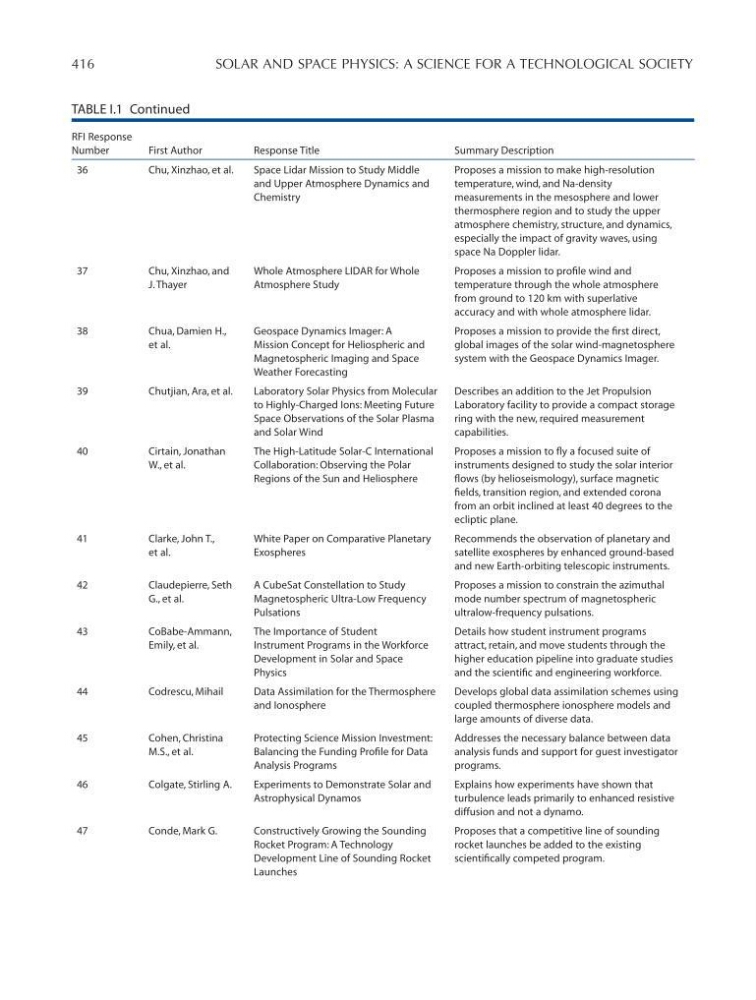
TABLE I.1 Continued
Solar and Space Physics: A Science for a Technological Society
416
SOLAR AND SPACE PHYSICS: A SCIENCE FOR A TECHNOLOGICAL SOCIETY
RFI Response
Number
First Author
Response Title
Summary Description
36
Chu, Xinzhao, et al.
Space Lidar Mission to Study Middle
and Upper Atmosphere Dynamics and
Chemistry
Proposes a mission to make high-resolution
temperature, wind, and Na-density
measurements in the mesosphere and lower
thermosphere region and to study the upper
atmosphere chemistry, structure, and dynamics,
especially the impact of gravity waves, using
space Na Doppler lidar.
37
Chu, Xinzhao, and
J. Thayer
Whole Atmosphere LIDAR for Whole
Atmosphere Study
Proposes a mission to profile wind and
temperature through the whole atmosphere
from ground to 120 km with superlative
accuracy and with whole atmosphere lidar.
38
Chua, Damien H.,
et al.
Geospace Dynamics Imager: A
Mission Concept for Heliospheric and
Magnetospheric Imaging and Space
Weather Forecasting
Proposes a mission to provide the first direct,
global images of the solar wind-magnetosphere
system with the Geospace Dynamics Imager.
39
Chutjian, Ara, et al.
Laboratory Solar Physics from Molecular
to Highly-Charged Ions: Meeting Future
Space Observations of the Solar Plasma
and Solar Wind
Describes an addition to the Jet Propulsion
Laboratory facility to provide a compact storage
ring with the new, required measurement
capabilities.
40
Cirtain, Jonathan
W., et al.
The High-Latitude Solar-C International
Collaboration: Observing the Polar
Regions of the Sun and Heliosphere
Proposes a mission to fly a focused suite of
instruments designed to study the solar interior
flows (by helioseismology), surface magnetic
fields, transition region, and extended corona
from an orbit inclined at least 40 degrees to the
ecliptic plane.
41
Clarke, John T.,
et al.
White Paper on Comparative Planetary
Exospheres
Recommends the observation of planetary and
satellite exospheres by enhanced ground-based
and new Earth-orbiting telescopic instruments.
42
Claudepierre, Seth
G., et al.
A CubeSat Constellation to Study
Magnetospheric Ultra-Low Frequency
Pulsations
Proposes a mission to constrain the azimuthal
mode number spectrum of magnetospheric
ultralow-frequency pulsations.
43
CoBabe-Ammann,
Emily, et al.
The Importance of Student
Instrument Programs in the Workforce
Development in Solar and Space
Physics
Details how student instrument programs
attract, retain, and move students through the
higher education pipeline into graduate studies
and the scientific and engineering workforce.
44
Codrescu, Mihail
Data Assimilation for the Thermosphere
and Ionosphere
Develops global data assimilation schemes using
coupled thermosphere ionosphere models and
large amounts of diverse data.
45
Cohen, Christina
M.S., et al.
Protecting Science Mission Investment:
Balancing the Funding Profile for Data
Analysis Programs
Addresses the necessary balance between data
analysis funds and support for guest investigator
programs.
46
Colgate, Stirling A.
Experiments to Demonstrate Solar and
Astrophysical Dynamos
Explains how experiments have shown that
turbulence leads primarily to enhanced resistive
diffusion and not a dynamo.
47
Conde, Mark G.
Constructively Growing the Sounding
Rocket Program: A Technology
Development Line of Sounding Rocket
Launches
Proposes that a competitive line of sounding
rocket launches be added to the existing
scientifically competed program.
TABLE I.1 Continued