

Copyright © National Academy of Sciences. All rights reserved.
Solar and Space Physics: A Science for a Technological Society
APPENDIX I
415
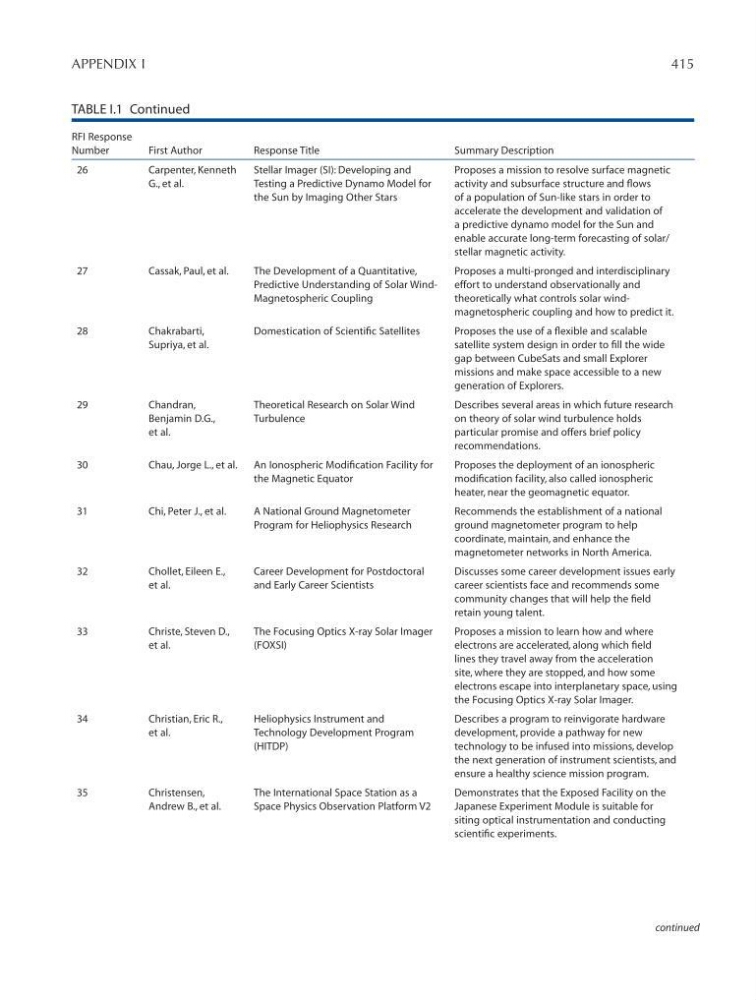
RFI Response
Number
First Author
Response Title
Summary Description
26
Carpenter, Kenneth
G., et al.
Stellar Imager (SI): Developing and
Testing a Predictive Dynamo Model for
the Sun by Imaging Other Stars
Proposes a mission to resolve surface magnetic
activity and subsurface structure and flows
of a population of Sun-like stars in order to
accelerate the development and validation of
a predictive dynamo model for the Sun and
enable accurate long-term forecasting of solar/
stellar magnetic activity.
27
Cassak, Paul, et al.
The Development of a Quantitative,
Predictive Understanding of Solar WindMagnetospheric Coupling
Proposes a multi-pronged and interdisciplinary
effort to understand observationally and
theoretically what controls solar windmagnetospheric coupling and how to predict it.
28
Chakrabarti,
Supriya, et al.
Domestication of Scientific Satellites
Proposes the use of a flexible and scalable
satellite system design in order to fill the wide
gap between CubeSats and small Explorer
missions and make space accessible to a new
generation of Explorers.
29
Chandran,
Benjamin D.G.,
et al.
Theoretical Research on Solar Wind
Turbulence
Describes several areas in which future research
on theory of solar wind turbulence holds
particular promise and offers brief policy
recommendations.
30
Chau, Jorge L., et al. An Ionospheric Modification Facility for
the Magnetic Equator
Proposes the deployment of an ionospheric
modification facility, also called ionospheric
heater, near the geomagnetic equator.
31
Chi, Peter J., et al.
A National Ground Magnetometer
Program for Heliophysics Research
Recommends the establishment of a national
ground magnetometer program to help
coordinate, maintain, and enhance the
magnetometer networks in North America.
32
Chollet, Eileen E.,
et al.
Career Development for Postdoctoral
and Early Career Scientists
Discusses some career development issues early
career scientists face and recommends some
community changes that will help the field
retain young talent.
33
Christe, Steven D.,
et al.
The Focusing Optics X- ray Solar Imager
(FOXSI)
Proposes a mission to learn how and where
electrons are accelerated, along which field
lines they travel away from the acceleration
site, where they are stopped, and how some
electrons escape into interplanetary space, using
the Focusing Optics X-ray Solar Imager.
34
Christian, Eric R.,
et al.
Heliophysics Instrument and
Technology Development Program
(HITDP)
Describes a program to reinvigorate hardware
development, provide a pathway for new
technology to be infused into missions, develop
the next generation of instrument scientists, and
ensure a healthy science mission program.
35
Christensen,
Andrew B., et al.
The International Space Station as a
Space Physics Observation Platform V2
Demonstrates that the Exposed Facility on the
Japanese Experiment Module is suitable for
siting optical instrumentation and conducting
scientific experiments.
TABLE I.1 Continued
continued
Solar and Space Physics: A Science for a Technological Society
APPENDIX I
415
RFI Response
Number
First Author
Response Title
Summary Description
26
Carpenter, Kenneth
G., et al.
Stellar Imager (SI): Developing and
Testing a Predictive Dynamo Model for
the Sun by Imaging Other Stars
Proposes a mission to resolve surface magnetic
activity and subsurface structure and flows
of a population of Sun-like stars in order to
accelerate the development and validation of
a predictive dynamo model for the Sun and
enable accurate long-term forecasting of solar/
stellar magnetic activity.
27
Cassak, Paul, et al.
The Development of a Quantitative,
Predictive Understanding of Solar WindMagnetospheric Coupling
Proposes a multi-pronged and interdisciplinary
effort to understand observationally and
theoretically what controls solar windmagnetospheric coupling and how to predict it.
28
Chakrabarti,
Supriya, et al.
Domestication of Scientific Satellites
Proposes the use of a flexible and scalable
satellite system design in order to fill the wide
gap between CubeSats and small Explorer
missions and make space accessible to a new
generation of Explorers.
29
Chandran,
Benjamin D.G.,
et al.
Theoretical Research on Solar Wind
Turbulence
Describes several areas in which future research
on theory of solar wind turbulence holds
particular promise and offers brief policy
recommendations.
30
Chau, Jorge L., et al. An Ionospheric Modification Facility for
the Magnetic Equator
Proposes the deployment of an ionospheric
modification facility, also called ionospheric
heater, near the geomagnetic equator.
31
Chi, Peter J., et al.
A National Ground Magnetometer
Program for Heliophysics Research
Recommends the establishment of a national
ground magnetometer program to help
coordinate, maintain, and enhance the
magnetometer networks in North America.
32
Chollet, Eileen E.,
et al.
Career Development for Postdoctoral
and Early Career Scientists
Discusses some career development issues early
career scientists face and recommends some
community changes that will help the field
retain young talent.
33
Christe, Steven D.,
et al.
The Focusing Optics X- ray Solar Imager
(FOXSI)
Proposes a mission to learn how and where
electrons are accelerated, along which field
lines they travel away from the acceleration
site, where they are stopped, and how some
electrons escape into interplanetary space, using
the Focusing Optics X-ray Solar Imager.
34
Christian, Eric R.,
et al.
Heliophysics Instrument and
Technology Development Program
(HITDP)
Describes a program to reinvigorate hardware
development, provide a pathway for new
technology to be infused into missions, develop
the next generation of instrument scientists, and
ensure a healthy science mission program.
35
Christensen,
Andrew B., et al.
The International Space Station as a
Space Physics Observation Platform V2
Demonstrates that the Exposed Facility on the
Japanese Experiment Module is suitable for
siting optical instrumentation and conducting
scientific experiments.
TABLE I.1 Continued
continued