

Copyright © National Academy of Sciences. All rights reserved.
Solar and Space Physics: A Science for a Technological Society
APPENDIX I
417
RFI Response
Number
First Author
Response Title
Summary Description
48
Cooper, John F.,
et al.
Space Weathering Impact on Solar
System Surfaces and Mission Science
Explains how surfaces and atmospheres directly
exposed to space environments of planetary
magnetospheres, the heliosphere, and the
local interstellar environment are eroded and
chemically modified.
49
Coster, Anthea J.,
et al.
Investigations of Global Space Weather
with GPS
Proposes improvements in the global
distribution of ionospheric sensors.
50
Cranmer, Steven
R., et al.
Ultraviolet Coronagraph Spectroscopy:
A Key Capability for Understanding the
Physics of Solar Wind Acceleration
Describes how ultraviolet coronagraph
spectroscopy enables measurements of the
collisionless processes responsible for producing
the solar wind.
51
Davila, Joseph M.,
et al.
The International Space Weather
Initiative (ISWI)
Details the deployment of 100 new instruments
in Africa and around the world, including GPS,
magnetometers, particle detectors, H-alpha
telescopes, and radio spectrographs.
52
Davila, Joseph M.,
et al.
Understanding Magnetic Storage,
Reconnection, and CME Initiation
Recommends the tracing of magnetic fields with
a high-resolution coronagraph.
53
de la Beaujardiere,
Odile, and C. Fesen
Global scintillation prediction
Proposes a systems-approach mission to predict
scintillations from ultra-high frequency to
L-band at all latitudes.
54
de la Beaujardiere,
Odile, and D. Ober
Long-Term Changes in the Ionosphere/
Magnetosphere System and Reliable
Platform for Innovations in Space
Sensors
Recommends that the Defense Weather Satellite
System accommodate instruments that provide
the observations required for long-term trends
in the magnetosphere ionosphere system
as well as provide a reliable “home” for flight
opportunity to test new instruments.
55
Denig, William F.,
et al.
On the Utility of Operational Satellite
Data to Solar and Space Physics
Research
Recommends increased interaction between the
operational and research communities.
56
Desai, Mihir I., et al.
Particle Acceleration and Transport in
the Heliosphere (PATH)
Proposes a mission to determine the
mechanisms responsible for the acceleration
and propagation of SEPs through the inner
heliosphere.
57
Donovan, Eric
The Great Geospace Observatory and
Simultaneous Missions of Opportunity
Presents a novel concept of a cost-effective
multiagency initiative to fly the “Great Geospace
Observatory” and provide a revolutionary threedimensional view of Earth’s plasma environment.
58
Dorelli, John C.,
et al.
A Proposal for a Computational
Heliophysics Innovation Program (CHIP)
Proposes that NASA create a program to ensure
that the heliophysics community keeps up
with the rapidly advancing high performance
computing frontier over the next decade.
59
Doschek, George A. A Concept White Paper for a New
Solar Flare Instrument Designed to
Determine the Plasma Parameters in
the Reconnection Region of Solar Flares
at Flare Onset
Describes a possible Bragg crystal spectrometer
experiment that could provide spectroscopic
plasma diagnostics of the reconnection region
of solar flares, such as electron temperature,
turbulence, flows, and polarization.
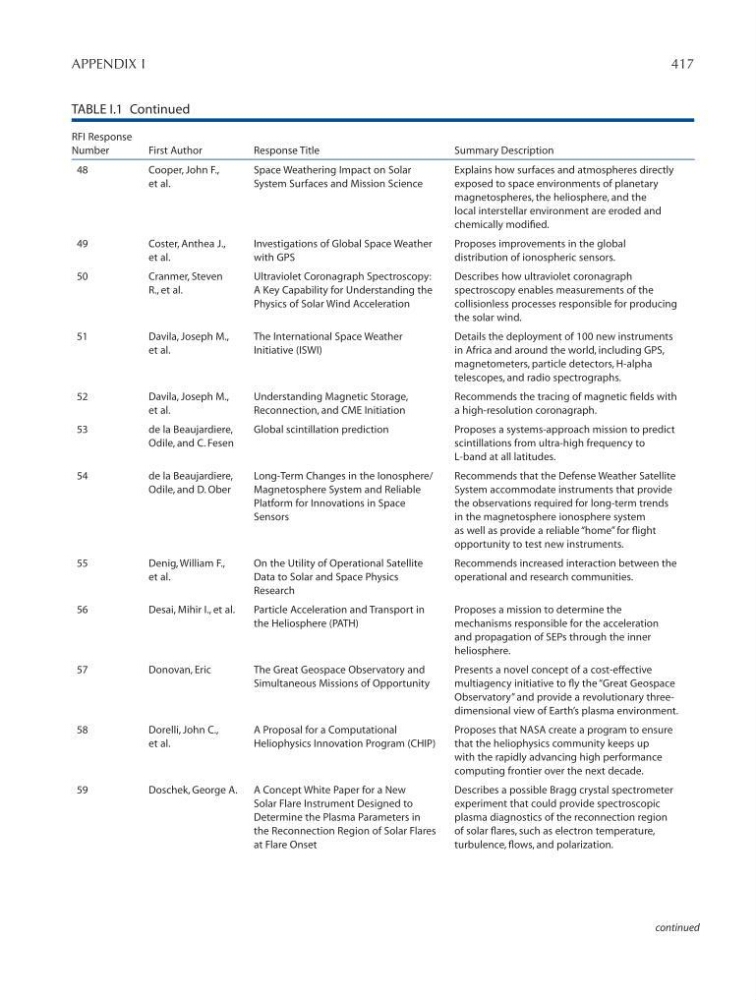
TABLE I.1 Continued
continued
Solar and Space Physics: A Science for a Technological Society
APPENDIX I
417
RFI Response
Number
First Author
Response Title
Summary Description
48
Cooper, John F.,
et al.
Space Weathering Impact on Solar
System Surfaces and Mission Science
Explains how surfaces and atmospheres directly
exposed to space environments of planetary
magnetospheres, the heliosphere, and the
local interstellar environment are eroded and
chemically modified.
49
Coster, Anthea J.,
et al.
Investigations of Global Space Weather
with GPS
Proposes improvements in the global
distribution of ionospheric sensors.
50
Cranmer, Steven
R., et al.
Ultraviolet Coronagraph Spectroscopy:
A Key Capability for Understanding the
Physics of Solar Wind Acceleration
Describes how ultraviolet coronagraph
spectroscopy enables measurements of the
collisionless processes responsible for producing
the solar wind.
51
Davila, Joseph M.,
et al.
The International Space Weather
Initiative (ISWI)
Details the deployment of 100 new instruments
in Africa and around the world, including GPS,
magnetometers, particle detectors, H-alpha
telescopes, and radio spectrographs.
52
Davila, Joseph M.,
et al.
Understanding Magnetic Storage,
Reconnection, and CME Initiation
Recommends the tracing of magnetic fields with
a high-resolution coronagraph.
53
de la Beaujardiere,
Odile, and C. Fesen
Global scintillation prediction
Proposes a systems-approach mission to predict
scintillations from ultra-high frequency to
L-band at all latitudes.
54
de la Beaujardiere,
Odile, and D. Ober
Long-Term Changes in the Ionosphere/
Magnetosphere System and Reliable
Platform for Innovations in Space
Sensors
Recommends that the Defense Weather Satellite
System accommodate instruments that provide
the observations required for long-term trends
in the magnetosphere ionosphere system
as well as provide a reliable “home” for flight
opportunity to test new instruments.
55
Denig, William F.,
et al.
On the Utility of Operational Satellite
Data to Solar and Space Physics
Research
Recommends increased interaction between the
operational and research communities.
56
Desai, Mihir I., et al.
Particle Acceleration and Transport in
the Heliosphere (PATH)
Proposes a mission to determine the
mechanisms responsible for the acceleration
and propagation of SEPs through the inner
heliosphere.
57
Donovan, Eric
The Great Geospace Observatory and
Simultaneous Missions of Opportunity
Presents a novel concept of a cost-effective
multiagency initiative to fly the “Great Geospace
Observatory” and provide a revolutionary threedimensional view of Earth’s plasma environment.
58
Dorelli, John C.,
et al.
A Proposal for a Computational
Heliophysics Innovation Program (CHIP)
Proposes that NASA create a program to ensure
that the heliophysics community keeps up
with the rapidly advancing high performance
computing frontier over the next decade.
59
Doschek, George A. A Concept White Paper for a New
Solar Flare Instrument Designed to
Determine the Plasma Parameters in
the Reconnection Region of Solar Flares
at Flare Onset
Describes a possible Bragg crystal spectrometer
experiment that could provide spectroscopic
plasma diagnostics of the reconnection region
of solar flares, such as electron temperature,
turbulence, flows, and polarization.
TABLE I.1 Continued
continued