

Copyright © National Academy of Sciences. All rights reserved.
Solar and Space Physics: A Science for a Technological Society
APPENDIX E
373
BOX E.1 CATE OUTPUT PRODUCT FOR THE INTERSTELLAR MAPPING AND ACCELERATION
PROBE MISSION
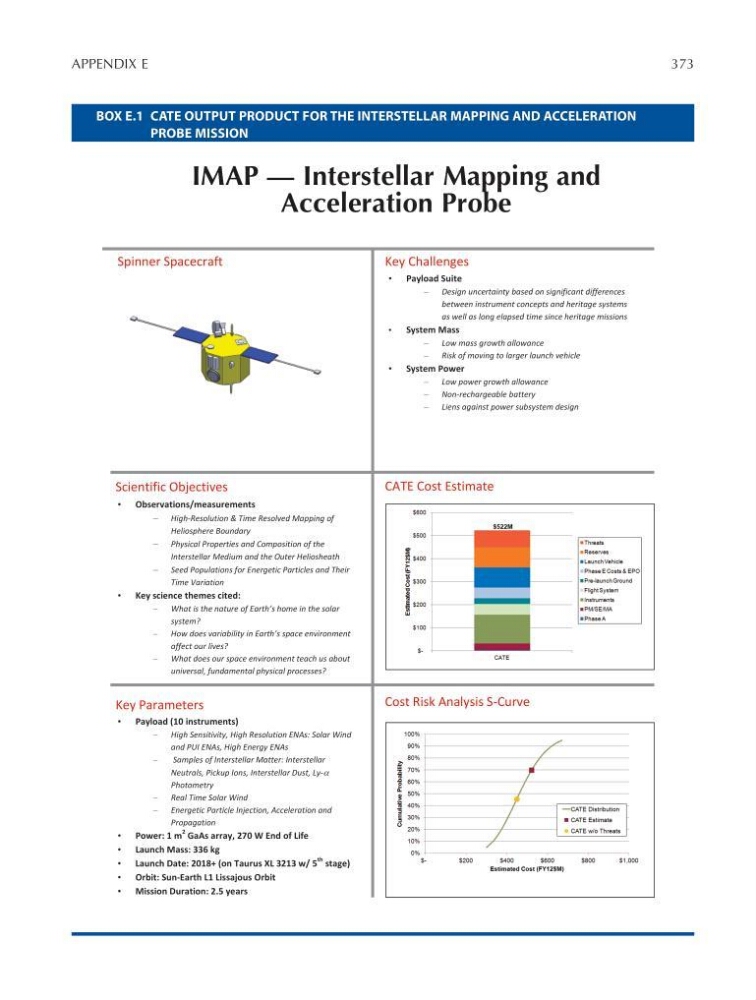
IMAP — Interstellar Mapping and
Acceleration Probe
Spinner Spacecraft
• Payload (10 instruments)
– High Sensitivity, High Resolution ENAs: Solar Wind
and PUI ENAs, High Energy ENAs
–
Samples of Interstellar Matter: Interstellar
Neutrals, Pickup Ions, Interstellar Dust, Ly-α
Photometry
– Real Time Solar Wind
– Energetic Particle Injection, Acceleration and
Propagation
• Power: 1 m
2 GaAs array, 270 W End of Life
• Launch Mass: 336 kg
• Launch Date: 2018+ (on Taurus XL 3213 w/ 5
th stage)
• Orbit: Sun-Earth L1 Lissajous Orbit
• Mission Duration: 2.5 years
• Payload Suite
– Design uncertainty based on significant differences
between instrument concepts and heritage systems
as well as long elapsed time since heritage missions
•
System Mass
– Low mass growth allowance
– Risk of moving to larger launch vehicle
• System Power
– Low power growth allowance
– Non-rechargeable battery
– Liens against power subsystem design
Key Parameters
Key Challenges
CATE Cost Estimate
Cost Risk Analysis S-Curve
Scientific Objectives
• Observations/measurements
– High-Resolution & Time Resolved Mapping of
Heliosphere Boundary
– Physical Properties and Composition of the
Interstellar Medium and the Outer Heliosheath
– Seed Populations for Energetic Particles and Their
Time Variation
• Key science themes cited:
– What is the nature of Earth’s home in the solar
system?
– How does variability in Earth’s space environment
affect our lives?
– What does our space environment teach us about
universal, fundamental physical processes?
Solar and Space Physics: A Science for a Technological Society
APPENDIX E
373
BOX E.1 CATE OUTPUT PRODUCT FOR THE INTERSTELLAR MAPPING AND ACCELERATION
PROBE MISSION
IMAP — Interstellar Mapping and
Acceleration Probe
Spinner Spacecraft
• Payload (10 instruments)
– High Sensitivity, High Resolution ENAs: Solar Wind
and PUI ENAs, High Energy ENAs
–
Samples of Interstellar Matter: Interstellar
Neutrals, Pickup Ions, Interstellar Dust, Ly-α
Photometry
– Real Time Solar Wind
– Energetic Particle Injection, Acceleration and
Propagation
• Power: 1 m
2 GaAs array, 270 W End of Life
• Launch Mass: 336 kg
• Launch Date: 2018+ (on Taurus XL 3213 w/ 5
th stage)
• Orbit: Sun-Earth L1 Lissajous Orbit
• Mission Duration: 2.5 years
• Payload Suite
– Design uncertainty based on significant differences
between instrument concepts and heritage systems
as well as long elapsed time since heritage missions
•
System Mass
– Low mass growth allowance
– Risk of moving to larger launch vehicle
• System Power
– Low power growth allowance
– Non-rechargeable battery
– Liens against power subsystem design
Key Parameters
Key Challenges
CATE Cost Estimate
Cost Risk Analysis S-Curve
Scientific Objectives
• Observations/measurements
– High-Resolution & Time Resolved Mapping of
Heliosphere Boundary
– Physical Properties and Composition of the
Interstellar Medium and the Outer Heliosheath
– Seed Populations for Energetic Particles and Their
Time Variation
• Key science themes cited:
– What is the nature of Earth’s home in the solar
system?
– How does variability in Earth’s space environment
affect our lives?
– What does our space environment teach us about
universal, fundamental physical processes?