

Copyright © National Academy of Sciences. All rights reserved.
Solar and Space Physics: A Science for a Technological Society
374
SOLAR AND SPACE PHYSICS: A SCIENCE FOR A TECHNOLOGICAL SOCIETY
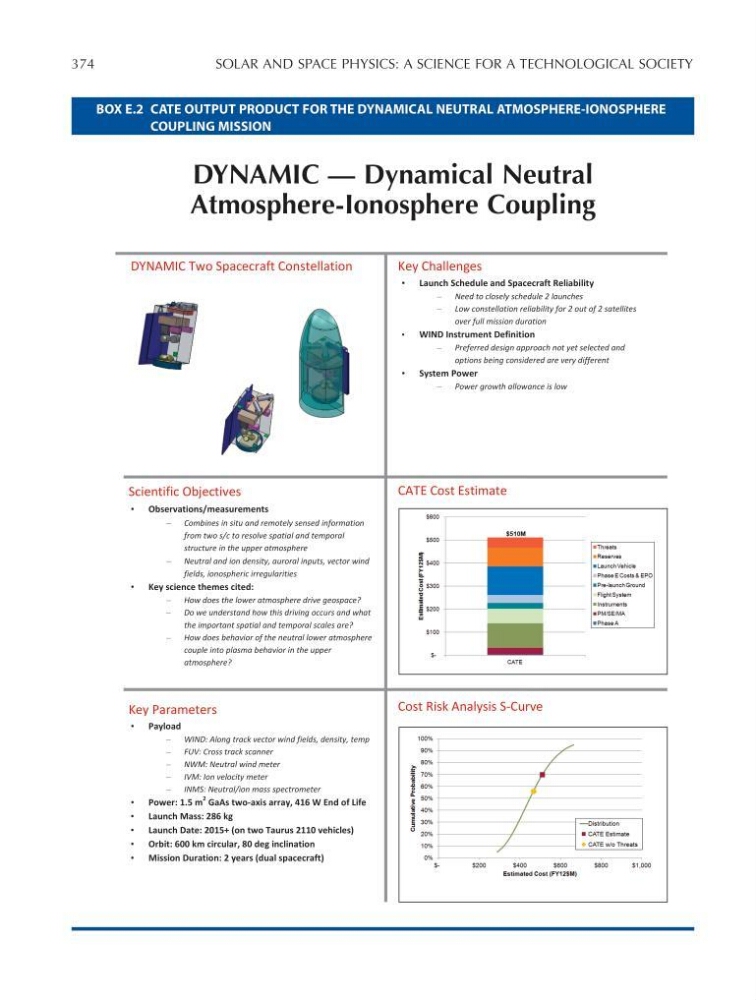
BOX E.2 CATE OUTPUT PRODUCT FOR THE DYNAMICAL NEUTRAL ATMOSPHERE-IONOSPHERE
COUPLING MISSION
• Payload
– WIND: Along track vector wind fields, density, temp
– FUV: Cross track scanner
– NWM: Neutral wind meter
– IVM: Ion velocity meter
– INMS: Neutral/ion mass spectrometer
• Power: 1.5 m
2 GaAs two-axis array, 416 W End of Life
• Launch Mass: 286 kg
• Launch Date: 2015+ (on two Taurus 2110 vehicles)
• Orbit: 600 km circular, 80 deg inclination
• Mission Duration: 2 years (dual spacecraft)
• Launch Schedule and Spacecraft Reliability
– Need to closely schedule 2 launches
– Low constellation reliability for 2 out of 2 satellites
over full mission duration
•
WIND Instrument Definition
–
Preferred design approach not yet selected and
options being considered are very different
• System Power
– Power growth allowance is low
Key Parameters
Key Challenges
CATE Cost Estimate
Cost Risk Analysis S-Curve
Scientific Objectives
• Observations/measurements
– Combines in situ and remotely sensed information
from two s/c to resolve spatial and temporal
structure in the upper atmosphere
– Neutral and ion density, auroral inputs, vector wind
fields, ionospheric irregularities
• Key science themes cited:
– How does the lower atmosphere drive geospace?
– Do we understand how this driving occurs and what
the important spatial and temporal scales are?
– How does behavior of the neutral lower atmosphere
couple into plasma behavior in the upper
atmosphere?
DYNAMIC Two Spacecraft Constellation
DYNAMIC — Dynamical Neutral
Atmosphere-Ionosphere Coupling
Solar and Space Physics: A Science for a Technological Society
374
SOLAR AND SPACE PHYSICS: A SCIENCE FOR A TECHNOLOGICAL SOCIETY
BOX E.2 CATE OUTPUT PRODUCT FOR THE DYNAMICAL NEUTRAL ATMOSPHERE-IONOSPHERE
COUPLING MISSION
• Payload
– WIND: Along track vector wind fields, density, temp
– FUV: Cross track scanner
– NWM: Neutral wind meter
– IVM: Ion velocity meter
– INMS: Neutral/ion mass spectrometer
• Power: 1.5 m
2 GaAs two-axis array, 416 W End of Life
• Launch Mass: 286 kg
• Launch Date: 2015+ (on two Taurus 2110 vehicles)
• Orbit: 600 km circular, 80 deg inclination
• Mission Duration: 2 years (dual spacecraft)
• Launch Schedule and Spacecraft Reliability
– Need to closely schedule 2 launches
– Low constellation reliability for 2 out of 2 satellites
over full mission duration
•
WIND Instrument Definition
–
Preferred design approach not yet selected and
options being considered are very different
• System Power
– Power growth allowance is low
Key Parameters
Key Challenges
CATE Cost Estimate
Cost Risk Analysis S-Curve
Scientific Objectives
• Observations/measurements
– Combines in situ and remotely sensed information
from two s/c to resolve spatial and temporal
structure in the upper atmosphere
– Neutral and ion density, auroral inputs, vector wind
fields, ionospheric irregularities
• Key science themes cited:
– How does the lower atmosphere drive geospace?
– Do we understand how this driving occurs and what
the important spatial and temporal scales are?
– How does behavior of the neutral lower atmosphere
couple into plasma behavior in the upper
atmosphere?
DYNAMIC Two Spacecraft Constellation
DYNAMIC — Dynamical Neutral
Atmosphere-Ionosphere Coupling