

Copyright © National Academy of Sciences. All rights reserved.
Solar and Space Physics: A Science for a Technological Society
APPENDIX E
371
VALIDATION APPROACH
The final step of the CATE process consisted of a series of validation reviews intended to ensure that
the assumptions and corresponding cost and schedule results are based on defensible assumptions, are fair
in their representation of the assessed missions, and are consistent with past missions of similar content
and complexity. The reviews consisted of a mix of both internal and external reviews conducted by the
Aerospace Corporation and by the committee, respectively. The CATE validation tool used for this survey
and all past surveys is the CoBRA tool developed by the Aerospace Corporation. Figures E.7 and E.8 map
the mission candidates onto cost and schedule grids for comparison with successful missions of varying
complexity plus “anchor missions” considered to be similar in size and complexity.
The results show excellent correlation between CATE results for mission concepts compared to successful missions and anchor missions. Therefore, the CATE results are considered compatible with experience, with respect to both cost and schedule. As one would expect, the CATE missions representing a
70th-percentile distribution are generally above the mean. One interesting result, discussed in the next
section, is that the heliospheric anchor missions are generally below the mean trend line.
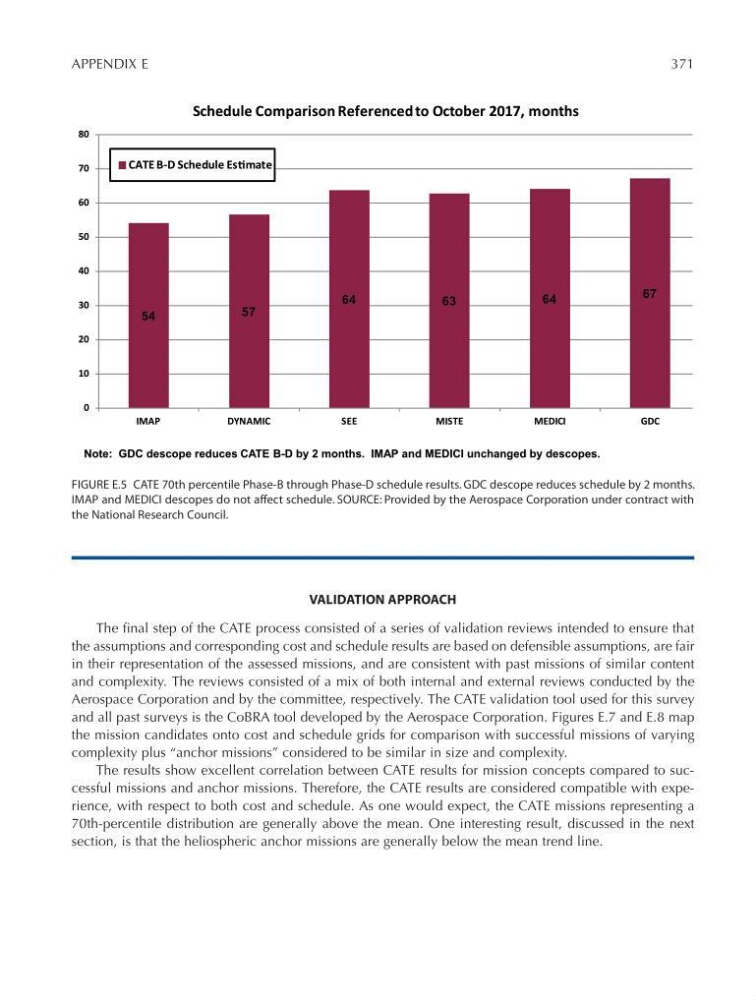
FIGURE E.5 CATE 70th percentile Phase-B through Phase-D schedule results. GDC descope reduces schedule by 2 months.
IMAP and MEDICI descopes do not affect schedule. SOURCE: Provided by the Aerospace Corporation under contract with
the National Research Council.
54
57
64
63
64
67
0
10
20
30
40
50
60
70
80
IMAP
DYNAMIC
S EE
MISTE
M EDICI
G DC
Schedule Comparison Referenced to October 2017, months
CATE B-D Schedule EsƟmate
Note: GDC descope reduces CATE B-D by 2 months. IMAP and MEDICI unchanged by descopes.
Figure E-5
Solar and Space Physics: A Science for a Technological Society
APPENDIX E
371
VALIDATION APPROACH
The final step of the CATE process consisted of a series of validation reviews intended to ensure that
the assumptions and corresponding cost and schedule results are based on defensible assumptions, are fair
in their representation of the assessed missions, and are consistent with past missions of similar content
and complexity. The reviews consisted of a mix of both internal and external reviews conducted by the
Aerospace Corporation and by the committee, respectively. The CATE validation tool used for this survey
and all past surveys is the CoBRA tool developed by the Aerospace Corporation. Figures E.7 and E.8 map
the mission candidates onto cost and schedule grids for comparison with successful missions of varying
complexity plus “anchor missions” considered to be similar in size and complexity.
The results show excellent correlation between CATE results for mission concepts compared to successful missions and anchor missions. Therefore, the CATE results are considered compatible with experience, with respect to both cost and schedule. As one would expect, the CATE missions representing a
70th-percentile distribution are generally above the mean. One interesting result, discussed in the next
section, is that the heliospheric anchor missions are generally below the mean trend line.
FIGURE E.5 CATE 70th percentile Phase-B through Phase-D schedule results. GDC descope reduces schedule by 2 months.
IMAP and MEDICI descopes do not affect schedule. SOURCE: Provided by the Aerospace Corporation under contract with
the National Research Council.
54
57
64
63
64
67
0
10
20
30
40
50
60
70
80
IMAP
DYNAMIC
S EE
MISTE
M EDICI
G DC
Schedule Comparison Referenced to October 2017, months
CATE B-D Schedule EsƟmate
Note: GDC descope reduces CATE B-D by 2 months. IMAP and MEDICI unchanged by descopes.
Figure E-5