

Copyright © National Academy of Sciences. All rights reserved.
Solar and Space Physics: A Science for a Technological Society
370
SOLAR AND SPACE PHYSICS: A SCIENCE FOR A TECHNOLOGICAL SOCIETY
Specific to this survey is the recognition that several large missions are already through formulation
or in the late stages of formulation such that they will become operational in stages that envelop most of
the coming decade. Given the evident funding challenge early in this decade, a frequent mission cadence
via the implementation of small- and medium-class missions over the entire decade is considered more
valuable to the community than the implementation of, at most, one additional large mission.
This “simplified mission strategy” biased toward targeted executable investigations becomes clearer
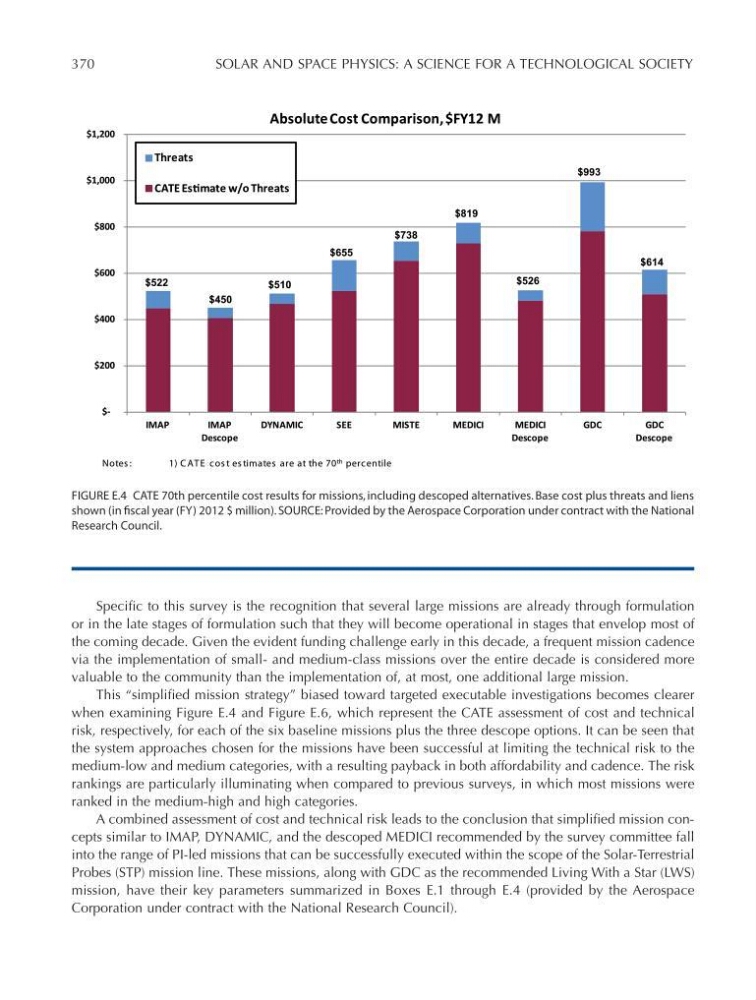
when examining Figure E.4 and Figure E.6, which represent the CATE assessment of cost and technical
risk, respectively, for each of the six baseline missions plus the three descope options. It can be seen that
the system approaches chosen for the missions have been successful at limiting the technical risk to the
medium-low and medium categories, with a resulting payback in both affordability and cadence. The risk
rankings are particularly illuminating when compared to previous surveys, in which most missions were
ranked in the medium-high and high categories.
A combined assessment of cost and technical risk leads to the conclusion that simplified mission concepts similar to IMAP, DYNAMIC, and the descoped MEDICI recommended by the survey committee fall
into the range of PI-led missions that can be successfully executed within the scope of the Solar-Terrestrial
Probes (STP) mission line. These missions, along with GDC as the recommended Living With a Star (LWS)
mission, have their key parameters summarized in Boxes E.1 through E.4 (provided by the Aerospace
Corporation under contract with the National Research Council).
FIGURE E.4 CATE 70th percentile cost results for missions, including descoped alternatives. Base cost plus threats and liens
shown (in fiscal year (FY) 2012 $ million). SOURCE: Provided by the Aerospace Corporation under contract with the National
Research Council.
Notes :
1) C ATE cos t es timates are at the 70 th percentile
$$200
$400
$600
$800
$1,000
$1,200
IMAP
IMAP
Descope
DYNAMIC
S EE
MISTE
M EDICI
M EDICI
Descope
GDC
G DC
Descope
Absolute Cost Comparison, $FY12 M
Threats
CATE EsƟmate w/o Threats
$522
$450
$738
$819
$655
$993
$510
$526
$614
Figure E-4
Solar and Space Physics: A Science for a Technological Society
370
SOLAR AND SPACE PHYSICS: A SCIENCE FOR A TECHNOLOGICAL SOCIETY
Specific to this survey is the recognition that several large missions are already through formulation
or in the late stages of formulation such that they will become operational in stages that envelop most of
the coming decade. Given the evident funding challenge early in this decade, a frequent mission cadence
via the implementation of small- and medium-class missions over the entire decade is considered more
valuable to the community than the implementation of, at most, one additional large mission.
This “simplified mission strategy” biased toward targeted executable investigations becomes clearer
when examining Figure E.4 and Figure E.6, which represent the CATE assessment of cost and technical
risk, respectively, for each of the six baseline missions plus the three descope options. It can be seen that
the system approaches chosen for the missions have been successful at limiting the technical risk to the
medium-low and medium categories, with a resulting payback in both affordability and cadence. The risk
rankings are particularly illuminating when compared to previous surveys, in which most missions were
ranked in the medium-high and high categories.
A combined assessment of cost and technical risk leads to the conclusion that simplified mission concepts similar to IMAP, DYNAMIC, and the descoped MEDICI recommended by the survey committee fall
into the range of PI-led missions that can be successfully executed within the scope of the Solar-Terrestrial
Probes (STP) mission line. These missions, along with GDC as the recommended Living With a Star (LWS)
mission, have their key parameters summarized in Boxes E.1 through E.4 (provided by the Aerospace
Corporation under contract with the National Research Council).
FIGURE E.4 CATE 70th percentile cost results for missions, including descoped alternatives. Base cost plus threats and liens
shown (in fiscal year (FY) 2012 $ million). SOURCE: Provided by the Aerospace Corporation under contract with the National
Research Council.
Notes :
1) C ATE cos t es timates are at the 70 th percentile
$$200
$400
$600
$800
$1,000
$1,200
IMAP
IMAP
Descope
DYNAMIC
S EE
MISTE
M EDICI
M EDICI
Descope
GDC
G DC
Descope
Absolute Cost Comparison, $FY12 M
Threats
CATE EsƟmate w/o Threats
$522
$450
$738
$819
$655
$993
$510
$526
$614
Figure E-4