

Copyright © National Academy of Sciences. All rights reserved.
Solar and Space Physics: A Science for a Technological Society
278
SOLAR AND SPACE PHYSICS: A SCIENCE FOR A TECHNOLOGICAL SOCIETY
SEP events are usually associated with strong shocks at 1 AU, there is seldom a one-to-one correspondence
between observations and theory, and this shows the need for near-Sun measurements.
Solar-cycle 23 produced about 100 large SEP events, including the largest ground-level event (observed
with neutron monitors) since 1956. New instrumentation on ACE, SOHO, and Wind permitted important
advances in measuring SEP elemental, isotopic, and ionic-charge-state composition from H to Ni (1 ≤ Z
≤ 28). SEP composition and spectral variations depend on ionic charge-to-mass (Q/M) ratios, probably
because of interactions with excited waves and variable shock geometry, but testing acceleration and
transport models will require near-Sun measurements where most of the acceleration occurs. SEPs remain
a major radiation hazard for spacecraft and astronauts, but the discovery that relativistic electrons provide
about a 1-hour warning of arriving SEP ions has provided a new forecast tool (motivation M2).
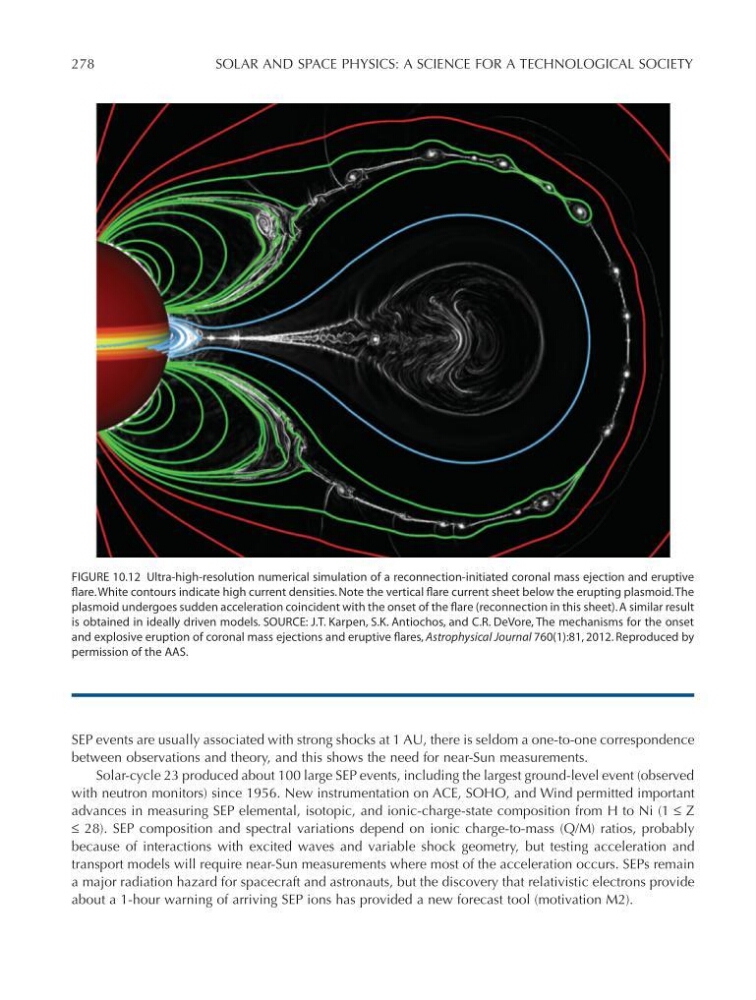
FIGURE 10.12 Ultra-high-resolution numerical simulation of a reconnection-initiated coronal mass ejection and eruptive
flare. White contours indicate high current densities. Note the vertical flare current sheet below the erupting plasmoid. The
plasmoid undergoes sudden acceleration coincident with the onset of the flare (reconnection in this sheet). A similar result
is obtained in ideally driven models. SOURCE: J.T. Karpen, S.K. Antiochos, and C.R. DeVore, The mechanisms for the onset
and explosive eruption of coronal mass ejections and eruptive flares, Astrophysical Journal 760(1):81, 2012. Reproduced by
permission of the AAS.
Figure 2-8 and 10-12
Solar and Space Physics: A Science for a Technological Society
278
SOLAR AND SPACE PHYSICS: A SCIENCE FOR A TECHNOLOGICAL SOCIETY
SEP events are usually associated with strong shocks at 1 AU, there is seldom a one-to-one correspondence
between observations and theory, and this shows the need for near-Sun measurements.
Solar-cycle 23 produced about 100 large SEP events, including the largest ground-level event (observed
with neutron monitors) since 1956. New instrumentation on ACE, SOHO, and Wind permitted important
advances in measuring SEP elemental, isotopic, and ionic-charge-state composition from H to Ni (1 ≤ Z
≤ 28). SEP composition and spectral variations depend on ionic charge-to-mass (Q/M) ratios, probably
because of interactions with excited waves and variable shock geometry, but testing acceleration and
transport models will require near-Sun measurements where most of the acceleration occurs. SEPs remain
a major radiation hazard for spacecraft and astronauts, but the discovery that relativistic electrons provide
about a 1-hour warning of arriving SEP ions has provided a new forecast tool (motivation M2).
FIGURE 10.12 Ultra-high-resolution numerical simulation of a reconnection-initiated coronal mass ejection and eruptive
flare. White contours indicate high current densities. Note the vertical flare current sheet below the erupting plasmoid. The
plasmoid undergoes sudden acceleration coincident with the onset of the flare (reconnection in this sheet). A similar result
is obtained in ideally driven models. SOURCE: J.T. Karpen, S.K. Antiochos, and C.R. DeVore, The mechanisms for the onset
and explosive eruption of coronal mass ejections and eruptive flares, Astrophysical Journal 760(1):81, 2012. Reproduced by
permission of the AAS.
Figure 2-8 and 10-12