

Copyright © National Academy of Sciences. All rights reserved.
Solar and Space Physics: A Science for a Technological Society
REPORT OF THE PANEL ON SOLAR AND HELIOSPHERIC PHYSICS
279
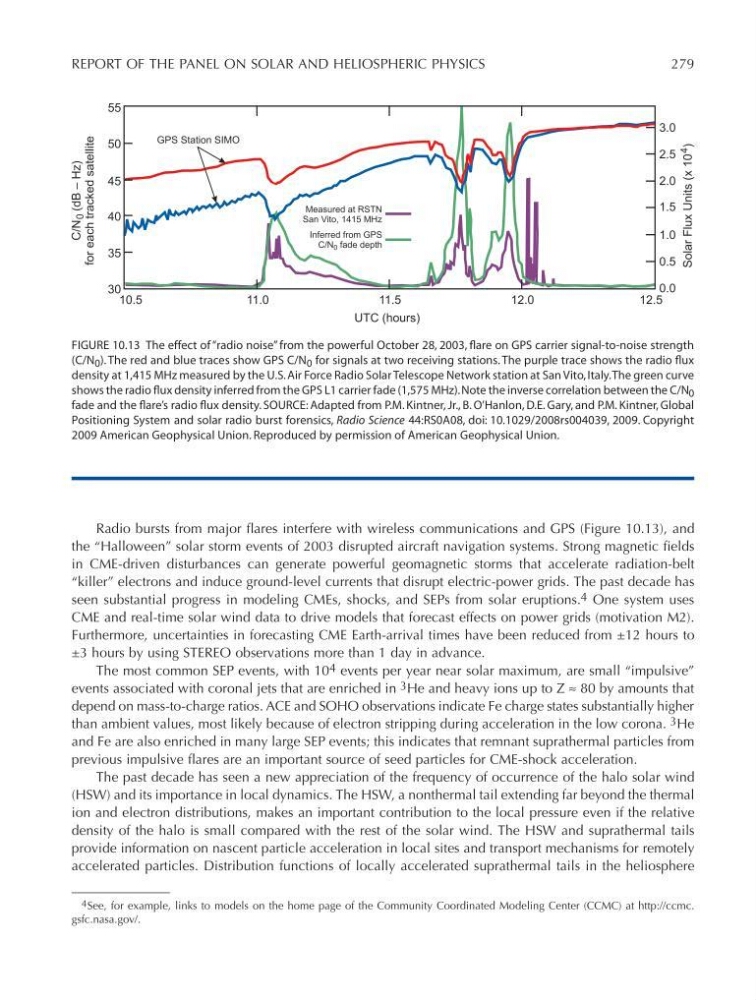
Radio bursts from major flares interfere with wireless communications and GPS (Figure 10.13), and
the “Halloween” solar storm events of 2003 disrupted aircraft navigation systems. Strong magnetic fields
in CME-driven disturbances can generate powerful geomagnetic storms that accelerate radiation-belt
“killer” electrons and induce ground-level currents that disrupt electric-power grids. The past decade has
seen substantial progress in modeling CMEs, shocks, and SEPs from solar eruptions. 4 One system uses
CME and real-time solar wind data to drive models that forecast effects on power grids (motivation M2).
Furthermore, uncertainties in forecasting CME Earth-arrival times have been reduced from ±12 hours to
±3 hours by using STEREO observations more than 1 day in advance.
The most common SEP events, with 10 4 events per year near solar maximum, are small “impulsive”
events associated with coronal jets that are enriched in 3 He and heavy ions up to Z ≈ 80 by amounts that
depend on mass-to-charge ratios. ACE and SOHO observations indicate Fe charge states substantially higher
than ambient values, most likely because of electron stripping during acceleration in the low corona. 3 He
and Fe are also enriched in many large SEP events; this indicates that remnant suprathermal particles from
previous impulsive flares are an important source of seed particles for CME-shock acceleration.
The past decade has seen a new appreciation of the frequency of occurrence of the halo solar wind
(HSW) and its importance in local dynamics. The HSW, a nonthermal tail extending far beyond the thermal
ion and electron distributions, makes an important contribution to the local pressure even if the relative
density of the halo is small compared with the rest of the solar wind. The HSW and suprathermal tails
provide information on nascent particle acceleration in local sites and transport mechanisms for remotely
accelerated particles. Distribution functions of locally accelerated suprathermal tails in the heliosphere
4 See, for example, links to models on the home page of the Community Coordinated Modeling Center (CCMC) at http://ccmc.
gsfc.nasa.gov/.
FIGURE 10.13 The effect of “radio noise” from the powerful October 28, 2003, flare on GPS carrier signal-to-noise strength
(C/N 0 ). The red and blue traces show GPS C/N 0 for signals at two receiving stations. The purple trace shows the radio flux
density at 1,415 MHz measured by the U.S. Air Force Radio Solar Telescope Network station at San Vito, Italy. The green curve
shows the radio flux density inferred from the GPS L1 carrier fade (1,575 MHz). Note the inverse correlation between the C/N 0
fade and the flare’s radio flux density. SOURCE: Adapted from P.M. Kintner, Jr., B. O’Hanlon, D.E. Gary, and P.M. Kintner, Global
Positioning System and solar radio burst forensics, Radio Science 44:RS0A08, doi: 10.1029/2008rs004039, 2009. Copyright
2009 American Geophysical Union. Reproduced by permission of American Geophysical Union.
Figure 10-13 replaced
Solar and Space Physics: A Science for a Technological Society
REPORT OF THE PANEL ON SOLAR AND HELIOSPHERIC PHYSICS
279
Radio bursts from major flares interfere with wireless communications and GPS (Figure 10.13), and
the “Halloween” solar storm events of 2003 disrupted aircraft navigation systems. Strong magnetic fields
in CME-driven disturbances can generate powerful geomagnetic storms that accelerate radiation-belt
“killer” electrons and induce ground-level currents that disrupt electric-power grids. The past decade has
seen substantial progress in modeling CMEs, shocks, and SEPs from solar eruptions. 4 One system uses
CME and real-time solar wind data to drive models that forecast effects on power grids (motivation M2).
Furthermore, uncertainties in forecasting CME Earth-arrival times have been reduced from ±12 hours to
±3 hours by using STEREO observations more than 1 day in advance.
The most common SEP events, with 10 4 events per year near solar maximum, are small “impulsive”
events associated with coronal jets that are enriched in 3 He and heavy ions up to Z ≈ 80 by amounts that
depend on mass-to-charge ratios. ACE and SOHO observations indicate Fe charge states substantially higher
than ambient values, most likely because of electron stripping during acceleration in the low corona. 3 He
and Fe are also enriched in many large SEP events; this indicates that remnant suprathermal particles from
previous impulsive flares are an important source of seed particles for CME-shock acceleration.
The past decade has seen a new appreciation of the frequency of occurrence of the halo solar wind
(HSW) and its importance in local dynamics. The HSW, a nonthermal tail extending far beyond the thermal
ion and electron distributions, makes an important contribution to the local pressure even if the relative
density of the halo is small compared with the rest of the solar wind. The HSW and suprathermal tails
provide information on nascent particle acceleration in local sites and transport mechanisms for remotely
accelerated particles. Distribution functions of locally accelerated suprathermal tails in the heliosphere
4 See, for example, links to models on the home page of the Community Coordinated Modeling Center (CCMC) at http://ccmc.
gsfc.nasa.gov/.
FIGURE 10.13 The effect of “radio noise” from the powerful October 28, 2003, flare on GPS carrier signal-to-noise strength
(C/N 0 ). The red and blue traces show GPS C/N 0 for signals at two receiving stations. The purple trace shows the radio flux
density at 1,415 MHz measured by the U.S. Air Force Radio Solar Telescope Network station at San Vito, Italy. The green curve
shows the radio flux density inferred from the GPS L1 carrier fade (1,575 MHz). Note the inverse correlation between the C/N 0
fade and the flare’s radio flux density. SOURCE: Adapted from P.M. Kintner, Jr., B. O’Hanlon, D.E. Gary, and P.M. Kintner, Global
Positioning System and solar radio burst forensics, Radio Science 44:RS0A08, doi: 10.1029/2008rs004039, 2009. Copyright
2009 American Geophysical Union. Reproduced by permission of American Geophysical Union.
Figure 10-13 replaced