

Copyright © National Academy of Sciences. All rights reserved.
Solar and Space Physics: A Science for a Technological Society
REPORT OF THE PANEL ON SOLAR WIND-MAGNETOSPHERE INTERACTIONS
249
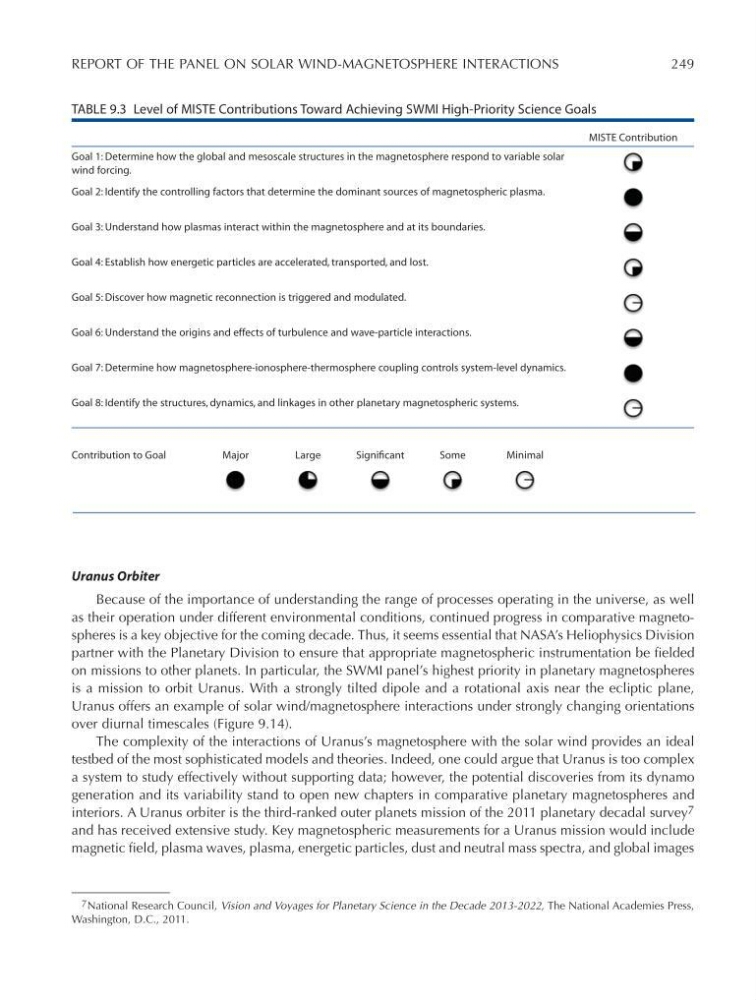
TABLE 9.3 Level of MISTE Contributions Toward Achieving SWMI High-Priority Science Goals
MISTE Contribution
Goal 1: Determine how the global and mesoscale structures in the magnetosphere respond to variable solar
wind forcing.
Goal 2: Identify the controlling factors that determine the dominant sources of magnetospheric plasma.
Goal 3: Understand how plasmas interact within the magnetosphere and at its boundaries.
Goal 4: Establish how energetic particles are accelerated, transported, and lost.
Goal 5: Discover how magnetic reconnection is triggered and modulated.
Goal 6: Understand the origins and effects of turbulence and wave-particle interactions.
Goal 7: Determine how magnetosphere-ionosphere-thermosphere coupling controls system-level dynamics.
Goal 8: Identify the structures, dynamics, and linkages in other planetary magnetospheric systems.
Contribution to Goal
Major
Large
Significant
Some
Minimal
Uranus Orbiter
Because of the importance of understanding the range of processes operating in the universe, as well
as their operation under different environmental conditions, continued progress in comparative magnetospheres is a key objective for the coming decade. Thus, it seems essential that NASA’s Heliophysics Division
partner with the Planetary Division to ensure that appropriate magnetospheric instrumentation be fielded
on missions to other planets. In particular, the SWMI panel’s highest priority in planetary magnetospheres
is a mission to orbit Uranus. With a strongly tilted dipole and a rotational axis near the ecliptic plane,
Uranus offers an example of solar wind/magnetosphere interactions under strongly changing orientations
over diurnal timescales (Figure 9.14).
The complexity of the interactions of Uranus’s magnetosphere with the solar wind provides an ideal
testbed of the most sophisticated models and theories. Indeed, one could argue that Uranus is too complex
a system to study effectively without supporting data; however, the potential discoveries from its dynamo
generation and its variability stand to open new chapters in comparative planetary magnetospheres and
interiors. A Uranus orbiter is the third-ranked outer planets mission of the 2011 planetary decadal survey 7
and has received extensive study. Key magnetospheric measurements for a Uranus mission would include
magnetic field, plasma waves, plasma, energetic particles, dust and neutral mass spectra, and global images
7 National Research Council, Vision and Voyages for Planetary Science in the Decade 2013-2022, The National Academies Press,
Washington, D.C., 2011.
Solar and Space Physics: A Science for a Technological Society
REPORT OF THE PANEL ON SOLAR WIND-MAGNETOSPHERE INTERACTIONS
249
TABLE 9.3 Level of MISTE Contributions Toward Achieving SWMI High-Priority Science Goals
MISTE Contribution
Goal 1: Determine how the global and mesoscale structures in the magnetosphere respond to variable solar
wind forcing.
Goal 2: Identify the controlling factors that determine the dominant sources of magnetospheric plasma.
Goal 3: Understand how plasmas interact within the magnetosphere and at its boundaries.
Goal 4: Establish how energetic particles are accelerated, transported, and lost.
Goal 5: Discover how magnetic reconnection is triggered and modulated.
Goal 6: Understand the origins and effects of turbulence and wave-particle interactions.
Goal 7: Determine how magnetosphere-ionosphere-thermosphere coupling controls system-level dynamics.
Goal 8: Identify the structures, dynamics, and linkages in other planetary magnetospheric systems.
Contribution to Goal
Major
Large
Significant
Some
Minimal
Uranus Orbiter
Because of the importance of understanding the range of processes operating in the universe, as well
as their operation under different environmental conditions, continued progress in comparative magnetospheres is a key objective for the coming decade. Thus, it seems essential that NASA’s Heliophysics Division
partner with the Planetary Division to ensure that appropriate magnetospheric instrumentation be fielded
on missions to other planets. In particular, the SWMI panel’s highest priority in planetary magnetospheres
is a mission to orbit Uranus. With a strongly tilted dipole and a rotational axis near the ecliptic plane,
Uranus offers an example of solar wind/magnetosphere interactions under strongly changing orientations
over diurnal timescales (Figure 9.14).
The complexity of the interactions of Uranus’s magnetosphere with the solar wind provides an ideal
testbed of the most sophisticated models and theories. Indeed, one could argue that Uranus is too complex
a system to study effectively without supporting data; however, the potential discoveries from its dynamo
generation and its variability stand to open new chapters in comparative planetary magnetospheres and
interiors. A Uranus orbiter is the third-ranked outer planets mission of the 2011 planetary decadal survey 7
and has received extensive study. Key magnetospheric measurements for a Uranus mission would include
magnetic field, plasma waves, plasma, energetic particles, dust and neutral mass spectra, and global images
7 National Research Council, Vision and Voyages for Planetary Science in the Decade 2013-2022, The National Academies Press,
Washington, D.C., 2011.