

Copyright © National Academy of Sciences. All rights reserved.
Solar and Space Physics: A Science for a Technological Society
250
SOLAR AND SPACE PHYSICS: A SCIENCE FOR A TECHNOLOGICAL SOCIETY
in UV, IR, and ENA. To make continued exciting progress toward understanding other magnetospheres,
the SWMI panel concluded with the following SWMI imperative:
SWMI Imperative: Through partnership between NASA’s Heliophysics Division and Planetary Division, ensure that appropriate magnetospheric instrumentation is fielded on missions to other planets. In
particular, the SWMI panel’s highest priority in planetary magnetospheres is a mission to orbit Uranus.
9.5.2.5 Future Strategic Missions
Determining how mesoscale and global structures in the magnetosphere respond to variable solar
wind forcing and understanding how plasmas interact within the magnetosphere and at its boundaries
both require observations that match these scales. This effort essentially necessitates global-scale imaging
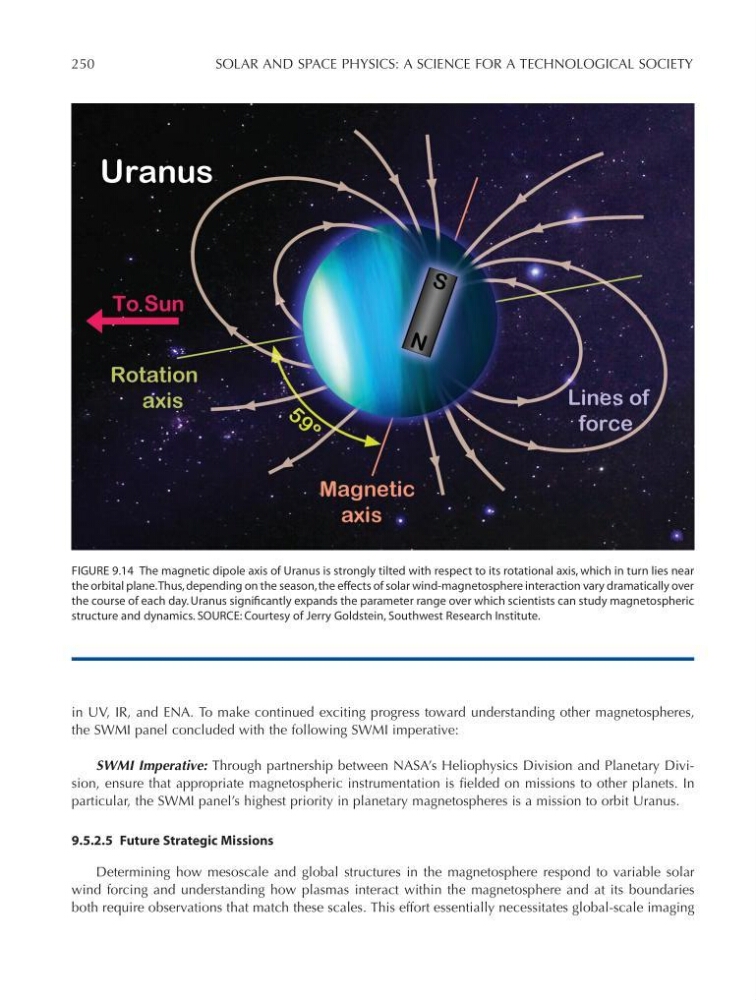
FIGURE 9.14 The magnetic dipole axis of Uranus is strongly tilted with respect to its rotational axis, which in turn lies near
the orbital plane. Thus, depending on the season, the effects of solar wind-magnetosphere interaction vary dramatically over
the course of each day. Uranus significantly expands the parameter range over which scientists can study magnetospheric
structure and dynamics. SOURCE: Courtesy of Jerry Goldstein, Southwest Research Institute.
Figure 9-14
Solar and Space Physics: A Science for a Technological Society
250
SOLAR AND SPACE PHYSICS: A SCIENCE FOR A TECHNOLOGICAL SOCIETY
in UV, IR, and ENA. To make continued exciting progress toward understanding other magnetospheres,
the SWMI panel concluded with the following SWMI imperative:
SWMI Imperative: Through partnership between NASA’s Heliophysics Division and Planetary Division, ensure that appropriate magnetospheric instrumentation is fielded on missions to other planets. In
particular, the SWMI panel’s highest priority in planetary magnetospheres is a mission to orbit Uranus.
9.5.2.5 Future Strategic Missions
Determining how mesoscale and global structures in the magnetosphere respond to variable solar
wind forcing and understanding how plasmas interact within the magnetosphere and at its boundaries
both require observations that match these scales. This effort essentially necessitates global-scale imaging
FIGURE 9.14 The magnetic dipole axis of Uranus is strongly tilted with respect to its rotational axis, which in turn lies near
the orbital plane. Thus, depending on the season, the effects of solar wind-magnetosphere interaction vary dramatically over
the course of each day. Uranus significantly expands the parameter range over which scientists can study magnetospheric
structure and dynamics. SOURCE: Courtesy of Jerry Goldstein, Southwest Research Institute.
Figure 9-14