

Copyright © National Academy of Sciences. All rights reserved.
Solar and Space Physics: A Science for a Technological Society
REPORT OF THE PANEL ON SOLAR WIND-MAGNETOSPHERE INTERACTIONS
243
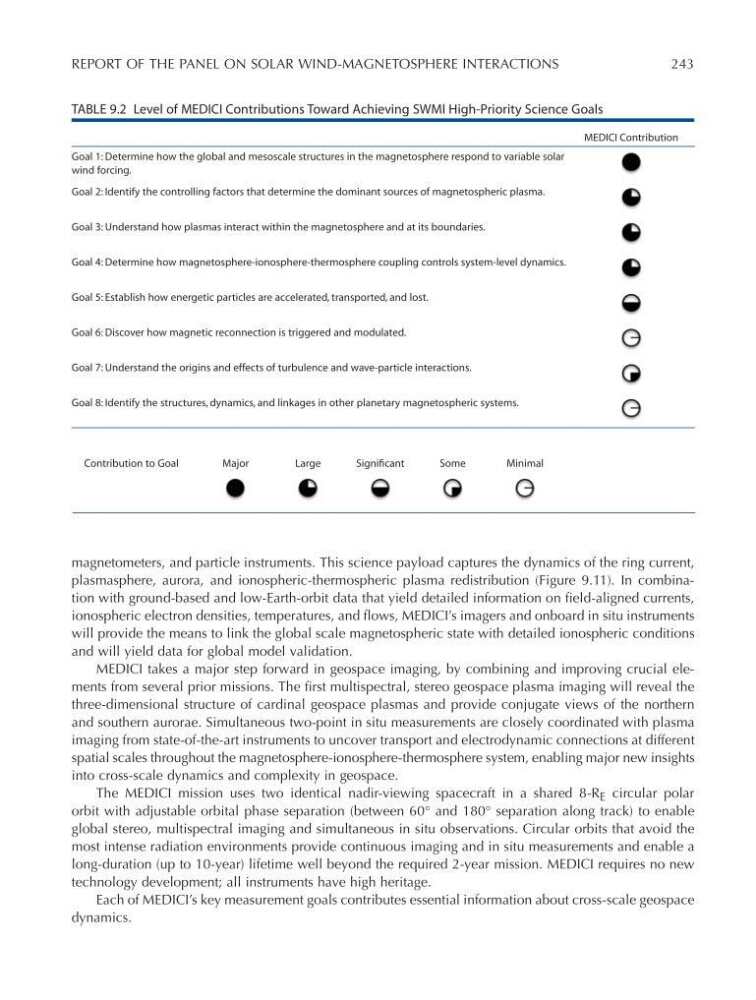
TABLE 9.2 Level of MEDICI Contributions Toward Achieving SWMI High-Priority Science Goals
MEDICI Contribution
Goal 1: Determine how the global and mesoscale structures in the magnetosphere respond to variable solar
wind forcing.
Goal 2: Identify the controlling factors that determine the dominant sources of magnetospheric plasma.
Goal 3: Understand how plasmas interact within the magnetosphere and at its boundaries.
Goal 4: Determine how magnetosphere-ionosphere-thermosphere coupling controls system-level dynamics.
Goal 5: Establish how energetic particles are accelerated, transported, and lost.
Goal 6: Discover how magnetic reconnection is triggered and modulated.
Goal 7: Understand the origins and effects of turbulence and wave-particle interactions.
Goal 8: Identify the structures, dynamics, and linkages in other planetary magnetospheric systems.
Contribution to Goal
Major
Large
Significant
Some
Minimal
magnetometers, and particle instruments. This science payload captures the dynamics of the ring current,
plasmasphere, aurora, and ionospheric-thermospheric plasma redistribution (Figure 9.11). In combination with ground-based and low-Earth-orbit data that yield detailed information on field-aligned currents,
ionospheric electron densities, temperatures, and flows, MEDICI’s imagers and onboard in situ instruments
will provide the means to link the global scale magnetospheric state with detailed ionospheric conditions
and will yield data for global model validation.
MEDICI takes a major step forward in geospace imaging, by combining and improving crucial elements from several prior missions. The first multispectral, stereo geospace plasma imaging will reveal the
three-dimensional structure of cardinal geospace plasmas and provide conjugate views of the northern
and southern aurorae. Simultaneous two-point in situ measurements are closely coordinated with plasma
imaging from state-of-the-art instruments to uncover transport and electrodynamic connections at different
spatial scales throughout the magnetosphere-ionosphere-thermosphere system, enabling major new insights
into cross-scale dynamics and complexity in geospace.
The MEDICI mission uses two identical nadir-viewing spacecraft in a shared 8-R E circular polar
orbit with adjustable orbital phase separation (between 60° and 180° separation along track) to enable
global stereo, multispectral imaging and simultaneous in situ observations. Circular orbits that avoid the
most intense radiation environments provide continuous imaging and in situ measurements and enable a
long-duration (up to 10-year) lifetime well beyond the required 2-year mission. MEDICI requires no new
technology development; all instruments have high heritage.
Each of MEDICI’s key measurement goals contributes essential information about cross-scale geospace
dynamics.
Solar and Space Physics: A Science for a Technological Society
REPORT OF THE PANEL ON SOLAR WIND-MAGNETOSPHERE INTERACTIONS
243
TABLE 9.2 Level of MEDICI Contributions Toward Achieving SWMI High-Priority Science Goals
MEDICI Contribution
Goal 1: Determine how the global and mesoscale structures in the magnetosphere respond to variable solar
wind forcing.
Goal 2: Identify the controlling factors that determine the dominant sources of magnetospheric plasma.
Goal 3: Understand how plasmas interact within the magnetosphere and at its boundaries.
Goal 4: Determine how magnetosphere-ionosphere-thermosphere coupling controls system-level dynamics.
Goal 5: Establish how energetic particles are accelerated, transported, and lost.
Goal 6: Discover how magnetic reconnection is triggered and modulated.
Goal 7: Understand the origins and effects of turbulence and wave-particle interactions.
Goal 8: Identify the structures, dynamics, and linkages in other planetary magnetospheric systems.
Contribution to Goal
Major
Large
Significant
Some
Minimal
magnetometers, and particle instruments. This science payload captures the dynamics of the ring current,
plasmasphere, aurora, and ionospheric-thermospheric plasma redistribution (Figure 9.11). In combination with ground-based and low-Earth-orbit data that yield detailed information on field-aligned currents,
ionospheric electron densities, temperatures, and flows, MEDICI’s imagers and onboard in situ instruments
will provide the means to link the global scale magnetospheric state with detailed ionospheric conditions
and will yield data for global model validation.
MEDICI takes a major step forward in geospace imaging, by combining and improving crucial elements from several prior missions. The first multispectral, stereo geospace plasma imaging will reveal the
three-dimensional structure of cardinal geospace plasmas and provide conjugate views of the northern
and southern aurorae. Simultaneous two-point in situ measurements are closely coordinated with plasma
imaging from state-of-the-art instruments to uncover transport and electrodynamic connections at different
spatial scales throughout the magnetosphere-ionosphere-thermosphere system, enabling major new insights
into cross-scale dynamics and complexity in geospace.
The MEDICI mission uses two identical nadir-viewing spacecraft in a shared 8-R E circular polar
orbit with adjustable orbital phase separation (between 60° and 180° separation along track) to enable
global stereo, multispectral imaging and simultaneous in situ observations. Circular orbits that avoid the
most intense radiation environments provide continuous imaging and in situ measurements and enable a
long-duration (up to 10-year) lifetime well beyond the required 2-year mission. MEDICI requires no new
technology development; all instruments have high heritage.
Each of MEDICI’s key measurement goals contributes essential information about cross-scale geospace
dynamics.