

Copyright © National Academy of Sciences. All rights reserved.
Solar and Space Physics: A Science for a Technological Society
242
SOLAR AND SPACE PHYSICS: A SCIENCE FOR A TECHNOLOGICAL SOCIETY
Science Objectives. Geospace is intrinsically interconnected over diverse scales of space and time. Plasma
and fields in the ionosphere and magnetosphere interact, and multiple processes compete simultaneously.
Observation of the relationships among components is critical to understand and characterize collective
behavior of this complex system across a broad range of spatial scales. MEDICI’s science questions address
how the magnetosphere-ionosphere-thermosphere system is coupled and responds to solar and magnetospheric forcing. In particular, this mission concept directly addresses SWMI critical science goals 1 and 4,
with very significant contributions as well to science goals 2 and 3 (Table 9.2).
MEDICI provides definitive, comprehensive answers to two fundamental science questions that have
been outstanding for decades: (1) How are magnetospheric and ionospheric plasma transported and accelerated by solar wind forcing and magnetosphere-ionosphere coupling? (2) How do magnetospheric and
ionospheric plasma pressure and currents drive cross-scale electric and magnetic fields, and how do these
fields in turn govern the plasma dynamics? Each of these two linked questions focuses on a crucial aspect
of the coupled dynamics of geospace. The first question looks at plasma transport: How are the cross-scale,
dynamic, three-dimensional plasma structures of the ring current, plasmasphere, and aurora reshaped by
acceleration and transport, what controls when and where ionospheric outflow occurs, and what are the
cross-scale effects on the system? The second question targets the electrodynamics of magnetosphereionosphere coupling: What are the cross-scale, interhemispheric structure and timing of currents and fields
that mediate magnetosphere-ionosphere coupling, and how do these MI coupling electromagnetic fields
feed back into the system to affect the plasmas that generated them?
Mission Concept. MEDICI is a cross-scale science mission concept that uses both high-resolution stereo
imaging and multipoint in situ measurements; as described in Part I of the report, MEDICI is an STP-class
strategic mission, but PI-led, following the Planetary Division’s Discovery mission class. It also incorporates an array of contemporaneously existing ground-based and orbiting observatories. MEDICI employs
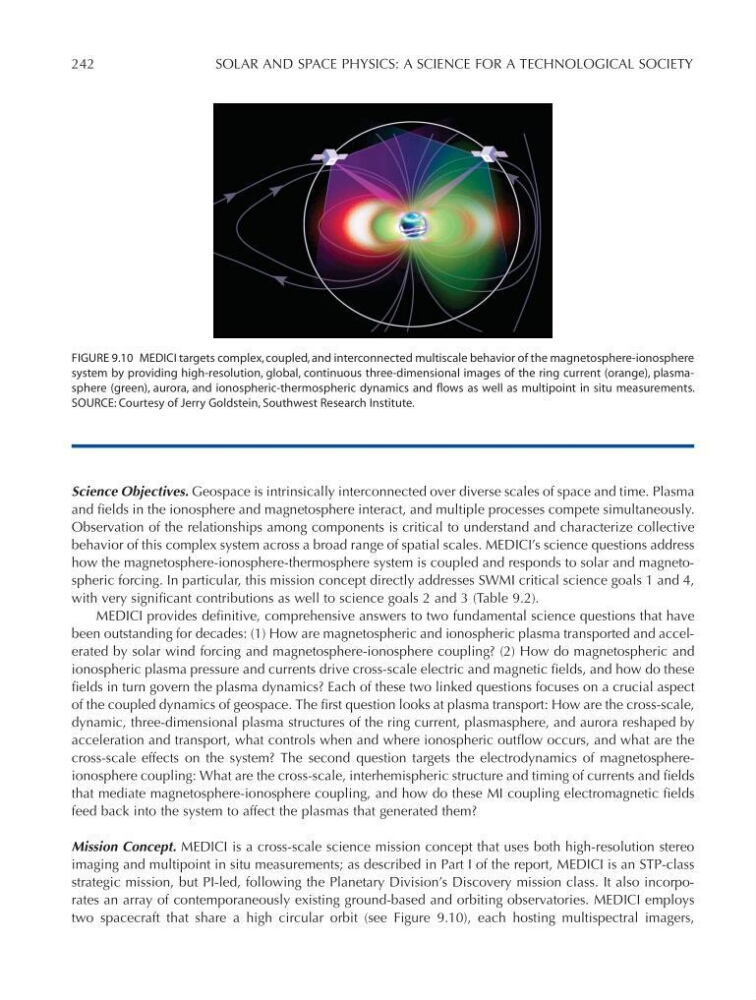
two spacecraft that share a high circular orbit (see Figure 9.10), each hosting multispectral imagers,
FIGURE 9.10 MEDICI targets complex, coupled, and interconnected multiscale behavior of the magnetosphere-ionosphere
system by providing high-resolution, global, continuous three-dimensional images of the ring current (orange), plasmasphere (green), aurora, and ionospheric-thermospheric dynamics and flows as well as multipoint in situ measurements.
SOURCE: Courtesy of Jerry Goldstein, Southwest Research Institute.
Solar and Space Physics: A Science for a Technological Society
242
SOLAR AND SPACE PHYSICS: A SCIENCE FOR A TECHNOLOGICAL SOCIETY
Science Objectives. Geospace is intrinsically interconnected over diverse scales of space and time. Plasma
and fields in the ionosphere and magnetosphere interact, and multiple processes compete simultaneously.
Observation of the relationships among components is critical to understand and characterize collective
behavior of this complex system across a broad range of spatial scales. MEDICI’s science questions address
how the magnetosphere-ionosphere-thermosphere system is coupled and responds to solar and magnetospheric forcing. In particular, this mission concept directly addresses SWMI critical science goals 1 and 4,
with very significant contributions as well to science goals 2 and 3 (Table 9.2).
MEDICI provides definitive, comprehensive answers to two fundamental science questions that have
been outstanding for decades: (1) How are magnetospheric and ionospheric plasma transported and accelerated by solar wind forcing and magnetosphere-ionosphere coupling? (2) How do magnetospheric and
ionospheric plasma pressure and currents drive cross-scale electric and magnetic fields, and how do these
fields in turn govern the plasma dynamics? Each of these two linked questions focuses on a crucial aspect
of the coupled dynamics of geospace. The first question looks at plasma transport: How are the cross-scale,
dynamic, three-dimensional plasma structures of the ring current, plasmasphere, and aurora reshaped by
acceleration and transport, what controls when and where ionospheric outflow occurs, and what are the
cross-scale effects on the system? The second question targets the electrodynamics of magnetosphereionosphere coupling: What are the cross-scale, interhemispheric structure and timing of currents and fields
that mediate magnetosphere-ionosphere coupling, and how do these MI coupling electromagnetic fields
feed back into the system to affect the plasmas that generated them?
Mission Concept. MEDICI is a cross-scale science mission concept that uses both high-resolution stereo
imaging and multipoint in situ measurements; as described in Part I of the report, MEDICI is an STP-class
strategic mission, but PI-led, following the Planetary Division’s Discovery mission class. It also incorporates an array of contemporaneously existing ground-based and orbiting observatories. MEDICI employs
two spacecraft that share a high circular orbit (see Figure 9.10), each hosting multispectral imagers,
FIGURE 9.10 MEDICI targets complex, coupled, and interconnected multiscale behavior of the magnetosphere-ionosphere
system by providing high-resolution, global, continuous three-dimensional images of the ring current (orange), plasmasphere (green), aurora, and ionospheric-thermospheric dynamics and flows as well as multipoint in situ measurements.
SOURCE: Courtesy of Jerry Goldstein, Southwest Research Institute.