

Copyright © National Academy of Sciences. All rights reserved.
Solar and Space Physics: A Science for a Technological Society
REPORT OF THE PANEL ON ATMOSPHERE-IONOSPHERE-MAGNETOSPHERE INTERACTIONS
199
the thermosphere and mesosphere. Recent lidar developments are also providing new possibilities for
observations in the thermosphere. A helium resonance lidar is under development to probe the resonance
structure of metastable helium in the upper atmosphere. If the lidar demonstrated, wind and temperatures
would be derivable from altitudes well above 200 km. The technological advances expected with this program will also help lead to future developments of a lidar system in space for upper-atmosphere research.
AIMI Priority: Create and operate a lidar observatory capable of measuring gravity waves, tides, wavewave and wave-mean flow interactions, and wave dissipation and vertical coupling processes from the
stratosphere to 200 km. Collocation with a research facility such as an incoherent scatter radar (ISR) installation would enable study of a number of local-scale plasma-neutral interactions relevant to space weather.
8.5.3.3 Southern Hemisphere Expansion of Incoherent Scatter Radar (ISR) Network
ISR is an extraordinarily powerful AIMI diagnostic, able to remotely sense the fundamental state
parameters of the ionospheric plasma (Ne, Te, Ti, Vi) as a function of range and time. Through the use of
ancillary models, higher-order parameters can also be resolved, including conductance, ion composition,
Joule heating, electric current systems, and neutral wind fields. The emergence of electronically steerable
ISRs in the previous decade has provided a major step forward in AIMI science. The Advanced Modular ISR
(AMISR) facilities have demonstrated enormous capabilities to study the ionosphere with unprecedented
resolution and precision. One example is provided in Figure 8.22, illustrating the capability of the Poker
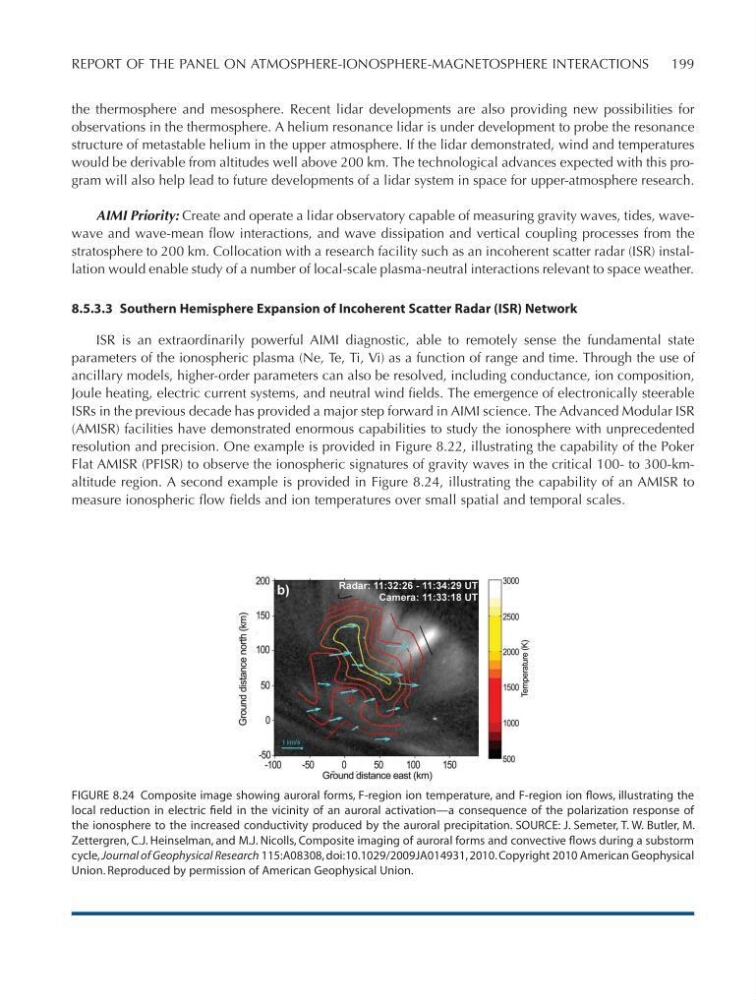
Flat AMISR (PFISR) to observe the ionospheric signatures of gravity waves in the critical 100- to 300-kmaltitude region. A second example is provided in Figure 8.24, illustrating the capability of an AMISR to
measure ionospheric flow fields and ion temperatures over small spatial and temporal scales.
FIGURE 8.24 Composite image showing auroral forms, F-region ion temperature, and F-region ion flows, illustrating the
local reduction in electric field in the vicinity of an auroral activation—a consequence of the polarization response of
the ionosphere to the increased conductivity produced by the auroral precipitation. SOURCE: J. Semeter, T. W. Butler, M.
Zettergren, C.J. Heinselman, and M.J. Nicolls, Composite imaging of auroral forms and convective flows during a substorm
cycle, Journal of Geophysical Research 115:A08308, doi:10.1029/2009JA014931, 2010. Copyright 2010 American Geophysical
Union. Reproduced by permission of American Geophysical Union.
Figure 8-24
Solar and Space Physics: A Science for a Technological Society
REPORT OF THE PANEL ON ATMOSPHERE-IONOSPHERE-MAGNETOSPHERE INTERACTIONS
199
the thermosphere and mesosphere. Recent lidar developments are also providing new possibilities for
observations in the thermosphere. A helium resonance lidar is under development to probe the resonance
structure of metastable helium in the upper atmosphere. If the lidar demonstrated, wind and temperatures
would be derivable from altitudes well above 200 km. The technological advances expected with this program will also help lead to future developments of a lidar system in space for upper-atmosphere research.
AIMI Priority: Create and operate a lidar observatory capable of measuring gravity waves, tides, wavewave and wave-mean flow interactions, and wave dissipation and vertical coupling processes from the
stratosphere to 200 km. Collocation with a research facility such as an incoherent scatter radar (ISR) installation would enable study of a number of local-scale plasma-neutral interactions relevant to space weather.
8.5.3.3 Southern Hemisphere Expansion of Incoherent Scatter Radar (ISR) Network
ISR is an extraordinarily powerful AIMI diagnostic, able to remotely sense the fundamental state
parameters of the ionospheric plasma (Ne, Te, Ti, Vi) as a function of range and time. Through the use of
ancillary models, higher-order parameters can also be resolved, including conductance, ion composition,
Joule heating, electric current systems, and neutral wind fields. The emergence of electronically steerable
ISRs in the previous decade has provided a major step forward in AIMI science. The Advanced Modular ISR
(AMISR) facilities have demonstrated enormous capabilities to study the ionosphere with unprecedented
resolution and precision. One example is provided in Figure 8.22, illustrating the capability of the Poker
Flat AMISR (PFISR) to observe the ionospheric signatures of gravity waves in the critical 100- to 300-kmaltitude region. A second example is provided in Figure 8.24, illustrating the capability of an AMISR to
measure ionospheric flow fields and ion temperatures over small spatial and temporal scales.
FIGURE 8.24 Composite image showing auroral forms, F-region ion temperature, and F-region ion flows, illustrating the
local reduction in electric field in the vicinity of an auroral activation—a consequence of the polarization response of
the ionosphere to the increased conductivity produced by the auroral precipitation. SOURCE: J. Semeter, T. W. Butler, M.
Zettergren, C.J. Heinselman, and M.J. Nicolls, Composite imaging of auroral forms and convective flows during a substorm
cycle, Journal of Geophysical Research 115:A08308, doi:10.1029/2009JA014931, 2010. Copyright 2010 American Geophysical
Union. Reproduced by permission of American Geophysical Union.
Figure 8-24