

Copyright © National Academy of Sciences. All rights reserved.
Solar and Space Physics: A Science for a Technological Society
198
SOLAR AND SPACE PHYSICS: A SCIENCE FOR A TECHNOLOGICAL SOCIETY
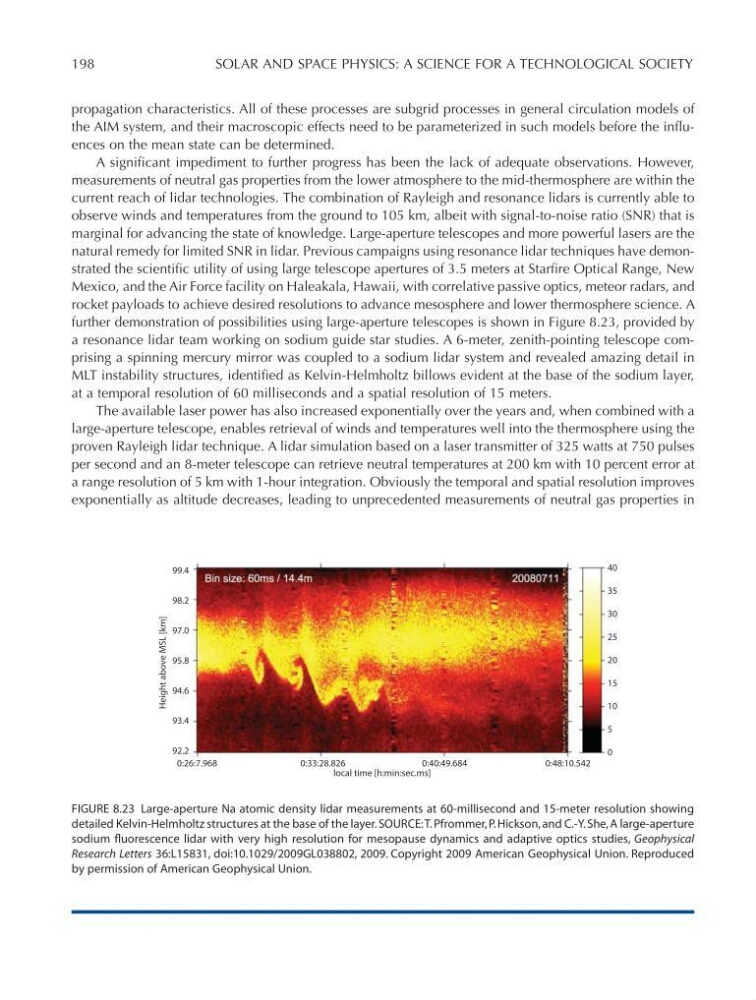
FIGURE 8.23 Large-aperture Na atomic density lidar measurements at 60-millisecond and 15-meter resolution showing
detailed Kelvin-Helmholtz structures at the base of the layer. SOURCE: T. Pfrommer, P. Hickson, and C.-Y. She, A large-aperture
sodium fluorescence lidar with very high resolution for mesopause dynamics and adaptive optics studies, Geophysical
Research Letters 36:L15831, doi:10.1029/2009GL038802, 2009. Copyright 2009 American Geophysical Union. Reproduced
by permission of American Geophysical Union.
Figure 2-12 and 8-23
40
35
30
25
20
15
10
5
0
local time [h:min:sec.ms]
0:26:7.968
0:33:28.826
0:40:49.684
0:48:10.542
99.4
98.2
97.0
95.8
94.6
93.4
92.2
Height above MSL [km]
propagation characteristics. All of these processes are subgrid processes in general circulation models of
the AIM system, and their macroscopic effects need to be parameterized in such models before the influences on the mean state can be determined.
A significant impediment to further progress has been the lack of adequate observations. However,
measurements of neutral gas properties from the lower atmosphere to the mid-thermosphere are within the
current reach of lidar technologies. The combination of Rayleigh and resonance lidars is currently able to
observe winds and temperatures from the ground to 105 km, albeit with signal-to-noise ratio (SNR) that is
marginal for advancing the state of knowledge. Large-aperture telescopes and more powerful lasers are the
natural remedy for limited SNR in lidar. Previous campaigns using resonance lidar techniques have demonstrated the scientific utility of using large telescope apertures of 3.5 meters at Starfire Optical Range, New
Mexico, and the Air Force facility on Haleakala, Hawaii, with correlative passive optics, meteor radars, and
rocket payloads to achieve desired resolutions to advance mesosphere and lower thermosphere science. A
further demonstration of possibilities using large-aperture telescopes is shown in Figure 8.23, provided by
a resonance lidar team working on sodium guide star studies. A 6-meter, zenith-pointing telescope comprising a spinning mercury mirror was coupled to a sodium lidar system and revealed amazing detail in
MLT instability structures, identified as Kelvin-Helmholtz billows evident at the base of the sodium layer,
at a temporal resolution of 60 milliseconds and a spatial resolution of 15 meters.
The available laser power has also increased exponentially over the years and, when combined with a
large-aperture telescope, enables retrieval of winds and temperatures well into the thermosphere using the
proven Rayleigh lidar technique. A lidar simulation based on a laser transmitter of 325 watts at 750 pulses
per second and an 8-meter telescope can retrieve neutral temperatures at 200 km with 10 percent error at
a range resolution of 5 km with 1-hour integration. Obviously the temporal and spatial resolution improves
exponentially as altitude decreases, leading to unprecedented measurements of neutral gas properties in
Solar and Space Physics: A Science for a Technological Society
198
SOLAR AND SPACE PHYSICS: A SCIENCE FOR A TECHNOLOGICAL SOCIETY
FIGURE 8.23 Large-aperture Na atomic density lidar measurements at 60-millisecond and 15-meter resolution showing
detailed Kelvin-Helmholtz structures at the base of the layer. SOURCE: T. Pfrommer, P. Hickson, and C.-Y. She, A large-aperture
sodium fluorescence lidar with very high resolution for mesopause dynamics and adaptive optics studies, Geophysical
Research Letters 36:L15831, doi:10.1029/2009GL038802, 2009. Copyright 2009 American Geophysical Union. Reproduced
by permission of American Geophysical Union.
Figure 2-12 and 8-23
40
35
30
25
20
15
10
5
0
local time [h:min:sec.ms]
0:26:7.968
0:33:28.826
0:40:49.684
0:48:10.542
99.4
98.2
97.0
95.8
94.6
93.4
92.2
Height above MSL [km]
propagation characteristics. All of these processes are subgrid processes in general circulation models of
the AIM system, and their macroscopic effects need to be parameterized in such models before the influences on the mean state can be determined.
A significant impediment to further progress has been the lack of adequate observations. However,
measurements of neutral gas properties from the lower atmosphere to the mid-thermosphere are within the
current reach of lidar technologies. The combination of Rayleigh and resonance lidars is currently able to
observe winds and temperatures from the ground to 105 km, albeit with signal-to-noise ratio (SNR) that is
marginal for advancing the state of knowledge. Large-aperture telescopes and more powerful lasers are the
natural remedy for limited SNR in lidar. Previous campaigns using resonance lidar techniques have demonstrated the scientific utility of using large telescope apertures of 3.5 meters at Starfire Optical Range, New
Mexico, and the Air Force facility on Haleakala, Hawaii, with correlative passive optics, meteor radars, and
rocket payloads to achieve desired resolutions to advance mesosphere and lower thermosphere science. A
further demonstration of possibilities using large-aperture telescopes is shown in Figure 8.23, provided by
a resonance lidar team working on sodium guide star studies. A 6-meter, zenith-pointing telescope comprising a spinning mercury mirror was coupled to a sodium lidar system and revealed amazing detail in
MLT instability structures, identified as Kelvin-Helmholtz billows evident at the base of the sodium layer,
at a temporal resolution of 60 milliseconds and a spatial resolution of 15 meters.
The available laser power has also increased exponentially over the years and, when combined with a
large-aperture telescope, enables retrieval of winds and temperatures well into the thermosphere using the
proven Rayleigh lidar technique. A lidar simulation based on a laser transmitter of 325 watts at 750 pulses
per second and an 8-meter telescope can retrieve neutral temperatures at 200 km with 10 percent error at
a range resolution of 5 km with 1-hour integration. Obviously the temporal and spatial resolution improves
exponentially as altitude decreases, leading to unprecedented measurements of neutral gas properties in