

Copyright © National Academy of Sciences. All rights reserved.
Solar and Space Physics: A Science for a Technological Society
REPORT OF THE PANEL ON ATMOSPHERE-IONOSPHERE-MAGNETOSPHERE INTERACTIONS
197
sensors in space. The “seamless” assimilation of distributed measurements from ground and from space is
at the heart of the heterogeneous facility concept discussed in Appendix C
AIMI Priority: Develop, deploy, and operate a network of 40 or more autonomous observing stations
extending from pole to pole through the (North and South) American longitudinal sector. The network
nodes should be populated with heterogeneous instrumentation capable of measuring such features as
winds, temperatures, emissions, scintillations, and plasma parameters for study of a variety of local and
regional ionosphere-thermosphere phenomena over extended latitudinal ranges.
8.5.3.2 Whole-Atmosphere Lidar Observatory
One of the most fundamental and least-understood topics in upper-atmosphere research concerns the
vertical evolution of the wave spectrum from the troposphere to the lower and middle thermosphere (ca.
100-200 km) where many of the waves are dissipated. As waves propagate into the more tenuous upper
atmosphere, they grow in amplitude exponentially with height; this leads to nonlinear interactions causing
energy to cascade between wave scales, and to convective instability resulting in turbulence and mixing
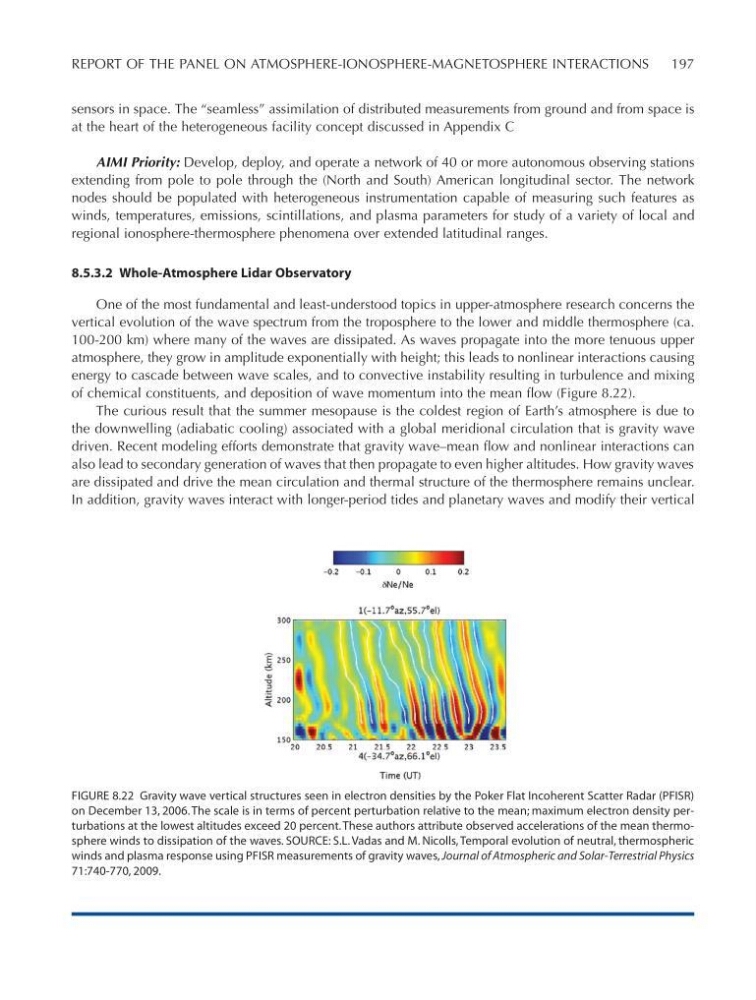
of chemical constituents, and deposition of wave momentum into the mean flow (Figure 8.22).
The curious result that the summer mesopause is the coldest region of Earth’s atmosphere is due to
the downwelling (adiabatic cooling) associated with a global meridional circulation that is gravity wave
driven. Recent modeling efforts demonstrate that gravity wave–mean flow and nonlinear interactions can
also lead to secondary generation of waves that then propagate to even higher altitudes. How gravity waves
are dissipated and drive the mean circulation and thermal structure of the thermosphere remains unclear.
In addition, gravity waves interact with longer-period tides and planetary waves and modify their vertical
FIGURE 8.22 Gravity wave vertical structures seen in electron densities by the Poker Flat Incoherent Scatter Radar (PFISR)
on December 13, 2006. The scale is in terms of percent perturbation relative to the mean; maximum electron density perturbations at the lowest altitudes exceed 20 percent. These authors attribute observed accelerations of the mean thermosphere winds to dissipation of the waves. SOURCE: S.L. Vadas and M. Nicolls, Temporal evolution of neutral, thermospheric
winds and plasma response using PFISR measurements of gravity waves, Journal of Atmospheric and Solar-Terrestrial Physics
71:740-770, 2009.
ARTICLE IN PRESS
Figure 8-22
Solar and Space Physics: A Science for a Technological Society
REPORT OF THE PANEL ON ATMOSPHERE-IONOSPHERE-MAGNETOSPHERE INTERACTIONS
197
sensors in space. The “seamless” assimilation of distributed measurements from ground and from space is
at the heart of the heterogeneous facility concept discussed in Appendix C
AIMI Priority: Develop, deploy, and operate a network of 40 or more autonomous observing stations
extending from pole to pole through the (North and South) American longitudinal sector. The network
nodes should be populated with heterogeneous instrumentation capable of measuring such features as
winds, temperatures, emissions, scintillations, and plasma parameters for study of a variety of local and
regional ionosphere-thermosphere phenomena over extended latitudinal ranges.
8.5.3.2 Whole-Atmosphere Lidar Observatory
One of the most fundamental and least-understood topics in upper-atmosphere research concerns the
vertical evolution of the wave spectrum from the troposphere to the lower and middle thermosphere (ca.
100-200 km) where many of the waves are dissipated. As waves propagate into the more tenuous upper
atmosphere, they grow in amplitude exponentially with height; this leads to nonlinear interactions causing
energy to cascade between wave scales, and to convective instability resulting in turbulence and mixing
of chemical constituents, and deposition of wave momentum into the mean flow (Figure 8.22).
The curious result that the summer mesopause is the coldest region of Earth’s atmosphere is due to
the downwelling (adiabatic cooling) associated with a global meridional circulation that is gravity wave
driven. Recent modeling efforts demonstrate that gravity wave–mean flow and nonlinear interactions can
also lead to secondary generation of waves that then propagate to even higher altitudes. How gravity waves
are dissipated and drive the mean circulation and thermal structure of the thermosphere remains unclear.
In addition, gravity waves interact with longer-period tides and planetary waves and modify their vertical
FIGURE 8.22 Gravity wave vertical structures seen in electron densities by the Poker Flat Incoherent Scatter Radar (PFISR)
on December 13, 2006. The scale is in terms of percent perturbation relative to the mean; maximum electron density perturbations at the lowest altitudes exceed 20 percent. These authors attribute observed accelerations of the mean thermosphere winds to dissipation of the waves. SOURCE: S.L. Vadas and M. Nicolls, Temporal evolution of neutral, thermospheric
winds and plasma response using PFISR measurements of gravity waves, Journal of Atmospheric and Solar-Terrestrial Physics
71:740-770, 2009.
ARTICLE IN PRESS
Figure 8-22