

Copyright © National Academy of Sciences. All rights reserved.
Solar and Space Physics: A Science for a Technological Society
196
SOLAR AND SPACE PHYSICS: A SCIENCE FOR A TECHNOLOGICAL SOCIETY
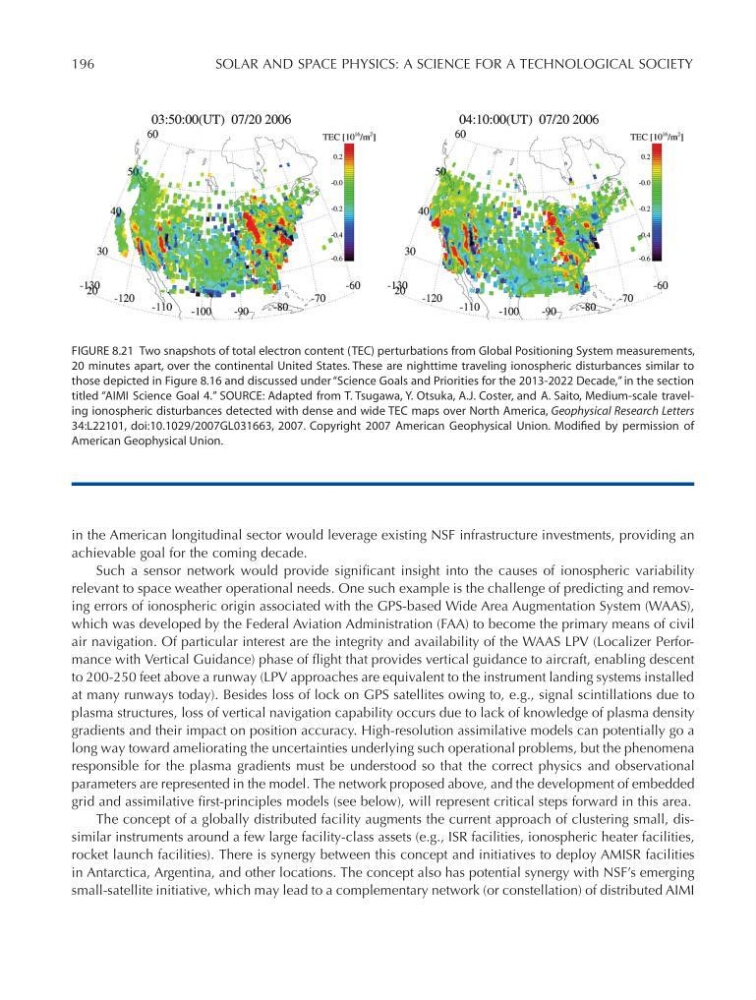
FIGURE 8.21 Two snapshots of total electron content (TEC) perturbations from Global Positioning System measurements,
20 minutes apart, over the continental United States. These are nighttime traveling ionospheric disturbances similar to
those depicted in Figure 8.16 and discussed under “Science Goals and Priorities for the 2013-2022 Decade,” in the section
titled “AIMI Science Goal 4.” SOURCE: Adapted from T. Tsugawa, Y. Otsuka, A.J. Coster, and A. Saito, Medium-scale traveling ionospheric disturbances detected with dense and wide TEC maps over North America, Geophysical Research Letters
34:L22101, doi:10.1029/2007GL031663, 2007. Copyright 2007 American Geophysical Union. Modified by permission of
American Geophysical Union.
in the American longitudinal sector would leverage existing NSF infrastructure investments, providing an
achievable goal for the coming decade.
Such a sensor network would provide significant insight into the causes of ionospheric variability
relevant to space weather operational needs. One such example is the challenge of predicting and removing errors of ionospheric origin associated with the GPS-based Wide Area Augmentation System (WAAS),
which was developed by the Federal Aviation Administration (FAA) to become the primary means of civil
air navigation. Of particular interest are the integrity and availability of the WAAS LPV (Localizer Performance with Vertical Guidance) phase of flight that provides vertical guidance to aircraft, enabling descent
to 200-250 feet above a runway (LPV approaches are equivalent to the instrument landing systems installed
at many runways today). Besides loss of lock on GPS satellites owing to, e.g., signal scintillations due to
plasma structures, loss of vertical navigation capability occurs due to lack of knowledge of plasma density
gradients and their impact on position accuracy. High-resolution assimilative models can potentially go a
long way toward ameliorating the uncertainties underlying such operational problems, but the phenomena
responsible for the plasma gradients must be understood so that the correct physics and observational
parameters are represented in the model. The network proposed above, and the development of embedded
grid and assimilative first-principles models (see below), will represent critical steps forward in this area.
The concept of a globally distributed facility augments the current approach of clustering small, dissimilar instruments around a few large facility-class assets (e.g., ISR facilities, ionospheric heater facilities,
rocket launch facilities). There is synergy between this concept and initiatives to deploy AMISR facilities
in Antarctica, Argentina, and other locations. The concept also has potential synergy with NSF’s emerging
small-satellite initiative, which may lead to a complementary network (or constellation) of distributed AIMI
Solar and Space Physics: A Science for a Technological Society
196
SOLAR AND SPACE PHYSICS: A SCIENCE FOR A TECHNOLOGICAL SOCIETY
FIGURE 8.21 Two snapshots of total electron content (TEC) perturbations from Global Positioning System measurements,
20 minutes apart, over the continental United States. These are nighttime traveling ionospheric disturbances similar to
those depicted in Figure 8.16 and discussed under “Science Goals and Priorities for the 2013-2022 Decade,” in the section
titled “AIMI Science Goal 4.” SOURCE: Adapted from T. Tsugawa, Y. Otsuka, A.J. Coster, and A. Saito, Medium-scale traveling ionospheric disturbances detected with dense and wide TEC maps over North America, Geophysical Research Letters
34:L22101, doi:10.1029/2007GL031663, 2007. Copyright 2007 American Geophysical Union. Modified by permission of
American Geophysical Union.
in the American longitudinal sector would leverage existing NSF infrastructure investments, providing an
achievable goal for the coming decade.
Such a sensor network would provide significant insight into the causes of ionospheric variability
relevant to space weather operational needs. One such example is the challenge of predicting and removing errors of ionospheric origin associated with the GPS-based Wide Area Augmentation System (WAAS),
which was developed by the Federal Aviation Administration (FAA) to become the primary means of civil
air navigation. Of particular interest are the integrity and availability of the WAAS LPV (Localizer Performance with Vertical Guidance) phase of flight that provides vertical guidance to aircraft, enabling descent
to 200-250 feet above a runway (LPV approaches are equivalent to the instrument landing systems installed
at many runways today). Besides loss of lock on GPS satellites owing to, e.g., signal scintillations due to
plasma structures, loss of vertical navigation capability occurs due to lack of knowledge of plasma density
gradients and their impact on position accuracy. High-resolution assimilative models can potentially go a
long way toward ameliorating the uncertainties underlying such operational problems, but the phenomena
responsible for the plasma gradients must be understood so that the correct physics and observational
parameters are represented in the model. The network proposed above, and the development of embedded
grid and assimilative first-principles models (see below), will represent critical steps forward in this area.
The concept of a globally distributed facility augments the current approach of clustering small, dissimilar instruments around a few large facility-class assets (e.g., ISR facilities, ionospheric heater facilities,
rocket launch facilities). There is synergy between this concept and initiatives to deploy AMISR facilities
in Antarctica, Argentina, and other locations. The concept also has potential synergy with NSF’s emerging
small-satellite initiative, which may lead to a complementary network (or constellation) of distributed AIMI