

Copyright © National Academy of Sciences. All rights reserved.
Solar and Space Physics: A Science for a Technological Society
192
SOLAR AND SPACE PHYSICS: A SCIENCE FOR A TECHNOLOGICAL SOCIETY
and thermosphere interact with energy inputs from the magnetosphere that can be characterized by the
field-aligned Poynting flux and the flux of the precipitating charged particles. Variations in these inputs
are expected to be among the largest sources of variability in the ionosphere and thermosphere. However,
they are poorly understood and poorly represented in global models due largely to the inability so far to
identify the most important spatial and temporal scales that characterize the interaction. Magnetospheric
energy inputs, which can vary with timescales of a few minutes and be input over spatial scales of 100
km, are redistributed as heat and momentum in the ionosphere and thermosphere, producing changes in
the dynamics and effective conductance over spatial scales of thousands of kilometers and temporal scales
of many hours. Changes in the neutral atmosphere dynamics and conductance also change the internally
generated electric fields and the coupling processes to the magnetosphere. Thus the ability to specify the
energy input and view the dynamic state of a large volume at middle and high latitudes over time periods
ranging from less than 1 minute to many tens of minutes is necessary to determine how magnetosphereatmosphere coupling processes affect the behavior of both regions.
This challenge can be efficiently met with a Magnetosphere-Atmosphere Coupling (MAC) mission.
With two spacecraft spaced in the same orbit in the ionosphere and a single satellite imaging the sampled
volume from high altitude, it is possible to identify coherent spatial features in the input drivers from the
magnetosphere and the temporal and spatial scales over which the ionosphere and thermosphere respond.
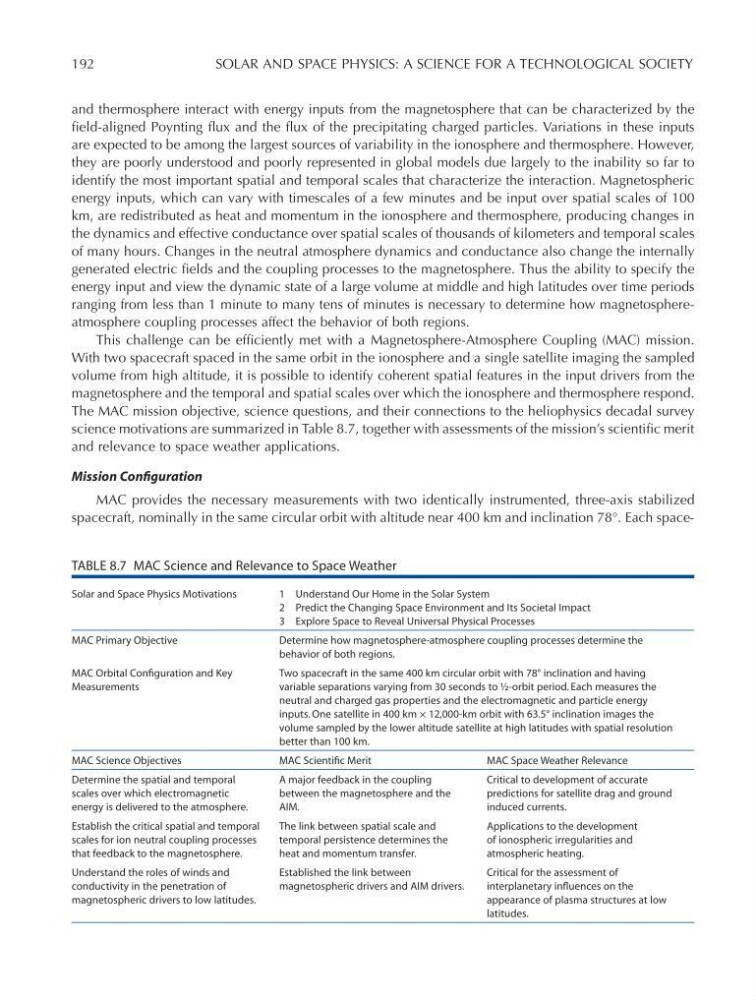
The MAC mission objective, science questions, and their connections to the heliophysics decadal survey
science motivations are summarized in Table 8.7, together with assessments of the mission’s scientific merit
and relevance to space weather applications.
Mission Configuration
MAC provides the necessary measurements with two identically instrumented, three-axis stabilized
spacecraft, nominally in the same circular orbit with altitude near 400 km and inclination 78°. Each spaceTABLE 8.7 MAC Science and Relevance to Space Weather
Solar and Space Physics Motivations
1 Understand Our Home in the Solar System
2 Predict the Changing Space Environment and Its Societal Impact
3 Explore Space to Reveal Universal Physical Processes
MAC Primary Objective
Determine how magnetosphere-atmosphere coupling processes determine the
behavior of both regions.
MAC Orbital Configuration and Key
Measurements
Two spacecraft in the same 400 km circular orbit with 78° inclination and having
variable separations varying from 30 seconds to ½-orbit period. Each measures the
neutral and charged gas properties and the electromagnetic and particle energy
inputs. One satellite in 400 km × 12,000-km orbit with 63.5° inclination images the
volume sampled by the lower altitude satellite at high latitudes with spatial resolution
better than 100 km.
MAC Science Objectives
MAC Scientific Merit
MAC Space Weather Relevance
Determine the spatial and temporal
scales over which electromagnetic
energy is delivered to the atmosphere.
A major feedback in the coupling
between the magnetosphere and the
AIM.
Critical to development of accurate
predictions for satellite drag and ground
induced currents.
Establish the critical spatial and temporal
scales for ion neutral coupling processes
that feedback to the magnetosphere.
The link between spatial scale and
temporal persistence determines the
heat and momentum transfer.
Applications to the development
of ionospheric irregularities and
atmospheric heating.
Understand the roles of winds and
conductivity in the penetration of
magnetospheric drivers to low latitudes.
Established the link between
magnetospheric drivers and AIM drivers.
Critical for the assessment of
interplanetary influences on the
appearance of plasma structures at low
latitudes.
Solar and Space Physics: A Science for a Technological Society
192
SOLAR AND SPACE PHYSICS: A SCIENCE FOR A TECHNOLOGICAL SOCIETY
and thermosphere interact with energy inputs from the magnetosphere that can be characterized by the
field-aligned Poynting flux and the flux of the precipitating charged particles. Variations in these inputs
are expected to be among the largest sources of variability in the ionosphere and thermosphere. However,
they are poorly understood and poorly represented in global models due largely to the inability so far to
identify the most important spatial and temporal scales that characterize the interaction. Magnetospheric
energy inputs, which can vary with timescales of a few minutes and be input over spatial scales of 100
km, are redistributed as heat and momentum in the ionosphere and thermosphere, producing changes in
the dynamics and effective conductance over spatial scales of thousands of kilometers and temporal scales
of many hours. Changes in the neutral atmosphere dynamics and conductance also change the internally
generated electric fields and the coupling processes to the magnetosphere. Thus the ability to specify the
energy input and view the dynamic state of a large volume at middle and high latitudes over time periods
ranging from less than 1 minute to many tens of minutes is necessary to determine how magnetosphereatmosphere coupling processes affect the behavior of both regions.
This challenge can be efficiently met with a Magnetosphere-Atmosphere Coupling (MAC) mission.
With two spacecraft spaced in the same orbit in the ionosphere and a single satellite imaging the sampled
volume from high altitude, it is possible to identify coherent spatial features in the input drivers from the
magnetosphere and the temporal and spatial scales over which the ionosphere and thermosphere respond.
The MAC mission objective, science questions, and their connections to the heliophysics decadal survey
science motivations are summarized in Table 8.7, together with assessments of the mission’s scientific merit
and relevance to space weather applications.
Mission Configuration
MAC provides the necessary measurements with two identically instrumented, three-axis stabilized
spacecraft, nominally in the same circular orbit with altitude near 400 km and inclination 78°. Each spaceTABLE 8.7 MAC Science and Relevance to Space Weather
Solar and Space Physics Motivations
1 Understand Our Home in the Solar System
2 Predict the Changing Space Environment and Its Societal Impact
3 Explore Space to Reveal Universal Physical Processes
MAC Primary Objective
Determine how magnetosphere-atmosphere coupling processes determine the
behavior of both regions.
MAC Orbital Configuration and Key
Measurements
Two spacecraft in the same 400 km circular orbit with 78° inclination and having
variable separations varying from 30 seconds to ½-orbit period. Each measures the
neutral and charged gas properties and the electromagnetic and particle energy
inputs. One satellite in 400 km × 12,000-km orbit with 63.5° inclination images the
volume sampled by the lower altitude satellite at high latitudes with spatial resolution
better than 100 km.
MAC Science Objectives
MAC Scientific Merit
MAC Space Weather Relevance
Determine the spatial and temporal
scales over which electromagnetic
energy is delivered to the atmosphere.
A major feedback in the coupling
between the magnetosphere and the
AIM.
Critical to development of accurate
predictions for satellite drag and ground
induced currents.
Establish the critical spatial and temporal
scales for ion neutral coupling processes
that feedback to the magnetosphere.
The link between spatial scale and
temporal persistence determines the
heat and momentum transfer.
Applications to the development
of ionospheric irregularities and
atmospheric heating.
Understand the roles of winds and
conductivity in the penetration of
magnetospheric drivers to low latitudes.
Established the link between
magnetospheric drivers and AIM drivers.
Critical for the assessment of
interplanetary influences on the
appearance of plasma structures at low
latitudes.